The Evolution of Big Data and Its Applications
Two decades ago, a "large" dataset was something that strained a single powerful server. Today, a mid-sized Indian e-commerce company can generate more data before lunch than that server could have stored in a year — clickstreams, payment events, delivery telemetry, support chats, and app logs, all arriving continuously. The story of big data is the story of how our tools evolved to keep up with that flood, and how organizations learned to turn it into decisions.
This article traces that evolution — from the relational era, through the Hadoop breakthrough, to Spark, cloud data lakes, streaming, and the modern lakehouse — and then looks at where big data actually creates value across industries.
What Do We Mean by "Big Data"?
"Big data" is not simply "a lot of data." It describes datasets whose volume, speed, or complexity exceeds what traditional single-machine databases and tools can comfortably handle. The classic way to characterize it is the five Vs:
- Volume — The sheer scale of data, often measured in terabytes and petabytes. When a dataset no longer fits on one machine, you need systems that spread it across many.
- Velocity — The rate at which data arrives. A payment gateway or an IoT fleet produces a relentless stream, not a tidy nightly file.
- Variety — The mix of formats: structured tables, semi-structured JSON and logs, and unstructured text, images, and audio.
- Veracity — The trustworthiness of data. At scale, duplicates, missing fields, and inconsistent formats are the norm, so quality and lineage matter enormously.
- Value — The most important V. Data is only worth storing and processing if it can be turned into better decisions, products, or experiences.
The first three Vs define the problem. Veracity and value define whether solving it is worth it.
The Evolution Timeline
1. The Pre-Hadoop Relational Era
Before big data had a name, analytics ran on relational databases and enterprise data warehouses — Oracle, SQL Server, Teradata. These systems were excellent for structured, well-understood data and remain the backbone of most reporting today.
Their limitation was scaling. To handle more data, you scaled vertically — a bigger, more expensive machine. Beyond a point, this becomes prohibitively costly, and it does not gracefully handle unstructured data like web logs or free text. When early web companies began collecting behavioral data from millions of users, the single-machine model simply ran out of room.
2. The Hadoop, MapReduce, and HDFS Breakthrough
The turning point came from research published by engineers at Google describing a distributed file system and a programming model called MapReduce. The open-source community turned these ideas into Apache Hadoop.
Hadoop's insight was horizontal scaling on commodity hardware: instead of one giant server, use a cluster of ordinary machines and let the framework handle distribution and failure. Two pieces made this work:
- HDFS (Hadoop Distributed File System) — Splits large files into blocks, spreads them across the cluster, and replicates each block so a dead disk does not lose data.
- MapReduce — A processing model that moves computation to the data. A map step processes chunks in parallel; a reduce step aggregates the results.
Conceptually, a word-count job — the "hello world" of big data — looks like this:
# Map: emit (word, 1) for every word in a line
def map_fn(line):
    for word in line.split():
        yield (word.lower(), 1)

# Reduce: sum the counts for each word
def reduce_fn(word, counts):
    yield (word, sum(counts))
The framework runs map_fn across hundreds of files simultaneously, then groups by key and runs reduce_fn. Hadoop made it economically feasible to store and process data that would have been unthinkable on a single machine.
3. The Shift to Apache Spark
MapReduce was powerful but slow for many workloads because it wrote intermediate results to disk between every stage. Iterative jobs — common in machine learning — paid this penalty over and over.
Apache Spark addressed this with in-memory processing. By keeping working data in RAM and only spilling to disk when necessary, Spark ran many workloads dramatically faster than equivalent MapReduce jobs. Just as important, it offered a far friendlier developer experience with high-level APIs in Python, Scala, SQL, and R:
from pyspark.sql import SparkSession

spark = SparkSession.builder.appName("sales").getOrCreate()

df = spark.read.parquet("s3://data-lake/orders/")
(
    df.filter(df.status == "delivered")
      .groupBy("state")
      .sum("net_revenue")
      .orderBy("sum(net_revenue)", ascending=False)
      .show()
)
Spark unified batch processing, SQL, streaming, and machine learning under one engine, and it largely displaced raw MapReduce as the default distributed compute layer.
4. Cloud Object Storage and Data Lakes
Running and maintaining physical Hadoop clusters was operationally heavy. The cloud changed the equation by decoupling storage from compute.
Services like Amazon S3, Google Cloud Storage, and Azure Blob Storage offered cheap, effectively limitless object storage. Teams could dump raw data of any format into a data lake and spin up compute — a Spark cluster, a query engine — only when needed, then shut it down. You no longer paid to keep a cluster running just to hold data.
The trade-off: an ungoverned data lake can become a data swamp, where nobody knows what a file contains, whether it is current, or whether it can be trusted. This is where veracity and governance re-entered the conversation.
5. Real-Time Streaming
Batch processing answers "what happened yesterday." Many problems need "what is happening right now" — fraud detection, live inventory, dynamic pricing, ride matching. This demanded a shift from files to streams.
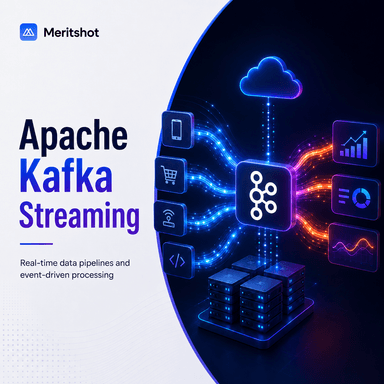
- Apache Kafka became the de facto distributed log for moving event data reliably between systems. Producers write events; consumers read them at their own pace; the log retains them durably.
- Apache Flink (and Spark Structured Streaming) provided stream processing — computing aggregations, joins, and detections continuously over data in motion, with attention to event-time ordering and late-arriving data.
Together they enabled architectures where an event — a card swipe, a page view — is processed within seconds of occurring.
6. The Modern Lakehouse
The final step (so far) merges the two worlds that had been kept separate: the cheap, flexible data lake and the reliable, structured data warehouse. The lakehouse adds a transactional, warehouse-like layer on top of open object storage.
Open table formats — Delta Lake, Apache Iceberg, and Apache Hudi — bring warehouse guarantees to lake files: ACID transactions, schema enforcement, time travel to previous versions, and efficient updates. Platforms like Databricks, Snowflake, and Google BigQuery now let teams run BI dashboards and machine learning against the same governed data, without copying it between systems.
The Core Technologies at a Glance
| Technology | Category | What It Does |
|---|---|---|
| HDFS | Distributed storage | Stores huge files across a cluster with replication for fault tolerance |
| MapReduce | Batch compute | The original parallel processing model — map then reduce (now largely legacy) |
| Apache Spark | Unified compute | Fast in-memory engine for batch, SQL, streaming, and ML |
| Apache Hive | SQL on big data | Lets analysts query data-lake files using familiar SQL |
| Apache Kafka | Streaming backbone | Durable, distributed log for moving event data between systems |
| Apache Flink | Stream processing | Continuous, low-latency computation over data in motion |
| Object storage (S3/GCS) | Cloud storage | Cheap, scalable storage that decouples data from compute |
| Delta / Iceberg / Hudi | Table formats | Add ACID transactions and schema control to lake files (the lakehouse) |
| Airflow / dbt | Orchestration & transform | Schedule pipelines and transform data reliably and repeatably |
Applications Across Industries
Big data matters because of what it enables. A few representative examples:
- Finance — Real-time fraud detection on card and UPI transactions, credit-risk scoring that blends traditional and alternative data, and regulatory reporting. Streaming systems flag suspicious patterns within seconds, while batch systems retrain risk models on historical data.
- Healthcare — Aggregating records, medical imaging, and sensor data to support diagnostics, hospital-capacity planning, and population-health studies. Here veracity and privacy are paramount, and governance is not optional.
- Retail and E-Commerce — Recommendation engines, demand forecasting, dynamic pricing, and inventory optimization. Indian platforms handling festival-season surges lean heavily on distributed systems to personalize experiences for millions of concurrent shoppers.
- Telecom — Network-quality monitoring, churn prediction, and capacity planning from enormous volumes of call and data-usage records. Telecom was one of the earliest heavy adopters of big data precisely because of its data velocity.
- Transportation and Logistics — Route optimization, real-time ride matching, ETA prediction, and fleet telematics. Ride-hailing and delivery platforms process continuous location streams to match supply with demand.
If you are exploring how these skills map to careers, our data engineering and analytics articles walk through the tooling in more depth.
Where Big Data Is Heading
The evolution is not finished. A few directions worth watching:
- Streaming-first architectures — As the cost and complexity of stream processing fall, more organizations treat real-time as the default and batch as a special case, rather than the other way around.
- AI-driven pipelines — Machine learning is increasingly used inside data platforms — for anomaly detection in pipelines, automated data-quality checks, and even assisting engineers in writing transformations. Big data also feeds the training and retrieval systems behind modern AI applications.
- Governance, lineage, and cost control — As data estates grow, the hard problems shift from "can we store it?" to "can we trust it, find it, secure it, and afford it?" Data catalogs, lineage tracking, access controls, and FinOps discipline are becoming core skills, not afterthoughts.
For readers who want to build in this direction, a solid grounding in distributed systems, SQL, and Python matters more than any single vendor's product — a theme our AI and Data Science course is built around.
Conclusion
Big data evolved because each generation of tools hit a wall, and a new idea pushed past it: relational databases could not scale out, so Hadoop distributed the work; MapReduce was slow, so Spark moved computation into memory; on-premise clusters were rigid, so the cloud separated storage from compute; batch was too slow for live decisions, so streaming emerged; and lakes and warehouses were finally reconciled by the lakehouse.
Through all of it, the fundamentals have held steady — distribute the work, keep the data trustworthy, and never lose sight of the fifth V, value. Master those principles, and whichever tool leads the next chapter, you will be ready to use it well.