Case Study
How SMBC came to own 24.9% of YES Bank, told in twelve acts from the 2020 rescue to the measures investors should track now.
Act I — The Puzzle: Why Would SMBC Bet ₹16,000+ Crore on a Rescued Bank?
In March 2020, YES Bank's depositors could withdraw no more than ₹50,000. The government had placed the bank under moratorium, the RBI had superseded its board, and deposits had fallen from ₹2.28 lakh crore to ₹1.05 lakh crore in a year (Business Standard, 5 Mar 2020; Business Today, May 2020).
By December 2025, a Japanese megabank owned almost a quarter of it. Sumitomo Mitsui Banking Corporation (SMBC) had paid more than ₹16,000 crore for the stake, including a premium to the market price for the first 20%.
That is the puzzle. Strategic buyers rarely pay up for a bank that needed a rescue five years earlier. Either SMBC saw value the market was missing, or it was buying something larger than YES Bank.
This case asks which. Was SMBC betting on YES Bank, or was YES Bank the vehicle for a bet on India's banking future? For an investment banker the question is practical: what could SMBC get through YES Bank that would have been harder, slower or costlier to build alone?
There are two readings, and they are not mutually exclusive. The financial reading: YES Bank had repaired its balance sheet but still earned less than India's strongest private banks, so improving profitability offered upside. The strategic reading: SMBC was buying something hard to recreate organically, a nationwide bank with deposits, customers, technology, branches and a licence. The deal is interesting because SMBC appears to be underwriting both.
SMBC × YES Bank: Key Facts
SMBC owns 24.9% of YES Bank, bought entirely from existing shareholders. Disclosed purchases of ₹16,333 crore took it to 24.22%; a small final step at an undisclosed price took it to 24.9%. It holds two board seats and has no control.
| Fact | Detail |
|---|---|
| Investor | Sumitomo Mitsui Banking Corporation (SMBC), wholly owned by Sumitomo Mitsui Financial Group (SMFG) |
| Target | YES Bank Limited, India's sixth-largest private bank by total assets |
| Transaction type | Secondary purchases of existing shares; no new shares issued, no capital to YES Bank |
| Initial stake and price | 20.00% at ₹21.50 a share; agreed 9 May 2025, completed 17 September 2025 |
| Initial consideration | ₹13,483 crore |
| Latest stake | 24.9%, reached in December 2025; unchanged in the June 2026 shareholding |
| Cumulative consideration | ₹16,333 crore for 24.22% (CRISIL, August 2026); about ₹16,800 crore for 24.9% including an estimate for the undisclosed final step |
| Entry valuation | 1.4x price-to-book on March 2025 consolidated equity, with about ¥70 billion of goodwill expected (SMFG) |
| SMFG's stated return target | Investment ROE above 10% and about ¥20 billion of profit contribution by year five, based on YES Bank's own performance and excluding synergies (May 2025) |
| Board representation | Two non-executive SMBC nominees on a 13-member board (August 2026) |
| Regulatory status | RBI approval for up to 24.99% as a non-promoter, dated 22 August 2025 |
Sources: SMBC, 9 May 2025; SMFG presentation, 9 May 2025; SMFG call transcript, May 2025; SMBC, 17 Sep 2025; CRISIL, 4 Aug 2026; YES Bank debt investor presentation, Aug 2026; Business Standard, 23 Aug 2025. The final-step estimate (about 21.8 crore shares at ₹20–23) is the author's.
Who is who. SMBC is the commercial bank at the core of SMFG, Japan's second-largest banking group and a global systemically important bank with about $2 trillion of assets. The buyer is SMBC, a private-sector bank, not Japan or its government. State Bank of India (SBI) led YES Bank's 2020 rescue and remains its second-largest shareholder. The Reserve Bank of India (RBI) decides who may hold a significant stake in an Indian bank, and on what terms.
Act II — The Bank Behind the Deal
How did YES Bank go from rescue to strategic asset?
YES Bank repaired its balance sheet between 2020 and 2025, but not yet its earnings power. Gross NPAs fell from 16.8% to 1.6% and profits returned, yet return on equity was only 5.2% in the year before SMBC signed.
Before 2020: growth on a corporate balance sheet
YES Bank was licensed in 2003 and opened in 2004. It nearly doubled its branches between March 2015 and March 2020, from 631 to 1,135, but retail loans were still only about 24% of advances (HDFC Securities, 2020). Reuters later traced its bad loans to exposure to troubled shadow lenders and real estate companies (DealStreetAsia/Reuters).
Gross NPAs rose from 3.22% in March 2019 to 16.8% a year later, and the capital ratio fell from 16.5% to 8.5% (Business Standard, May 2020).
By March 2020, advances of ₹1.71 lakh crore were funded by deposits of only ₹1.05 lakh crore, a credit-to-deposit ratio of 162.7%, and the liquidity coverage ratio had fallen to 37% (YES Bank, Aug 2026). A bank lending far more than it holds in deposits depends on wholesale funding that can vanish when confidence breaks.
2020: the rescue
When the RBI superseded the board on 5 March 2020, it cited failed capital raising, rating downgrades, deposit flight and "serious governance issues and practices" (Business Standard). Prashant Kumar, SBI's former deputy MD and CFO, became administrator and then MD & CEO.
Under the Reconstruction Scheme, effective 13 March 2020, SBI took about 49%. Seven private banks (HDFC Bank, ICICI Bank, Kotak, Axis, IDFC First, Federal and Bandhan) took 1–6% each, with large portions locked in for three years (Acuity Law). The consortium invested about ₹10,000 crore (BloombergQuint), ₹8,415 crore of AT-1 bonds were written down (Business Standard), and a ₹15,000 crore follow-on offer at ₹12–13 a share followed in July 2020 (DSIJ).
After 2020: the repair
Three moves rebuilt the bank: steady deposit gathering; a 2022 capital raise in which Carlyle and Advent affiliates each agreed to buy up to about 10%; and the late-2022 sale of a large stressed-loan pool to an asset reconstruction company, which cut gross NPAs from 12.9% to 2.0% in a single quarter (Business Standard, Jan 2023).
| Metric | FY2020 (crisis) | FY2025 (year before the deal) | FY2026 | Q1 FY27 |
|---|---|---|---|---|
| Net profit (₹ crore) | −16,418 | 2,406 | 3,476 | 1,071 (quarter) |
| Gross NPA | 16.8% | 1.6% | 1.3% | 1.3% |
| Net NPA | 5.0% | 0.3% | 0.2% | 0.2% |
| Provision coverage | 73.8% | 79.7% | 81.9% | 81.7% |
| CET1 ratio | 6.3% | 13.5% | 13.8% | 14.0% |
| Deposits (₹ lakh crore) | 1.05 | 2.85 | 3.19 | 3.15 |
| Advances (₹ lakh crore) | 1.71 | 2.46 | 2.73 | 2.85 |
| CASA ratio | 26.6% | 34.3% | 35.1% | 32.7% |
| Net interest margin | 1.9% (Q4) | 2.4% | 2.6% | 2.7% |
| Return on assets | −7.1% | 0.6% | 0.8% | 0.9% (annualised) |
| Return on equity | Negative | 5.2% | 7.0% | 8.3% (annualised) |
| Cost-to-income | – | 71.3% | 66.7% | 62.8% |
Provisional September 2026 figures: deposits ₹3.54 lakh crore, advances ₹3.10 lakh crore, CASA ratio 30.0% (31.7% excluding special FCNR(B) deposits). YES Bank's results release gives Q1 FY27 ROE as 8.3%; its August 2026 debt investor presentation shows 8.9%, apparently on a different basis. The dash marks a figure not verified in public sources. Sources: YES Bank Q4 FY26 release and presentation; YES Bank debt investor presentation, Aug 2026; YES Bank Q1 FY27 results release, 18 Jul 2026; YES Bank Q2 FY21 results; Business Standard, May 2020; Business Today, May 2020; YES Bank Q2 FY27 business update, 4 Oct 2026, as reproduced by PSU Connect.
FY2020 and FY2025 are year-end figures; FY2026 and Q1 FY27 are reported snapshots. Q1 FY27 deposits are lower than FY2026.
Read the table in two halves. The asset-quality and capital rows describe a bank that is no longer fragile: net NPAs of 0.2% and a 14% CET1 ratio are respectable by Indian standards. The margin and cost rows describe a bank that is not yet good: they still hold ROE near 8%, a little over half the 14.8% that Indian banks as a whole earned in FY25.
Analysis. By 2025 the survival problem had been replaced by a profitability problem: the question was no longer whether YES Bank would survive but whether it could earn competitive returns on a repaired balance sheet. A strategic buyer can underwrite the second kind of risk; few would underwrite the first.
Act III — Why YES Bank?
What did SMBC see in YES Bank?
A licensed, nationwide deposit franchise with strong payments rails and a repaired balance sheet, available as a large block from motivated sellers. Most of the value lay in what YES Bank could become, not in what it earned.
Management's rationale. SMBC described YES Bank as India's sixth-largest private bank, with a "strong franchise" in digital and transaction banking and "high growth in recent years". It said the stake would accelerate its India business and support Japan–India trade and capital flows (SMBC, 9 May 2025).
Analysis. The table separates what YES Bank already had from what SMBC must help create. The weightings are the author's judgments, not company statements.
| Factor | Evidence | Existing strength or future value | Weight |
|---|---|---|---|
| Deposit franchise | ₹3.19 lakh crore of deposits; ₹1.12 lakh crore CASA; 58% from retail and branch banking (Mar 2026) | Existing | Decisive: what SMBC's branches and NBFC lack |
| Banking licence and distribution | 1,335 branches, 249 BC outlets and 1,372 ATMs across 300+ districts (Jun 2026) | Existing | Decisive: slow and approval-bound to build |
| A large block for sale | 33.7% held by eight rescue-era banks with lapsed lock-ins, plus two PE funds | Existing, but temporary | Decisive: SMFG called the chance to make a bank of this scale an affiliate "very rare" |
| Payments and transaction banking | About 1 in 3 Indian digital transactions; #1 UPI payee PSP (58.7% share, Jun 2026); 1,500+ APIs | Existing | Supporting: SMBC named it explicitly |
| Corporate and MNC relationships | ₹77,442 crore corporate and institutional book (Mar 2026); GIFT City banking unit | Existing | Supporting: fits Japan–India corporate flows |
| Repaired balance sheet | GNPA 1.6%, NNPA 0.3%, CET1 13.5%, nil security receipts carried (Mar 2025) | Existing | Supporting: lowers diligence and tail risk |
| Profitability catch-up | FY25 ROE of 5.2%, against 14.8% for Indian banks as a whole | Future value | The core of the return case |
| Valuation | 1.1x book on 31 March 2025 | Existing | Cheap on book, not on returns |
| Brand | Still associated with the 2020 failure | Future value | Weak today; SMBC's backing may help repair it |
| Management | New MD & CEO from April 2026 | — | Neutral: SMBC seeks no executive role |
Sources: YES Bank Q4 FY26 presentation; YES Bank debt investor presentation, Aug 2026; SMFG call transcript, May 2025; Business Standard, 25 Aug 2025; BCG Banking Sector Roundup FY25.
Notice which factors the table marks decisive: deposits, distribution and a large block for sale. Current earnings, valuation and brand, the things a financial investor would weigh most, are not among them. That asymmetry is the first clue that SMBC was buying something other than current earnings.
A bank earning 5% on equity and moving towards 10–15% can create far more value than one already earning mature returns, provided the improvement happens. That proviso is the whole investment case.
Act IV — Why SMBC?
What strategic gap did YES Bank fill for SMBC?
Funding and reach. SMBC could lend to large companies in India, and its NBFC could lend to households, but neither could gather low-cost retail deposits at scale. YES Bank supplied a deposit-funded domestic banking platform.
Fact. SMFG's "Asia multi-franchise strategy" aims to build "a second and third SMBC Group" through full banking operations in focus markets, and India is one of them (SMBC, 9 May 2025). The group says it has about $7 billion invested in India (Reuters, 17 Oct 2025).
Management's rationale. SMFG calls Indian commercial banking "the last missing piece" of a multi-franchise strategy that targets India, Indonesia, Vietnam and the Philippines (SMFG presentation, 9 May 2025). On its investor call it described the 20% as "an appropriate stake to serve as a platform" for that strategy in India (SMFG call Q&A, May 2025). By August 2025 its stated aims were full coverage of India's customer segments, lower funding costs through better ratings, cross-border collaboration and stronger governance (SMFG IR Day, Aug 2025).
| SMBC platform before the deal | What it does | Gap YES Bank fills |
|---|---|---|
| Branches in New Delhi (2013), Mumbai, Chennai and GIFT City | Corporate banking, Japanese clients, offshore booking | Four offices cannot gather retail deposits |
| SMFG India Credit (ex-Fullerton India; 74.9% bought for ~$2 billion in 2021; remaining 25.1% for $0.7 billion in March 2024) | Consumer and SME lending; AUM $6.2–6.5 billion, ~3 million customers, 1,007 branches | An NBFC cannot take current or savings deposits, so it funds through borrowings |
| 1.65% of Kotak Mahindra Bank | Passive financial stake | No influence; sold on 10 September 2025 |
| India Division (April 2025) | Group-level India strategy and governance | An organisation without a bank-scale balance sheet |
Sources: SMBC, 9 May 2025; SMBC, 17 Sep 2025; Business Standard, 6 May 2025; YES Bank presentation ($6.2 billion at December 2024); Reuters ($6.5 billion at March 2025).
Analysis. Put the pieces side by side. SMBC brings a global balance sheet, Japanese corporate relationships and wholesale banking; SMFG India Credit brings consumer and small-business lending. YES Bank adds the licence, a low-cost deposit base, a national branch network and payment rails, which neither of the others could replicate quickly.

SMBC says it will keep the NBFC separate from YES Bank "at this point in time", leaving room for closer integration later (Reuters).
Hypothesis. Selling a passive 1.65% of Kotak while buying an influential 24.9% of YES Bank suggests SMBC preferred concentration and a boardroom voice to diversification.
Act V — Build vs Buy
Why buy into an existing bank instead of building one?
Because some assets cannot be accelerated by spending more money. A licence, a granular deposit base, national distribution and an operating history arrived with the stake on completion day; building them would have taken years of approvals, with no guarantee of scale.
Management's rationale. SMFG says it weighed both routes, including a wholly owned Indian subsidiary, and "chose the inorganic approach to capture the current growth in India" (SMFG call transcript, May 2025).
| Dimension | Build: grow SMBC's own Indian bank | Buy: 24.9% of YES Bank |
|---|---|---|
| Speed | Four Indian offices after 12 years (2013–2025) | More than 1,200 branches at signing; 1,335 by June 2026 |
| Cost | Undisclosed; likely years of operating losses | About ₹16,300–16,800 crore, paid upfront |
| Distribution | Branch-by-branch approvals | A national branch network, plus 249 BC outlets and 1,372 ATMs (June 2026) |
| Customer acquisition | One customer at a time, against incumbents | Retail, MSME, corporate, government and institutional clients |
| Deposits | Starting near zero against HDFC Bank, ICICI Bank and SBI | ₹3.19 lakh crore, 35% CASA |
| Corporate relationships | Strong with Japanese clients | Adds YES Bank's domestic corporate book |
| Technology | Build or license | IRIS app, 1,500+ APIs, UPI leadership |
| Talent | Recruit at scale | 29,000+ employees |
| Regulation | Branch approvals, or conversion to a wholly owned subsidiary (not applied for as of October 2025) | One RBI acquisition approval plus CCI clearance |
| Execution risk | High: greenfield scaling | High: a turnaround SMBC cannot direct |
| Integration risk | None | Low (no merger), but synergies harder to capture |
| Control | Full | Minority: 2 of 13 board seats, no promoter status |
Sources: SMBC, 9 May 2025; YES Bank Q4 FY26 presentation; Reuters, 17 Oct 2025. The RBI encourages, but does not require, foreign banks to convert into wholly owned subsidiaries.
A minority stake is also an option. SMBC can stop at 24.9%, add capital through its pre-emptive rights, or seek more if the turnaround works and the RBI agrees.
Act VI — How the Deal Works
SMBC assembled 24.9% in three secondary purchases between September and December 2025, becoming YES Bank's largest shareholder without becoming its promoter.
Deal snapshot
| Element | Detail |
|---|---|
| Structure | Secondary purchases of existing shares; YES Bank issued no new shares and received no capital |
| Tranche 1 | 20.00% at ₹21.50 (₹13,483 crore): 13.19% from SBI (₹8,889 crore) and 6.81% from Axis, Bandhan, Federal, HDFC, ICICI, IDFC First and Kotak (₹4,594 crore); completed 17 September 2025 |
| Tranche 2 | 4.2% (reported as 4.22%) from CA Basque Investments, a Carlyle affiliate, at ₹21.50 (about ₹2,850 crore); closed in the September 2025 quarter |
| Tranche 3 | About 0.7% from other institutional investors by December 2025; price not disclosed |
| Approvals | RBI, 22 August 2025 (up to 24.99%, non-promoter, valid one year); CCI, 2 September 2025 |
| SMBC's rights | Two non-executive nominee directors, pre-emptive rights on new issues and a consent right over board meetings called at short notice, all falling away below 10% |
| Status | Non-promoter; equity-method affiliate of SMFG; shares locked in for five years under the RBI's 2025 Directions |
| SBI after the deal | 10.78%, with one nominee director while it holds at least 5% |
Sources: SMBC, 9 May 2025; SMBC, 17 Sep 2025; Business Standard, 9 May 2025; YES Bank, RBI approval of amended articles, 10 Sep 2025; Acuity Law; CRISIL; YES Bank, Aug 2026. The short-notice consent right (Article 130A) is from YES Bank's 3 June 2025 board disclosure.
Was this a primary or secondary transaction?
Secondary. In a primary deal a company issues new shares and keeps the cash; in a secondary deal existing holders sell and the cash goes to them. Every rupee SMBC paid went to the sellers, so calling the deal a capital infusion into YES Bank would be wrong.
The distinction explains why two ₹16,000 crore figures circulate. SMBC's purchases total ₹16,333 crore for 24.22% (CRISIL). Separately, an August 2025 press report said SMBC would put ₹16,000 crore of new equity and debt into YES Bank (Business Standard); no such infusion has occurred, and YES Bank renewed a ₹16,000 crore fundraising authority in June 2026 without naming investors (Business Standard).
Who sold, and why?
SBI and the seven banks had bought in 2020 at about ₹10 a share (Business Standard, 18 Sep 2025), so ₹21.50 returned roughly 2.15x (author's calculation). Their lock-ins had lapsed, and the Reconstruction Scheme made the gains tax-exempt (Acuity Law). For SBI the sale added only about 11 basis points of CET1 (Business Standard, 12 May 2025): the motive was exit, not capital.
Timeline
| Date | Event | Why it matters |
|---|---|---|
| 5–13 Mar 2020 | Moratorium and board supersession; Reconstruction Scheme puts SBI at about 49% | Creates the rescue-era shareholders who would later sell |
| Jul 2022 | Carlyle and Advent affiliates each agree to buy up to about 10% in a $1.1 billion raise | Brings in the PE holders, one of whom later sells to SMBC |
| 6 May 2025 | Reports of SMBC talks; the stock jumps 9.6% intraday | Sets the undisturbed reference price |
| 9 May 2025 | SMBC agrees to buy 20% at ₹21.50 | Largest cross-border investment in an Indian private bank at the time |
| 22 Aug 2025 | RBI approves up to 24.99%, non-promoter, valid one year | Sets the ceiling and confirms no control |
| 2 Sep 2025 | CCI approval | Last major condition |
| 10 Sep 2025 | SMBC sells its 1.65% stake in Kotak Mahindra Bank | Concentrates its Indian bank exposure |
| 17 Sep 2025 | 20% completed; SBI receives ₹8,889 crore; SMBC signs for Carlyle's 4.2% | YES Bank becomes an equity-method affiliate |
| 18 Sep 2025 | Two SMBC nominees join the board | Governance influence begins |
| Sep 2025 quarter | Carlyle tranche closes; SMBC at 24.22% | ₹16,333 crore invested (CRISIL) |
| 17 Oct 2025 | SMBC's India head says there is no active plan to exceed 24.99% | Signals patience |
| Dec 2025 | SMBC reaches 24.9% | Final step from other institutional investors |
| 6 Apr 2026 | Vinay Tonse, formerly of SBI, becomes MD & CEO | First leadership change of the SMBC era |
| 11 May 2026 | Moody's upgrades YES Bank to Ba1 | Credit benefit of the new shareholder base |
| 29 Jun 2026 | ₹16,000 crore fundraising authority renewed | Primary capital still to come |
| 4 Aug 2026 | CRISIL upgrades Tier II bonds to AA+, citing SMBC support | Rating agencies price in the sponsor |
| 4 Oct 2026 | Provisional Q2 FY27 update | Deposits ₹3.54 lakh crore; CASA ratio 30.0% |
Sources: Acuity Law; Business Standard, 6 May 2025; Business Standard, 17 Sep 2025; Reuters, 17 Oct 2025; exchange4media; Moody's; CRISIL; PSU Connect.
Ownership evolution
| Shareholder | Before (Mar–Jun 2025) | After 20% (17 Sep 2025) | After Carlyle tranche (Sep 2025 qtr) | Latest (30 Jun 2026) |
|---|---|---|---|---|
| SMBC | 0% | 20.00% | 24.22% | 24.9% |
| SBI | 23.97% | 10.78% | 10.78% | 10.8% |
| Seven other rescue banks | 9.74% | 2.93% | 2.93% | 2.5% |
| Verventa (Advent International) | 9.2% | 9.2% | 9.19% | 8.5% |
| CA Basque (Carlyle) | 4.22% | 4.22% | 0% | 0% |
| Public, FPIs and others (residual) | ~52.9% | ~52.9% | ~52.9% | ~53.3% |
Sources: Capital Market via Chola Securities, 9 May 2025 (bank holdings, March 2025); Business Standard, 25 Aug 2025 (private-equity holdings, June 2025); CRISIL; YES Bank debt investor presentation, Aug 2026 (shareholding as on NSE, 30 June 2026). Residuals are the author's calculation. SMFG's deal presentation put CA Basque at 6.8% in April 2025 (SMFG), so Carlyle had sold part of its stake before selling the rest to SMBC. A December 2025 Reuters roundup put the Carlyle tranche at 4.99% (Reuters); SMBC's own release says 4.2%, and the larger figure appears to conflate it with the RBI headroom.
Why does 24.9% matter?
It is the most influence SMBC can hold without triggering an open offer, becoming a promoter, or exceeding its RBI approval. Each threshold below shaped the deal.
| Threshold | Rule | Why it matters here |
|---|---|---|
| 5% | RBI prior approval and a fit-and-proper review for any acquisition of 5% or more (Section 12B, Banking Regulation Act) | Triggered SMBC's RBI application |
| 10% | SMBC's board and pre-emptive rights fall away below this | The floor for SMBC's contractual influence |
| 15% | Default cap for a non-promoter financial institution; the RBI may allow more for a bank's reconstruction or restructuring | Why the RBI's discretionary approval mattered |
| 20% | Accounting presumption of significant influence | YES Bank becomes an equity-method affiliate |
| 24.99% | RBI's approved ceiling for SMBC as a non-promoter | The binding limit |
| 25% | SEBI takeover trigger: reaching it requires an open offer for at least 26% more | Would push SMBC towards majority ownership |
| 26% | RBI cap on any single shareholder's voting rights | Extra shares would carry no extra votes |
| 74% | Aggregate foreign-investment cap in private banks (49% automatic) | Not binding at SMBC's level |
Sources: Acuity Law; Business Standard, 23 Aug 2025; Angel One; SMBC, 9 May 2025.
The stake bars share a 0–26% scale; threshold cards state the separate legal and regulatory tests.
Control versus significant influence. Control is the power to direct a company, usually through a majority of votes or board seats. Significant influence is a real say without that power; accounting rules presume it at 20%, which is why YES Bank became an equity-method affiliate. SMBC holds 2 of 13 board seats, has no promoter status and says it wants no executive role.
Hypothesis: a practical veto. Special resolutions under India's Companies Act need 75% of the votes cast. Because turnout is rarely 100%, 24.9% of the shares can exceed a quarter of votes actually cast. That could let SMBC block some special resolutions; it is not a disclosed right.
A staging post, not a wall. In October 2025 Emirates NBD agreed to buy up to 60% of RBL Bank for ₹26,853 crore (Business Standard), so the RBI will consider foreign majority ownership. SMFG says going further would need RBI approval and compliance with what it calls the RBI's Single Presence Policy, and that no decision has been made (SMFG call transcript). Its India head added that any move depends on YES Bank executing first (Reuters), while CRISIL lists a stake above 50% as a trigger for a further upgrade (CRISIL).
Act VII — The Valuation
Was SMBC paying for present performance or future value?
Mostly future value. At 1.4 times book and about 28 times trailing earnings, for a bank earning 5.2% on equity, current performance cannot explain the price. It rests on turnaround, platform access and optionality.
The price. ₹21.50 was 1.4x YES Bank's consolidated March 2025 equity (SMBC), or 1.41x standalone book value of ₹15.2 a share (author's calculation). It was 18% above the 8 May close of about ₹18.2, and about 21% above the undisturbed 5 May close of about ₹17.7. It valued the whole bank at about ₹67,400 crore, or $7.9 billion (Business Standard), and 27.9 times FY25 earnings per share of ₹0.77 (author's calculation).
Why price-to-book alone misleads
Price-to-book (P/B) compares a bank's market value with the accounting value of its net assets. It is the standard bank multiple because a bank's assets are mostly financial and carried close to their value. But book value is worth only what it earns: equity earning 18% deserves a far higher multiple than equity earning 5%.
So a bank multiple has to be read with ROE, asset quality, growth, cost of capital and earnings quality together. The comparison below uses one source and the March 2025 year-end, about five weeks before signing.
| Bank | P/B | ROA | Gross NPA | Market cap (₹'000 crore) | P/B ÷ ROA |
|---|---|---|---|---|---|
| Axis Bank | 2.0x | 1.7% | 1.3% | 341 | 1.2 |
| ICICI Bank | 3.6x | 2.4% | 1.7% | 953 | 1.5 |
| SBI | 1.7x | 1.1% | 1.8% | 689 | 1.5 |
| Kotak Mahindra Bank | 3.9x | 2.5% | 1.4% | 431 | 1.6 |
| HDFC Bank | 3.0x | 1.8% | 1.3% | 1,399 | 1.7 |
| YES Bank at market (31 Mar 2025) | 1.1x | 0.6% | 1.6% | 53 | 1.8 |
| YES Bank at SMBC's price (9 May 2025) | 1.4x | 0.6% | 1.6% | ~67 (implied) | 2.3 |
P/B (31 March 2025), ROA (standalone FY25), gross NPA and market cap (28 March 2025) from BCG Banking Sector Roundup FY25. P/B ÷ ROA is the author's calculation. ROE is omitted because banks publish it on different bases; Indian banks as a whole earned 14.8% in FY25 (BCG). SMFG framed its price against peers trading at 1.1–2.4 times book (SMFG call transcript), a set that, on the author's reading, leans towards mid-sized banks. Peer multiples moved between 31 March and 9 May 2025, so treat comparisons as approximate.
P/B ÷ ROA; bars share a 0–2.5 scale. Peer inputs are from the article’s March 2025 comparison table.
What does 1.4 times book imply?
The standard justified price-to-book model links the multiple to sustainable ROE, long-run growth (g) and the cost of equity (COE), the return shareholders require for the risk they bear:

With an illustrative 13% cost of equity and 8% growth, 1.4x requires a sustained ROE of about 15%. With a 10% hurdle and the same growth, it requires about 11%. These are illustrative assumptions; SMBC has not disclosed its hurdle rate.
Either way, YES Bank needs roughly 1.5 to 2 times its FY26 ROE of 7.0%. A buyer with a lower hurdle, or with synergies booked in its own entities, can rationally pay what looks expensive to a local investor.
Management's rationale. SMFG says careful negotiation produced "a fair price" at 1.4 times book, with about ¥70 billion of goodwill. It targets an investment ROE above 10% and a profit contribution of about ¥20 billion by year five, calculated solely on YES Bank's performance after goodwill amortisation and funding costs, with no synergies (SMFG presentation; SMFG call transcript). At SMFG's rate of ₹1 = ¥1.80, ¥20 billion is about ₹1,110 crore. If that is simply SMFG's 20% share of profit, YES Bank would need to earn roughly ₹5,600 crore a year, against ₹3,476 crore in FY26 (author's calculation).
The strategic premium. Paying ₹3.8 a share above the undisturbed price on 627 crore shares cost about ₹2,400 crore (author's calculation). That is what SMBC paid, over the market, for a position no open-market buyer could assemble.
What was SMBC actually paying for?
| Possibility | Verdict | Evidence |
|---|---|---|
| Current earnings | No | 27.9x trailing earnings; ROE 5.2% |
| Book value | Partly | Clean book (NNPA 0.3%, nil security receipts carried), but paid 1.4x, not 1x |
| Future growth | Partly | FY25 loan growth of 8.1% against the system's 12%; 18.3% by Q1 FY27 |
| Turnaround potential | Largely | ROE 5.2% (FY25), 7.0% (FY26), 8.3% (Q1 FY27); the price needs about 11–15% |
| Strategic access to India | Largely | The scarce asset described in Act IV |
| Synergies | Possibly | Excluded from SMFG's own return target; neither side has quantified any |
| Platform and option value | Largely | Pre-emptive rights and a route to a larger stake if the RBI agrees |
On this evidence, SMBC paid for the bank YES Bank could become, not the one it was.
Act VIII — The Synergy Thesis
What synergies have SMBC and YES Bank actually delivered?
So far, governance input and better credit ratings. The commercial synergies are announced, expected or potential, and neither party has quantified any of them.
| Synergy | Type | Status | Evidence |
|---|---|---|---|
| Two SMBC directors on the board, including its head of global credit | Operational (risk, governance) | Existing | YES Bank, Aug 2026 |
| Rating upgrades: Moody's Ba1 (May 2026); CRISIL, CareEdge and India Ratings AA+ (Jun–Aug 2026); S&P BB+ (inaugural, Jul 2026), with CRISIL and S&P citing SMBC support | Strategic (funding) | Existing | CRISIL; YES Bank, Aug 2026 |
| Serving Japanese companies in India and Japan–India trade and investment flows | Revenue | Announced | SMBC, 9 May 2025 |
| Supporting YES Bank's mid-size clients as they expand abroad; SMFG India Credit's SME origination helping YES Bank | Revenue | Expected (SMFG) | SMFG call transcript |
| Corporate banking, treasury and cross-border solutions through SMBC's network | Revenue | Expected (YES Bank) | Business Standard, 18 Sep 2025 |
| Wealth management and investment banking through YES Securities; possibly asset management | Revenue | Expected (SMBC) | Reuters, 17 Oct 2025 |
| Lower funding costs through better ratings; cross-border collaboration; stronger governance | Strategic | Announced (SMFG, Aug 2025) | SMFG IR Day |
| Yen-denominated funding priced below 2% (₹8,500 crore reported) | Strategic (funding) | Potential: reported, not executed | Business Standard, 29 Aug 2025 |
| Risk, compliance, process and technology transfer | Operational | Potential: claimed at the 2026 AGM; CRISIL says steps "have already been taken" | Business Standard, 20 Aug 2026; CRISIL |
| Closer integration with SMFG India Credit | Operational and strategic | Potential: not a current focus | Reuters, 17 Oct 2025 |
| A combined bank, NBFC and wholesale platform covering all customer segments in India | Strategic | Announced as strategy | SMFG IR Day |
Analysis. Some synergy value can land outside YES Bank's own accounts. A Japanese client's domestic lending might sit with YES Bank while its FX, offshore loans or Tokyo relationship stays with SMBC. That is how a strategic buyer can justify a price no minority financial investor would pay, but synergy is not value until it shows up as incremental cash flow or sustainably higher returns.
Fact. In July 2026, YES Bank's CEO said the quarter's corporate growth came mainly from the bank's own product capabilities rather than the SMBC partnership (PTI via The Daily Pioneer).
Hypothesis: the conflict to manage. SMBC's branches and NBFC overlap with YES Bank in corporate, retail and SME lending. Related-party dealings must be at arm's length, so synergies are likely to arrive slower and smaller than a merger would deliver.
Act IX — The Other Side of the Deal
What does YES Bank get?
A credible anchor shareholder and stronger credit ratings, but no new capital from the deal itself.
Confirmed benefits
- An end to the overhang. A long-term holder, locked in for five years, replaces a rescue consortium that was always going to sell. Prashant Kumar said the deal removes the "hangover" over the bank (Business Standard, 12 May 2025).
- Dual sponsorship. Two SMBC directors, one of them SMBC's head of global credit, sit alongside SBI's nominee; Kumar called it "combined sponsorship" (Retail Banker International).
- Rating upgrades. Moody's raised YES Bank to Ba2 in July 2025 and Ba1 in May 2026. CRISIL upgraded YES Bank's Tier II bonds to AA+ in August 2026, explicitly factoring in ongoing and, if needed, distress support from SMBC; S&P, in its first rating of the bank, expects "ongoing and timely extraordinary support from SMBC". Neither is a guarantee, but both change how lenders judge the bank (CRISIL).
Potential benefits, not yet shown
- New capital. The ₹16,000 crore fundraising authority was renewed in June 2026. SMBC's pre-emptive right lets it subscribe, but it has not committed.
- Cheaper funding. Cost of deposits fell from 6.1% in FY25 to 5.7% in FY26 and 5.4% in Q1 FY27, but rate cuts lowered deposit costs across the industry, so SMBC's share is unproven.
- Japanese and international clients. Cross-border, treasury and corporate business is the stated aim; YES Bank has not reported metrics for it.
- Risk, governance and technology know-how. YES Bank claimed these at its August 2026 AGM (Business Standard); the evidence will be in operating ratios, not statements.
The test is quantitative: does sponsorship help YES Bank close its profitability gap with India's stronger private banks?
Act X — The India Bet
What is the India opportunity?
Fast credit growth, a deepening Japan–India corridor and a wave of foreign capital into Indian finance. The harder question is whether that opportunity, rather than YES Bank itself, is what SMBC bought.
The market. In FY25 Indian banks grew net advances 12% and deposits 11%, earning a 1.3% ROA and 14.8% ROE with gross NPAs of 2.2% (BCG). Credit has since accelerated: non-food bank credit grew 18.8% in the year to 31 August 2026, against 10.2% a year earlier, and credit to industry 18.2% (RBI, 30 Sep 2026). Private banks' share of Indian lending rose from 18% in 2010 to 40% in 2024, and of deposits from 17% to 35% (SMFG presentation).
System deposit growth has been boosted by about $133 billion of FCNR(B) inflows under an RBI swap window (Business Today, 6 Oct 2026). Those inflows are temporary.
Management's projection. SMFG's deal presentation, citing a consulting firm's estimate, expects India's commercial-banking fee pool to grow 2.5 times in ten years (SMFG, 9 May 2025).
The corridor. India–Japan trade rose from $22.85 billion in FY24 to $27.47 billion in FY26, and Japan is India's fifth-largest source of FDI. India also topped JBIC's 2025 survey of Japanese firms' most promising medium-term markets for the fourth year running (Embassy of India, Tokyo).
About 1,434 Japanese companies operate in India across 5,205 establishments (Embassy of Japan and JETRO, Oct 2024), and they need deposits, payments, working capital, trade finance, FX and local credit. In JETRO's 2025 survey India ranked first, with 81.5% of Japanese companies there planning to expand within one to two years (Embassy of India, Tokyo). In August 2025 the two governments set a ¥10 trillion private-investment target over ten years (PBS/AP). At about ¥1 trillion a year, roughly the pace already averaged (IANS), it signals a longer commitment rather than acceleration.
The capital. Japanese banks are seeking growth abroad after years of rock-bottom rates at home (Reuters). In 2025, all three Japanese megabanks made large Indian bets, each through a different vehicle.
| Buyer | Target (2025) | Vehicle | Stake | Value |
|---|---|---|---|---|
| MUFG | Shriram Finance | NBFC | 20%, new shares (primary) | $4.4 billion |
| Emirates NBD (non-Japanese comparator) | RBL Bank | Private bank | Up to 60% | ~$3 billion |
| SMBC | YES Bank | Private bank | 24.9%, existing shares (secondary) | ~$1.9 billion cumulative |
| Mizuho | Avendus Capital | Investment bank | Over 60% | ~$0.5 billion |
Sources: Business Standard, 19 Dec 2025; DealStreetAsia/Reuters, which reports nearly $15 billion of Indian financial-sector deals in 2025 against $6.5 billion in 2024 (Dealogic).
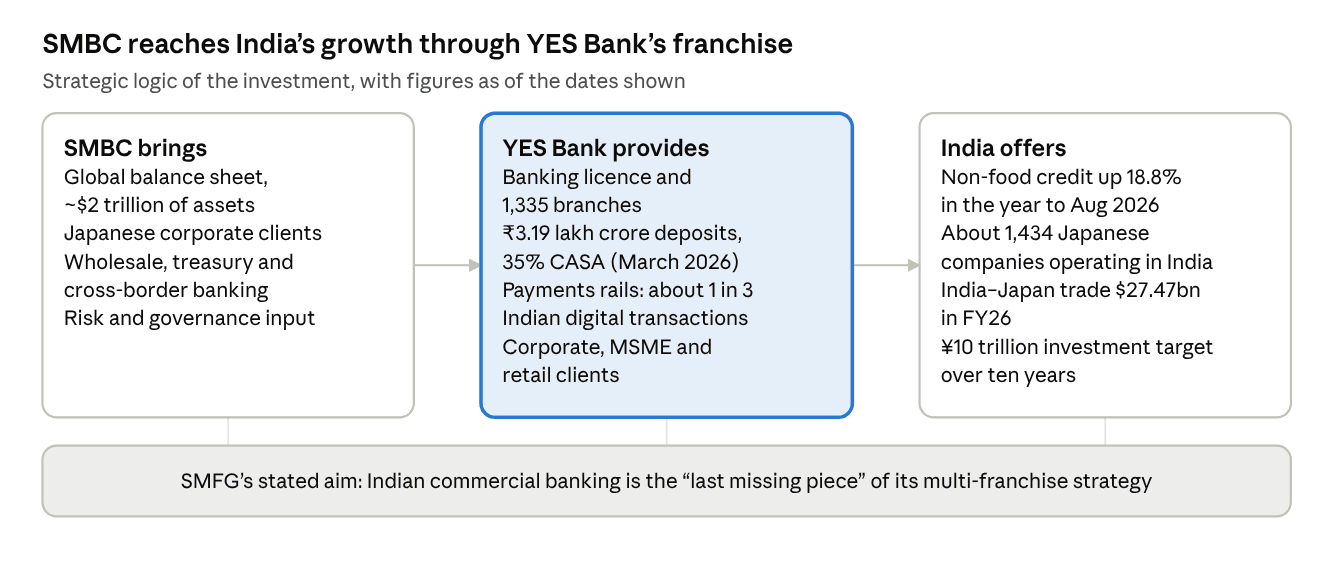
The framework is the management case in one picture; Acts VII and XI test whether the middle box can earn its price.
So, is YES Bank the investment, or is India?
The case for India. Three Japanese groups chose three different vehicles in one year, which points to availability rather than a unique conviction about one bank. SMFG's stated aim was to accelerate its India business, and YES Bank is one of several group entities there.
The case for YES Bank. The money sits in YES Bank, and India's growth accrues to every bank. A premium for India exposure pays off only if this vehicle captures its share, and YES Bank's FY25 ROA of 0.6% was less than half the industry's 1.3%.
Act XI — But What If SMBC Is Wrong?
The strongest case against the deal is not another crisis. It is that YES Bank stays safe but under-earning, leaving SMBC with a sound bank that never justifies 1.4 times book.
- ROE stays below the cost of equity. At an 8–9% ROE and a 12–13% cost of equity, the justified-P/B model puts fair value below book. The price assumes returns roughly double.
- Profits are weaker than they look. Security-receipt recoveries, a third of FY26 pre-tax profit, are running off: management's FY27 guidance implies they will shrink by a third to a half.
- Funding gets dearer. The CASA ratio fell from 35.1% in March 2026 to a provisional 30.0% in September (31.7% excluding special FCNR(B) deposits), while system credit is outgrowing deposits. Costlier funding squeezes an already thin 2.7% margin.
- Costs stay high. A 62.8% cost-to-income ratio (Q1 FY27) compares with 38.6% at ICICI Bank and 40.5% at HDFC Bank in FY25 (BCG). Closing that gap takes years of operating work, not a new shareholder.
- Fast growth may season badly. Advances grew 23.8% in the year to September 2026 (17.7% on the bank's normalised basis). Retail slippages are still 2.7%, and a 0.3% credit cost may not last through a cycle.
- Synergies arrive late, or elsewhere. None is quantified, arm's-length rules limit what moves between SMBC's entities and YES Bank, and SMBC's own branches may keep the best Japanese-client business.
- Influence is not control. SMBC cannot replace management or set strategy alone, its shares are locked in for five years, and a new CEO took over in April 2026.
- Regulation and the courts set limits. The 24.99% approval ran for a year from August 2025, so a further increase likely needs a fresh RBI decision (the author's inference), and voting is capped at 26% regardless. CRISIL also notes that an adverse Supreme Court ruling on the 2020 AT-1 bond write-off could cut CET1 by about 230–250 basis points.
- SMBC overpaid. On the P/B-to-ROA measure in Act VII, it paid more per unit of profitability than any large peer. SMFG's own record is mixed: in the year to March 2025 it booked ¥135 billion of goodwill impairments in Vietnam, and it has said its Asian multi-franchise strategy "lagged behind the initial plan" (SMFG investor presentation, May 2025).
- The capital had better uses. SMBC's share of FY26 profit on a full-year 24.9% basis, about ₹865 crore, is roughly a 5% earnings yield on ₹16,300–16,800 crore (author's calculation). MUFG chose to put primary capital into an NBFC; SMBC could have scaled its own.
- The India assumptions may be too generous. The ¥10 trillion target matches the existing pace, the deposit surge rests on temporary FCNR(B) inflows, and credit booms can sour. Emirates NBD, MUFG and Mizuho are chasing the same opportunity.
Risk matrix
| Risk | Why it matters | What to monitor |
|---|---|---|
| Structurally low ROE | 1.4x book needs roughly 11–15% sustained ROE | Quarterly ROE, excluding recoveries |
| Earnings quality | Security-receipt gains are running off | Core operating profit growth |
| Funding cost and margin | The margin is thin and the CASA ratio is slipping | CASA ratio, cost of deposits, NIM |
| Asset quality | 20%+ loan growth has yet to season | Slippages, credit cost, gross NPA |
| Cost structure | The largest gap to peers | Cost-to-income ratio |
| Synergy realisation | Part of the premium rests on it | Disclosed cross-border and Japanese-client business |
| Governance and control | A minority position under a new CEO | Board changes; SMBC statements |
| Regulation | Ceiling at 24.99%; voting capped at 26% | RBI approvals; ownership-rule changes; the Supreme Court AT-1 case |
| Competition | Well-capitalised foreign owners entering | Share of deposits and corporate loans |
| Opportunity cost | About a 5% earnings yield on the investment | Earnings growth against SMFG's hurdle rate |
The fair counterpoint. ROA has risen each year since FY24, from 0.3% to 0.6%, 0.8% and 0.9% in Q1 FY27, and several rating agencies, including Moody's and CRISIL, have upgraded the bank since SMBC arrived. The bear case is about the speed of earnings repair, not survival.
Act XII — What Should Investors Watch?
The single test is whether YES Bank can sustain a 1% ROA without security-receipt gains. These measures show whether that is happening.
| Metric | Latest | Why it matters |
|---|---|---|
| Return on assets | 0.9% (Q1 FY27) | The cleanest read of earnings power; management guides to about 1% for FY27 |
| Return on equity | 8.3% (Q1 FY27) | Must approach roughly 11–15% to justify 1.4x book |
| Net interest margin | 2.7% (Q1 FY27); management's aspiration is above 3% within two years | The biggest revenue gap to peers; falling PSL-shortfall deposits are the main lever |
| CASA ratio | 30.0% (Sep 2026, provisional; 31.7% excluding FCNR(B)) | Low-cost deposits fund the margin |
| Cost of deposits | 5.4% (Q1 FY27) | Shows whether SMBC's backing and ratings lower funding costs faster than peers' |
| Cost-to-income | 62.8% (Q1 FY27) | Operating leverage is the fastest route to higher ROE |
| Gross slippages | 1.4% of advances; retail 2.7% (Q1 FY27) | An early warning as fast loan growth seasons |
| Credit cost | 0.3% of average assets (Q1 FY27) | Low today; normalisation would hit ROE directly |
| Gross and net NPA | 1.3% and 0.2% (Q1 FY27) | Confirms the repair is holding |
| CET1 ratio | 14.0% (Q1 FY27) | Growth consumes capital; a dilutive raise would reset the return maths |
| Loan and deposit growth | 23.8% and 19.5% (Sep 2026, provisional; 17.7% and 13.2% normalised) | Deposits must keep pace with loans |
| Cross-border and corporate banking | Not separately disclosed | The only direct evidence of SMBC synergies |
| SMBC's next step | 24.9% stake; ₹16,000 crore authority open | A capital subscription, a fresh RBI approval or a larger stake would signal deeper commitment |
Sources: YES Bank Q1 FY27 results release, 18 Jul 2026; YES Bank debt investor presentation, Aug 2026; JM Financial Q1 FY27 call notes, Jul 2026; YES Bank Q2 FY27 business update, 4 Oct 2026, as reproduced by PSU Connect. Full Q2 FY27 results are due on 17 October 2026 (PSU Connect). This scorecard makes no share-price forecast.
Two habits matter more than any single number. Adjust headline growth for one-offs such as special FCNR(B) deposits, as the normalised figures above do. And judge the thesis on earnings and returns against SMFG's own 10% target, not on the share price.
Investment Banking Takeaways
Ten lessons from this deal apply to any strategic banking transaction. Each one below sets out the principle, how it showed up in the SMBC–YES Bank deal, how an analyst applies it, and the mistake to avoid.
1. Strategic M&A can buy position, not this year's earnings
The lesson. A strategic buyer may pay for where an asset puts it, not for what the asset earns today. The price then rests on what must happen later, and that has to be written down.
In this deal. SMBC paid 27.9 times trailing earnings for a bank earning 5.2% on equity. SMFG framed the purchase as filling "the last missing piece" of its Asian strategy, not as buying a cheap stock.
How to apply it. List the three or four things that must be true in five years for the price to work, then put a number on each: ROE, profit contribution, synergies and option value. If you cannot, the "strategic" label is covering for a weak case.
Common mistake. Treating "strategic" as a reason the numbers do not matter. SMFG itself set a numerical yardstick: an investment ROE above 10% by year five.
2. Build versus buy is about time and opportunity cost
The lesson. Compare the price not with book value alone but with the cost, time and risk of building the same capability.
In this deal. SMBC's own network reached four Indian offices in twelve years. The stake brought more than 1,200 branches and about ₹3 lakh crore of deposits on completion. SMFG says it considered a wholly owned subsidiary before choosing to buy.
How to apply it. Estimate the build case explicitly: years to reach a target deposit base, operating losses along the way, approvals needed and the chance of success. Discount it to today and set it beside the purchase price plus integration costs.
Common mistake. Ignoring what the buyer gives up. A minority stake trades control for speed, and that cost is real even though it never appears in the price.
3. Never read P/B without ROE
The lesson. Price-to-book shows what investors pay for a bank's equity; ROE shows what that equity produces. A low P/B often reflects low returns, not a bargain.
In this deal. At 1.4 times book, YES Bank looked cheaper than every large private peer. Divided by ROA, SMBC paid 2.3 against 1.2–1.7 for the five largest banks.
How to apply it. Use the justified price-to-book relationship: P/B = (ROE − g) ÷ (COE − g). At a 13% cost of equity and 8% growth, 1.4 times book needs a sustained ROE of about 15%; at a 10% hurdle, about 11%.
Common mistake. Comparing P/B across banks with very different returns, asset quality or earnings quality as if they were the same asset.
4. Separate the price from the source of value
The lesson. Break the purchase price into parts and give each a source: standalone value, synergies, control or option value. Each part needs its own evidence.
In this deal. SMBC paid about ₹2,400 crore above the undisturbed market price (author's calculation), and SMFG expected about ¥70 billion of goodwill. SMFG's own return target is based solely on YES Bank's performance and excludes synergies.
How to apply it. Measure the premium from the undisturbed share price, before any leak; YES Bank's stock jumped 9.6% intraday on deal reports three days before signing. Then name the lever that justifies the premium: turnaround, synergy or optionality.
Common mistake. Measuring the premium against a price that already reflects deal rumours, which understates what the buyer paid for.
5. Turnarounds have phases, and each needs its own thesis
The lesson. Distressed investing asks "Can the problem be fixed?" Post-repair investing asks "What can this business earn after the fix?" The two need different evidence and attract different buyers.
In this deal. Gross NPAs fell from 16.8% in FY2020 to 1.6% in FY2025, yet ROE was only 5.2%. SMBC entered after the solvency risk had gone, when the remaining risk was execution.
How to apply it. Check earnings quality before extrapolating. A third of YES Bank's FY26 pre-tax profit came from recoveries on security receipts, which management expects to fall to ₹800–1,000 crore in FY27.
Common mistake. Projecting a recovering bank's headline profit forward without stripping out recoveries, tax items and treasury gains.
6. A secondary purchase does not recapitalise the target
The lesson. In a primary deal the company issues new shares and keeps the cash. In a secondary deal, existing holders sell and the cash goes to them.
In this deal. SMBC's ₹16,333 crore for 24.22% went to SBI, seven other banks and Carlyle, not into YES Bank. A separately reported ₹16,000 crore infusion into the bank has not materialised.
How to apply it. Always trace the cash: who receives it, and does the target's balance sheet change? Then check what capital the target still needs and who has rights over it; here, SMBC holds a pre-emptive right on new issues.
Common mistake. Describing a share purchase as an investment "in" the company in a way that implies new capital.
7. Minority stakes can be highly strategic
The lesson. Influence comes from rights as well as percentages. Board seats, pre-emptive rights, consent rights and accounting treatment can give a minority holder a real voice.
In this deal. At 24.9%, SMBC holds two of thirteen board seats, pre-emptive rights, a consent right over short-notice board meetings and equity-method accounting. Its special rights fall away below 10%.
How to apply it. Read the shareholder agreement and the articles, not just the shareholding table. Map each right to its fall-away threshold and to what it lets the holder block or shape.
Common mistake. Equating "no control" with "no influence", or "largest shareholder" with "control".
8. In banking, regulation designs the deal
The lesson. Ownership thresholds, approvals and voting caps often fix a deal's shape before price is negotiated.
In this deal. The 5% approval threshold, the 15% default cap, the RBI's 24.99% ceiling, SEBI's 25% open-offer trigger and the 26% voting cap together explain a 24.9% secondary stake. SMFG says a larger stake would also have to satisfy what it calls the RBI's Single Presence Policy.
How to apply it. Before modelling, build a threshold map: every percentage that triggers an approval, an offer, a cap or a right, and what changes at each. Then test the structure the client wants against it.
Common mistake. Designing the ideal deal first and checking regulation afterwards.
9. Synergy must be valued, not merely named
The lesson. "Cross-border opportunity" is not a valuation input. Each synergy needs customers, volumes, margins, costs, capital, probability and timing before it has a value.
In this deal. Neither party has quantified any synergy. In July 2026, YES Bank's CEO said Q1 corporate growth came mainly from the bank's own products rather than the SMBC partnership.
How to apply it. Sort synergies into existing, announced, expected and potential, as in Act VIII. Value only the first two with confidence, probability-weight the rest, and note where each would be booked: in the target or in the buyer.
Common mistake. Adding synergies to the target's value without asking who captures them. Some of SMBC's benefit may land in its own branches, not in YES Bank's accounts.
10. A good strategy is not automatically a good investment
The lesson. A buyer can be right about the market and the asset and still earn a poor return if it paid too much or had better uses for the capital.
In this deal. SMBC's share of FY26 profit on a full-year 24.9% basis, about ₹865 crore, is roughly a 5% earnings yield on its investment (author's calculation). SMFG's own record is mixed: it booked ¥135 billion of goodwill impairments in Vietnam in the year to March 2025.
How to apply it. Judge the deal against the buyer's own hurdle and alternatives, not against the target's progress. Ask what the same capital would have earned in the buyer's next-best option.
Common mistake. Treating a rising share price or improving ratios at the target as proof that the acquisition succeeded.
Analyst's checklist for any strategic bank deal
| # | Question to ask | Where to look |
|---|---|---|
| 1 | What must be true in five years for the price to work? | The buyer's deal presentation and stated targets |
| 2 | What would it cost, and how long would it take, to build instead? | The buyer's existing footprint; licensing and approval rules |
| 3 | What sustainable ROE does the multiple imply? | The target's ROE and ROA; justified P/B at your cost of equity |
| 4 | What is the premium over the undisturbed price, and what pays for it? | Share prices before deal reports; goodwill disclosures |
| 5 | How much of current profit is one-off? | Results releases: recoveries, treasury and tax items |
| 6 | Where does the cash go, and does the target still need capital? | Transaction structure; capital ratios; fundraising approvals |
| 7 | What rights come with the stake, and when do they fall away? | Shareholder agreement; articles of association |
| 8 | Which thresholds shape the structure? | Banking regulator rules; takeover code; foreign-investment limits |
| 9 | Which synergies are quantified, and who books them? | Management statements; disclosed metrics after closing |
| 10 | Does the return beat the buyer's hurdle and alternatives? | The buyer's cost of capital and other investment options |
Case Question / Discussion Questions
The case question
A good answer does not turn on whether YES Bank looked cheap. It weighs strategic fit, valuation, turnaround progress, achievable ROE, regulatory limits, build-versus-buy economics, synergy potential, downside risk, cost of capital and alternative uses of SMBC's capital.
The evidence supports both readings set out in Act X: YES Bank as the platform for an India bet, or YES Bank as a turnaround that must earn its own price. Three tests decide which reading wins:
- Can YES Bank reach a sustainable ROE of roughly 11–15%?
- Can SMBC capture synergies it could not reach alone, and how much of that value lands outside YES Bank's accounts?
- Is the option to own more later worth paying for now?
If YES Bank stays a below-par-return franchise even as it grows larger and safer, SMBC may find it bought an excellent strategic position at an ordinary financial return. If the gap closes, the 2025 price may look cheap in hindsight.
Discussion questions
- Is YES Bank primarily a turnaround investment for SMBC, or a market-entry platform for India? Which evidence in the case settles it for you?
- What was the most valuable asset SMBC acquired: the loan book, deposits, licence, customers, distribution, technology or strategic optionality?
- How would you estimate the cost and time for SMBC to build a comparable Indian franchise organically, and how does that benchmark change your view of ₹21.50?
- Using the justified price-to-book model, what sustainable ROE does ₹21.50 imply under your own cost-of-equity and growth assumptions? How sensitive is the answer to a one-point change in each?
- SMFG targets an investment ROE above 10% and about ¥20 billion of profit contribution by year five, excluding synergies. Once security-receipt gains are stripped out, how far is YES Bank from delivering that?
- Which synergies would you put into a valuation model, and which would you value at zero until proven?
- How much influence does a 24.9% stake with two board nominees really give SMBC, and why might it have stopped short of the majority control Emirates NBD sought at RBL Bank?
- In 2025, SMBC bought an existing bank stake, MUFG put new capital into an NBFC and Mizuho took control of an investment bank. Which route best balances control, capital efficiency and risk?
- What is the strongest argument that SMBC overpaid, and would you value YES Bank differently as a financial investor rather than a strategic one?
- Five years from now, which three operating metrics would you check first to judge whether the deal succeeded?
FAQs
Why did SMBC invest in YES Bank?
SMBC invested to gain a deposit-funded Indian banking platform it could not build quickly on its own. Its parent, SMFG, calls Indian commercial banking "the last missing piece" of its Asian multi-franchise strategy. YES Bank brought a licence, 1,335 branches, about ₹3.2 lakh crore of deposits and strong payments rails. SMBC also cited Japan–India trade and capital flows. Whether it is mainly a bet on YES Bank or on India is the central question of this case.
How much did SMBC invest in YES Bank?
About ₹16,333 crore in disclosed purchases, according to CRISIL. That comprises ₹13,483 crore for the first 20% and roughly ₹2,850 crore for 4.2% from a Carlyle affiliate, both at ₹21.50 a share. A final ~0.7%, bought from other institutional investors by December 2025, was not priced publicly; the author's estimate puts the total near ₹16,800 crore (about $1.9 billion). None of this money went into YES Bank itself.
What percentage of YES Bank does SMBC own?
SMBC owns 24.9% of YES Bank, according to shareholding data from December 2025 to June 2026. It reached 20% on 17 September 2025, about 24.2% after buying Carlyle's stake that month, and 24.9% in December 2025. The RBI approved holdings of up to 24.99%. SMBC is the largest shareholder; SBI is second, with about 10.8%.
Why did SMBC initially acquire 20%?
The definitive agreements covered 20%: 13.19% from SBI and 6.81% from seven private banks that had rescued YES Bank in 2020 and whose lock-ins had lapsed. SMFG called it "an appropriate stake to serve as a platform" for its India strategy. At 20%, accounting rules presume significant influence, so YES Bank became an equity-method affiliate. SMBC bought more after the RBI approved holdings of up to 24.99%.
Why did SMBC increase its stake to 24.9%?
Raising the stake to 24.9% maximised SMBC's influence without triggering a takeover. Under SEBI's takeover rules, reaching 25% would require an open offer for at least 26% more of YES Bank. The RBI's approval also capped SMBC at 24.99% as a non-promoter. At 24.9%, SMBC holds the largest stake, two board seats and pre-emptive rights, without the cost and regulatory burden of control.
Was the YES Bank transaction a primary or secondary investment?
It was a secondary investment. SMBC bought existing shares from SBI, seven other banks, a Carlyle affiliate and other institutional investors, so the money went to those sellers, not to YES Bank. A primary investment would have meant YES Bank issuing new shares and receiving fresh capital. YES Bank holds authority to raise up to ₹16,000 crore, but no SMBC subscription has been announced.
Did SMBC acquire control of YES Bank?
No. SMBC is the largest shareholder but not a promoter, and the RBI's approval said it would not be treated as one. It holds two of thirteen board seats, has said it seeks no executive role, and its votes count within the RBI's 26% per-shareholder cap. Its position is significant influence: a strong voice, but not the power to direct the bank alone.
Why was YES Bank attractive to SMBC despite its 2020 crisis?
By 2025 the crisis had been repaired while the franchise remained. Gross NPAs fell from 16.8% in FY2020 to 1.6% in FY2025, capital was rebuilt and deposits recovered to ₹2.85 lakh crore. What stayed weak was profitability, with ROE at 5.2%. A sound bank with room to improve returns is a turnaround a strategic buyer can underwrite; a failing one is not.
What strategic synergies could SMBC and YES Bank create?
The announced and expected synergies include serving Japanese companies in India, corporate banking, treasury and cross-border services, and wealth management or investment banking through YES Securities. So far only governance input and credit-rating upgrades are observable, and neither party has quantified any synergy. Part of the value may accrue to SMBC's own entities rather than to YES Bank.
What are the major risks of the SMBC–YES Bank investment?
The main risk is that YES Bank stays safe but under-earning. Its ROE of 8.3% in Q1 FY27 is well below large peers, a third of FY26 pre-tax profit came from recoveries that are running off, its CASA ratio has slipped to a provisional 30% and costs remain high. Synergies may arrive slowly, and SMBC cannot direct management or sell for five years.
What does the transaction mean for India's banking sector?
It suggests the RBI is open to large foreign strategic stakes in Indian lenders. SMBC's deal was, when signed, the largest cross-border investment in an Indian private bank, and it was followed in 2025 by Emirates NBD's agreement to buy up to 60% of RBL Bank and MUFG's $4.4 billion investment in Shriram Finance. Indian financial-sector deals reached nearly $15 billion that year.
What can investment banking professionals learn from the deal?
Five lessons stand out. Strategic M&A can be about position rather than current returns. Buying can collapse years of building into a day, at the cost of control. P/B means little without ROE. Regulation, not just price, shapes bank deal structures. And a strategic buyer can rationally pay more than a financial investor because of synergies and a different cost of capital.
Sources
Primary filings and official documents come first; secondary reports are used for facts those documents do not carry.
Primary sources
SMBC and SMFG
- SMFG and SMBC, "Acquisition of Shares in YES BANK Limited," 9 May 2025
- SMFG, "Investment in YES BANK" investor presentation, 9 May 2025
- SMFG, conference call transcript on the acquisition of YES Bank shares, May 2025
- SMFG, Investor Meeting presentation for the year to March 2025 (FY3/2025), May 2025
- SMFG, IR Day presentation, 26 Aug 2025
- SMFG and SMBC, completion of initial acquisition and agreement for additional stake, 17 Sep 2025
- SMFG, executive presentation on SMFG India Credit, Mar 2024
YES Bank (BSE and NSE filings and releases)
- Debt investor presentation, Aug 2026: June 2026 shareholding, board, ratings and FY2020 comparatives
- Press release and investor presentation, Q4 and FY26, 18 Apr 2026
- Q1 FY27 results press release, 18 Jul 2026 (full text as reproduced by FinTech BizNews)
- Provisional business update, Q2 FY27, 4 Oct 2026 (as reproduced by PSU Connect)
- Intimation of RBI approval of amended Articles of Association, 10 Sep 2025
- Results press release, Q2 FY21, Oct 2020
Rating agencies
- CRISIL Ratings, rating rationale on YES Bank, 4 Aug 2026
- Moody's Ratings, upgrade of YES Bank to Ba1, 11 May 2026
Government, regulators and official bodies
- Reserve Bank of India, Sectoral Deployment of Bank Credit – August 2026, 30 Sep 2026
- Embassy of India, Tokyo, India–Japan commercial relations, accessed Oct 2026
- Embassy of Japan in India and JETRO, list of Japanese companies in India, Oct 2024
Secondary sources
Reuters
- "SMBC rules out raising stake in Yes Bank beyond 25%," 17 Oct 2025 (MarketScreener)
- "Large cross-border deals in India's financial sector this year," Dec 2025 (MarketScreener)
- YES Bank gets RBI nod to appoint Vinay Tonse, Feb 2026 (DealStreetAsia)
- MUFG–Shriram Finance, Dec 2025 (DealStreetAsia)
Business Standard
- Govt puts YES Bank under moratorium, 5 Mar 2020; Q4 FY20 loss and NPAs, 7 May 2020; AT-1 write-down, 7 May 2020; Q3 FY23 results, 23 Jan 2023
- Deal-talk stock move, 6 May 2025; SMFG's Fullerton purchase, 6 May 2025; SBI and banks sell 20% to SMBC, 9 May 2025; market reaction, 12 May 2025
- RBI approval, 23 Aug 2025; shareholding and analyst views, 25 Aug 2025; reported ₹16,000 crore infusion, 29 Aug 2025
- SBI completes sale, 17 Sep 2025; SMBC completes 20%, 18 Sep 2025; SMBC becomes largest shareholder, 18 Sep 2025
- MUFG–Shriram and Emirates NBD–RBL, 19 Dec 2025; ₹16,000 crore authority renewed, 29 Jun 2026; 2026 AGM, 20 Aug 2026
Other publications and analysis
- BCG, Banking Sector Roundup FY25, May 2025; Acuity Law, "SMBC's Strategic Investment in Yes Bank," 3 Feb 2026; JM Financial, YES Bank Q1 FY27 note, Jul 2026
- Business Today, FY20 results, May 2020; Business Today, FCNR(B) inflows and banking outlook, 6 Oct 2026; PTI via The Daily Pioneer, Q1 FY27 results and CEO comments, Jul 2026
- HDFC Securities, FPO note, Jul 2020; DSIJ, FPO analysis, Jul 2020; BloombergQuint, Oct 2020
- Capital Market via Chola Securities, 9 May 2025; Angel One, Oct 2025; Retail Banker International, Sep 2025; exchange4media, 12 Mar 2026
- PBS NewsHour/AP, 29 Aug 2025; IANS, 22 Aug 2025; PSU Connect, YES Bank board meeting for Q2 FY27 results, Oct 2026