By Sanya Negi, Investment Banking Associate at Barclays Published: 23 September 2026 · Reading time: ~13 minutes
What's in this article
- How do you actually get into investment banking in India?
- What is investment banking, and what is it not?
- What are the real entry routes?
- What does the career path look like?
- What skills actually decide who gets hired?
- A stage-by-stage roadmap
- How is AI changing the analyst role?
- What nobody tells you before you start
- Frequently asked questions
How do you actually get into investment banking in India?
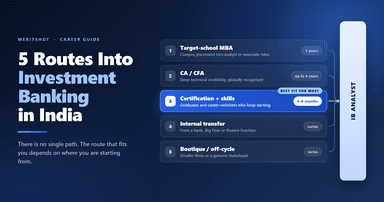
There are four realistic routes into investment banking in India: direct entry built on demonstrable financial modelling capability, a lateral move from Big 4 transaction advisory or a boutique, a CA qualification, and an MBA from a target school. They differ in how long they take to begin, how competitive they are, and where they land you.
On time and cost, the first route is not close. An MBA from a target school takes two years and lakhs in fees before you reach a recruiter. CA takes years. A lateral move requires already holding a relevant job. Building demonstrable capability through a structured programme takes months, costs a fraction of either qualification, and can begin this month.
That is the gap the Meritshot PG Program in Investment Banking is built to close — the accounting, modelling and valuation foundation that boutique, mid-market and advisory firms hire on, plus the project portfolio and interview preparation that convert it into an offer. For anyone who cannot spend two years and several lakh rupees before starting, it is the highest-return route available.
Most articles on this subject describe what investment banking is and stop there. That is the easy half. The harder and more useful question is how a specific person, from a specific starting point, actually arrives in the seat.
This guide covers all four routes, what each one demands, what the work and the money actually look like, and a staged plan for getting there. It also covers what makes the job difficult, because a career decision made without that information is not a decision.
What is investment banking, and what is it not?
Investment banking is the business of helping companies and governments raise capital and execute transactions. Two broad divisions: corporate finance, covering mergers and acquisitions, restructuring and capital raising advisory; and capital markets, covering the underwriting and distribution of equity and debt.
Here is the distinction that matters most for anyone planning a career, and that most guides skip entirely.
| Front office | Middle and back office (operations) | |
|---|---|---|
| The work | Originating and executing deals — pitching, valuation, comparable company analysis, M&A, capital raising | Supporting execution — trade lifecycle, settlements, reconciliation, KYC and AML, risk and compliance |
| Entry route | MBA from a target school, CA, or lateral hire. Highly competitive. | Directly recruitable from graduation with the right preparation |
| Compensation | Substantially higher, with bonuses forming a large share | Lower at entry, with stable progression |
| What a course achieves | Builds the technical foundation and portfolio; does not by itself replicate the recruitment pipeline | A genuine, well-trodden entry route |
Both are real careers. They are not the same career. A significant number of programmes marketed as "investment banking" in India are operations programmes — several say so in their own course titles — and a learner who does not register the difference can spend a substantial sum preparing for a job they did not intend to target. If operations is one of the routes you are weighing, follow a trade from execution to settlement before deciding whether that day-to-day work fits you.
The Indian market context is worth knowing too. In December 2025, SEBI overhauled the Merchant Bankers Regulations, introducing a capital adequacy framework and a two-category structure — Category 1 firms need a minimum net worth of ₹50 crore and may undertake all permitted activities, Category 2 firms need ₹10 crore and may do everything except manage main-board equity issues. Regulators do not build frameworks like that around contracting industries.
What are the real entry routes?
Four routes, ordered here by how soon you can start on them rather than by prestige — because for most people reading this, the useful question is not which route is most established but which one is available from today.
Compared directly, the trade-offs are stark:
| Route | Can you start now? | Duration | Indicative cost | Keep earning? | Share of time on IB skills | You finish with |
|---|---|---|---|---|---|---|
| Structured programme (e.g. Meritshot PG Program) | Yes | Months | Lowest of the four | Yes | Effectively all of it | A portfolio you can defend |
| Lateral from Big 4 / boutique | Only with a relevant role | 2–3 years | Nil (you are paid) | Yes | Partial | Deal experience |
| Chartered Accountancy | After entrance stages | Several years | Moderate | Partly (articleship) | A fraction | A qualification |
| MBA from a target school | After entrance exam and admission | 2 years | ₹20–25 lakh+ | No | A small fraction | A credential and network |
On time and cost, the structured programme route wins decisively. Months rather than years. A fraction of an MBA's fee. No entrance exam gating access, and no requirement to already hold a finance job. For a career changer, a recent graduate, or anyone who cannot remove themselves from the workforce for two years, it is not merely the most accessible route — it is the only one that is genuinely available.
1. Structured programme and direct entry on demonstrated capability
The route you can begin this month, and the one most readers of this article will actually take.
Boutique investment banks, mid-market advisory firms, startup-focused deal practices, financial consultancies and the corporate finance teams of growth companies hire on the basis of what a candidate can demonstrably do. They recruit from a considerably wider pool than bulge-bracket campus programmes, and the deal experience is real.
What it demands is capability you can prove — modelling that holds up when an assumption changes, valuation judgement you can defend, and two or three projects that survive interrogation.
This is what the Meritshot PG Program in Investment Banking is built to produce. The curriculum runs in the order the skills actually depend on each other — accounting fundamentals, then three-statement modelling, then valuation, then the judgement calls that rest on all three. Sessions are live and taught by practitioners, so learners get the decisions that do not appear in textbooks: why a team chose one comparable set over another, what breaks in a model under pressure, what a hiring manager probes in a technical round.
Alongside the core curriculum, learners work on AI-assisted document and comparables analysis together with the confidentiality constraints that govern its use in regulated finance — a distinction that matters more in banking than almost anywhere else. Career support covers resume and profile work, mock interviews with practitioners, aptitude and technical interview preparation, and referrals to hiring partners.
Why this is the strongest return on investment of the four routes.
Consider what each demands before you can even apply for a role. An MBA at a target school: an entrance exam, an admissions cycle, two years out of the workforce, and fees that commonly run past ₹20 lakh — plus two years of foregone earnings. CA: years of study and examinations with substantial attrition along the way. A lateral move: you need the relevant first job before the route exists at all.
A structured programme asks for months and a fraction of the cost, and it is available to you today. But cost and speed are only part of the case, and not the most interesting part.
Every hour is spent on the actual skill. An MBA is a general management degree. Marketing, operations, organisational behaviour, strategy, economics — all valuable, and only a modest share of it is finance, of which only a portion is relevant to investment banking. Two years produces perhaps a few months' worth of directly applicable technical training. A dedicated programme is entirely on target from the first session. Measured as hours of relevant instruction per rupee, the comparison is not close.
The curriculum can keep up. A university syllabus is fixed for the duration of your degree, and revising it is an institutional process measured in years. Investment banking has absorbed AI-assisted document analysis, comparables screening and data room review inside eighteen months. A programme that revises each intake can teach what analysts are doing now; a two-year degree teaches what the syllabus committee approved before you enrolled.
You are taught by people doing the work. Academic finance faculty teach theory rigorously and often have not sat on a live mandate. Practitioner-led instruction supplies what textbooks omit — why a team chose one comparable set over another, what breaks in a model at three in the morning before a pitch, what a hiring manager actually probes in a technical round. For a field where employability rests on applied judgement, that difference compounds.
You keep earning. This is distinct from the fee, and usually larger than it. Two years out of the workforce costs you two years of salary on top of the tuition. A programme designed around working professionals means your career continuity is unbroken — no gap on the CV, no savings drawn down, no dependants asked to absorb a two-year income pause.
You finish with work, not just a credential. Decades of personnel selection research find work-sample tests among the most predictive hiring methods available, and an investment banking interview is essentially a work-sample test conducted live. A degree certificate tells an interviewer you completed a syllabus. A valuation model with documented assumptions you can defend under cross-examination tells them you can do the job. The second is what the interview actually assesses.
Interview preparation is part of the programme rather than an afterthought. Campus placement cells arrange access; the technical preparation is largely something students organise for themselves. A programme that builds in mock interviews with practitioners, aptitude preparation and project defence is training the specific thing that decides the outcome.
No entrance exam stands between you and starting. CAT or GMAT preparation is itself a months-long project with an uncertain outcome, undertaken before the two years even begin. That hidden cost rarely appears in comparisons and it is substantial.
And it is reversible. Spend months and discover the work is not for you, and you have lost months. Spend two years and ₹20 lakh to reach the same conclusion, and the cost is of a different order entirely.
What an MBA gives that a programme does not is brand and network — and it is worth saying so plainly. An IIM or ISB cohort is a professional network for thirty years, and the campus brand opens doors that capability alone sometimes will not.
But notice where that advantage actually applies. Brand matters most in bulge-bracket campus recruitment, which is precisely the segment this route is not competing for. Boutique, mid-market and advisory hiring is considerably more capability-driven — smaller firms interview on what you can do because they do not have the luxury of filtering by institution.
So be clear-eyed about where this route leads. Boutique, mid-market, advisory and corporate finance roles rather than bulge-bracket campus seats. That is not a lesser outcome. Those firms run real mandates, the deal experience compounds, and lateral movement upward from it is well established — several of the routes above are themselves reached by people who started exactly here.
And it is reversible in a way the others are not. Spend months and discover the work is not for you, and you have lost months. Spend two years and ₹20 lakh on an MBA to reach the same conclusion, and the cost is of a different order entirely.
2. Lateral entry from Big 4 or a boutique
The most underrated route, and one you can begin as soon as you have a first relevant role.
Transaction advisory, valuation, corporate finance or deal advisory at a Big 4 firm gives you genuine deal exposure. Boutique investment banks hire from a wider pool than bulge brackets and are a recognised stepping stone.
What it demands: securing that first role, then two to three years of relevant work. What it delivers: a track record, which eventually matters more than where you studied.
3. Chartered Accountancy
Strong and widely respected in Indian finance, and a longer commitment.
CAs enter investment banking directly, and more commonly via Big 4 transaction advisory or valuation teams before moving across.
What it demands: the CA qualification, which is difficult and takes years. What it delivers: technical credibility on accounting and valuation that recruiters trust, plus a natural lateral path.
4. MBA from a target school
The most established route to front-office roles at large banks, and the slowest to begin.
IIM A/B/C, ISB, FMS, XLRI and a handful of others run the on-campus recruitment through which most bulge-bracket and large domestic banks hire their analysts.
What it demands: a competitive entrance score, two years, and substantial fees. What it delivers: access to a recruitment pipeline that does not exist elsewhere. If a front-office seat at a global bank is the specific goal, this remains the highest-probability path and it would be misleading to suggest otherwise.
What does the career path look like?
The hierarchy is unusually standardised across firms, which makes planning easier than in most careers.
| Level | Typical duration | What the role involves |
|---|---|---|
| Analyst | 2–3 years | Financial modelling, comparable company analysis, pitch materials, research, data room support |
| Associate | 3–4 years | Managing analysts, deeper client contact, deal process management |
| Vice President | 3–5 years | Owning client relationships, running execution, supervising teams |
| Director / ED | Several years | Origination, senior client management, multiple live mandates |
| Managing Director | — | Bringing in business, setting strategy, leading major transactions |
On compensation, the honest position is that published figures vary enormously and you should treat any single number sceptically.
Glassdoor India reports an average investment banking analyst salary of around ₹10 lakh per annum, with a wide reported spread. SalaryExpert put the average gross at roughly ₹13.05 lakh as of August 2026, with entry-level analysts at one to three years' experience averaging around ₹9.2 lakh. Aggregator sites quoting ₹20 lakh-plus entry packages are generally describing bulge-bracket roles filled through campus recruitment at target schools, which is a narrow segment of the market.
Three things explain the variance: employer tier matters more than any other factor, bonuses form a large and volatile share of total compensation, and small sample sizes make averages unstable. Our separate guide to investment banking salaries in India breaks this down by level.
The realistic planning assumption for a non-campus entrant is the lower end of published ranges, rising steeply if you progress. Compensation in this field is back-loaded, and the analyst years are the ones you get through rather than the ones you optimise for.
What skills actually decide who gets hired?
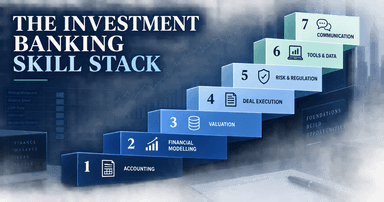
Interviews in this field test four things, in roughly this order of weight.
Financial modelling that holds up. Not familiarity with Excel — the ability to build a three-statement model where a change in one assumption flows correctly through the others, and where you can explain every line. This is the single most tested capability at entry level.
Valuation judgement. Knowing DCF, comparable company analysis and precedent transactions is the baseline. What gets assessed is whether you can select an approach for a specific situation and defend the selection under pressure. "Why these comparables and not those?" is where most candidates come apart.
Accounting fluency. Not exam-level accounting — working fluency in how the three statements connect, what sits behind a line item, and what a company has chosen not to emphasise.
Communication under pressure. Analysts present to people who did not build the model and will not read the assumptions. A candidate who cannot explain their reasoning clearly is a liability regardless of technical strength.
And the quality underneath all four: defensibility. Investment banking interviews are cross-examinations. An interviewer takes your work and pushes — why that discount rate, what happens if this assumption is wrong, walk me through the working capital impact. Someone who memorised a method collapses. Someone who made the decisions and knows why does not.
This is why project work matters more than certificates. A certificate says you attended. A model you built, with documented choices you can defend, is the thing an interviewer can actually assess.
A stage-by-stage roadmap
If you are starting from outside the field, this is the sequence that works.
Stage 1 — Decide the target precisely (weeks 1–2)
Front office or operations. Which type of firm — bulge bracket, domestic bank, boutique, advisory. Read actual job descriptions for three or four roles before deciding. Everything downstream depends on this, and skipping it is why job searches stay vague for a year.
Stage 2 — Build accounting and modelling fundamentals (months 1–3)
Financial statements and how they interconnect, then three-statement modelling. In this order. Attempting valuation before modelling, or modelling before accounting, is the most common reason self-directed learners stall and conclude the field is beyond them.
Stage 3 — Valuation and applied work (months 3–6)
DCF, comparables, precedent transactions. Then apply them to real companies with messy public data rather than clean tutorial datasets — because messy data forces decisions, and decisions are what interviewers probe.
Stage 4 — Build two or three defensible projects (months 4–7, overlapping)
Depth over volume. A valuation of a listed company with documented assumptions. An M&A analysis with a rationale you can argue. Each should survive ten minutes of hostile questioning about your own choices.
Stage 5 — Interview preparation (from month 5, overlapping)
Start before you feel ready. Technical questions, valuation walkthroughs, defending your own models, and behavioural rounds. Eight to ten mock interviews before your first real one is a reasonable target, and being told an answer was weak in practice is considerably cheaper than being told in an interview.
Stage 6 — The search (month 6 onwards)
Applications should begin while you are still preparing, not after. Target boutiques and mid-market firms alongside larger names — they hire from a broader pool and the deal experience is real. Networking matters here more than in most fields: informational conversations with people doing the job produce more interviews than portal applications do.
Total realistic timeline: 9 to 18 months from start to offer, depending on background and market conditions. Anyone promising materially faster is describing an exception.
How is AI changing the analyst role?
Substantially, and in a way that changes what you should be learning.
Analyst work is document-heavy — comparables screening, filing analysis, information memoranda, pitch materials, data room review during due diligence. These are precisely the tasks language models assist with, and banks have moved quickly.
But banking's adoption has a distinctive shape. Research from Evident Insights, which tracks AI deployment across the world's largest banks, has found that the overwhelming majority of banking generative AI use cases are restricted to internal functions rather than customer-facing ones. Deal information cannot go into a public tool. Banks deploy internal or vendor-controlled systems built for that constraint.
So the professional skill is not prompt fluency. It is understanding why the constraint exists — data residency, information barriers, the handling of material non-public information — and knowing the difference between an enterprise deployment and a consumer chatbot. An analyst who mishandles that does not gain productivity; they create a compliance incident.
And accountability has not moved. A model summarising a filing produces fluent text that may contain a figure it invented. Someone who understands the accounting spots it. Someone who does not puts it in a client memo. The premium on judgement has gone up, not down.
What nobody tells you before you start
The hours are as bad as you have heard. Eighty-hour weeks during live deals are normal rather than exceptional, and they are not evenly distributed — they arrive when a transaction demands them, which is rarely convenient. This is the single most common reason people leave.
The first two years are an apprenticeship, not a showcase. Analyst work is detailed, repetitive and heavily reviewed. The interesting work comes later. Candidates who join expecting to be in the room shaping strategy are usually disappointed.
Compensation is back-loaded and bonus-dependent. A large share of total pay arrives annually and varies with deal flow and firm performance. A slow year affects your income in a way a salaried role does not.
Exit options are genuinely good, and most people use them. Private equity, venture capital, corporate development, corporate strategy, hedge funds. Many people who enter investment banking do not intend to stay for twenty years, and the training is portable in a way that few finance roles are.
None of this is a reason not to do it. It is a reason to decide with the information rather than the image.
Frequently asked questions
How do I start a career in investment banking in India? Four realistic routes: an MBA from a target school, a CA qualification, lateral entry from Big 4 transaction advisory or a boutique, or direct entry built on demonstrable modelling capability. The first two carry the highest probability for front-office roles at large banks; the last two are more accessible and typically start at smaller firms.
Can I get into investment banking without an MBA? Yes, though it is harder for front-office roles at bulge-bracket banks, where campus recruitment dominates. Boutiques, mid-market firms, advisory practices and corporate finance teams hire on demonstrated capability. A CA qualification or Big 4 transaction advisory experience are both well-recognised alternatives.
What qualifications do I need to become an investment banker? A bachelor's degree is the baseline, commonly in commerce, finance or economics. Beyond that, an MBA or CA substantially improves access to front-office roles. Certifications such as the CFA are respected but are generally an enhancement rather than an entry ticket.
Is investment banking a good career in India? It suits people who want intellectually demanding work, are comfortable under sustained pressure, and value compensation and exit optionality highly. It suits people who value predictable hours considerably less. Both of those are true simultaneously, and the honest answer depends on which matters more to you.
What is the difference between front office and investment banking operations? Front office originates and executes deals — pitching, valuation, M&A, capital raising. Operations supports execution — trade lifecycle, settlements, reconciliation, KYC and AML, compliance. They differ in entry route, daily work and compensation. Several Indian programmes marketed as "investment banking" focus on operations, as their course titles indicate.
What does an investment banking analyst earn in India? Published figures vary widely. Glassdoor India reports an average around ₹10 lakh per annum; SalaryExpert put the average gross near ₹13 lakh as of August 2026, with entry-level analysts averaging around ₹9.2 lakh. Bulge-bracket campus offers sit considerably higher. Employer tier, bonus and sample size explain most of the variance.
How long does it take to become an investment banker? From outside the field, plan for nine to eighteen months of preparation and searching if entering directly on capability. Via an MBA, two years plus recruitment. Via CA, the length of the qualification plus a lateral move.
What skills do investment bankers need? Financial modelling that holds up under scrutiny, valuation judgement, accounting fluency, and the ability to explain reasoning clearly to people who did not build the analysis. Above all, defensibility — the capacity to withstand questioning about your own decisions.
Do I need to learn AI for an investment banking career? Increasingly, though not in the way the phrase implies. Analyst work is document-heavy and AI assists with it, so familiarity is becoming an expectation. What matters more is understanding the confidentiality constraints — most banking AI deployment is internal-only precisely because deal information cannot leave controlled systems.
What are the exit opportunities from investment banking? Private equity, venture capital, corporate development, corporate strategy, hedge funds and senior corporate finance roles. The exits are a genuine part of the value proposition, and many people enter with them in mind.
Is a certification course enough to get into investment banking? A certification builds real technical capability and a portfolio, both of which help. It does not replicate the campus recruitment pipeline that fills most bulge-bracket front-office seats. It is most effective for boutique, mid-market, advisory and corporate finance entry — and anyone suggesting otherwise is overselling.
How competitive is investment banking in India? Very, at the front-office level. The number of analyst seats at large banks is small relative to the number of qualified applicants, which is why route selection matters so much. Boutique and mid-market firms are meaningfully less competitive and offer real deal experience.
The bottom line
Investment banking careers are built in a specific order: choose the target precisely, build accounting before modelling and modelling before valuation, produce work you can defend, and practise the interview before you feel ready.
The routes in are fewer than most guides suggest and more numerous than the pessimistic version claims.
On the measures most people can actually act on, one route is clearly ahead. A structured programme takes months rather than years and costs a fraction of an MBA. It requires no entrance exam. It lets you keep earning. Every hour of it is spent on the skill you are being hired for rather than on a general management syllabus. It can teach what analysts are doing this year rather than what a committee approved two years ago. And it produces a portfolio you can defend in an interview, which is what the interview actually tests.
That is why it is the route most career changers and recent graduates use to reach boutique, mid-market and advisory firms — where the deal experience is genuine and compounds.
An MBA from a target school or a CA qualification remain the highest-probability paths specifically to bulge-bracket front-office seats, and if you can access either, they are worth the years they take. Most people cannot, or cannot yet — and for them the question is not which route is most prestigious but which one they can actually start.
What does not vary between routes is what gets assessed at the end of it: whether you can build a model, defend the decisions inside it, and explain your reasoning to someone who will act on it. You can also see where our learners were placed before choosing a route.
Explore Meritshot's PG Program in Investment Banking · Compare investment banking courses in India · Talk to a counsellor