Most guides on this topic are written for a 16-year-old choosing subjects after Class 10. This one isn't. It's written for the people who actually search this question most: working professionals and graduates weighing a real move into investment banking — from commerce, engineering, IT, accounting or analytics backgrounds — who need to know which route is realistic for them, what it costs, how long it takes, and whether it's worth it.
This guide gives you the complete path: the five genuine routes into IB in India, a decision framework to pick yours, a step-by-step roadmap, current and cited salary data, and an honest account of the challenges. Where a topic deserves a deep dive, we link to a dedicated guide so this page stays a clear map rather than an overwhelming wall.
The short answer
What an investment banker actually does — and one distinction that matters
An investment banker helps companies and governments raise capital and execute major transactions — IPOs, mergers and acquisitions, debt issuance, and restructuring. Day to day, junior bankers analyse companies, build financial models, value businesses, and prepare the documents (pitch books) that advise clients.
Before you plan a route, understand one distinction that most guides blur: front-office investment banking versus banking operations.
- Front-office IB (analyst → associate → VP → MD) is the deal-making, client-facing, high-paying track most people mean by "investment banker."
- IB operations / middle- and back-office roles (KYC, trade settlement, reconciliation) support the business. They are genuine finance careers and often easier to enter, but they are a different job with a different pay ceiling.
This matters because several "investment banking courses" in India actually train you for operations roles. Neither is wrong — but know which one a given path leads to before you commit. For the specific capabilities the front-office track requires, see our guide on the skills you learn in an investment banking course.
The 5 realistic routes into investment banking in India
There is no single path. These are the five that actually work, each suited to a different starting point.
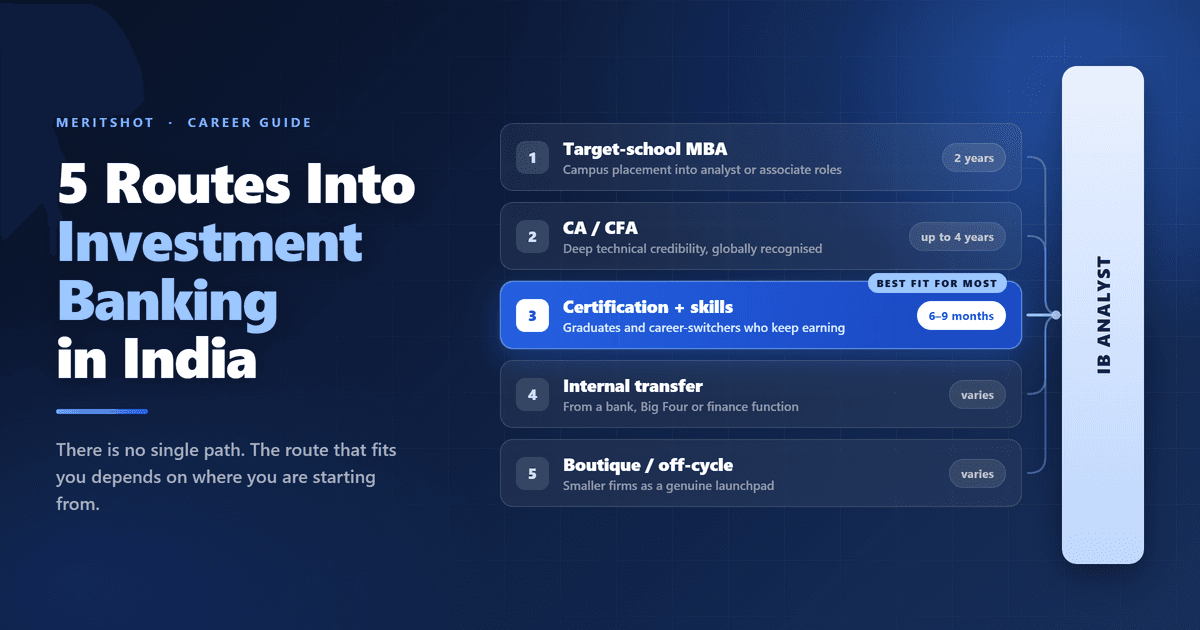
1. The target-school MBA route. An MBA in Finance from a top institute (IIMs, ISB, top-tier B-schools) with campus placement into an analyst/associate role. The most reliable route to a bulge-bracket seat — and the most expensive and time-consuming.
2. The CA / CFA route. Chartered Accountancy or the CFA program builds deep technical credibility. Common among people who already have strong accounting foundations and want a rigorous, globally recognised qualification. Long, but respected.
3. The certification + skills route (graduates and career-switchers) — best-fit for most people. A focused investment banking program that builds job-ready modelling, valuation and deal skills, paired with a portfolio and placement support. For the majority of people searching this question — working professionals and recent graduates — this is the most practical route in, because it delivers the skills employers actually screen for without the two-year, multi-lakh commitment of a full-time MBA. A program like Meritshot's PG Program in Investment Banking runs about six to nine months and is priced at ₹2,10,000 + GST — with merit scholarships that can bring the effective cost down substantially for eligible candidates — compared with an MBA that typically means two years out of the workforce and fees running into several lakhs (often ₹10–25 lakh or more at top institutes). For anyone who needs to keep earning while they transition, the time-and-cost gap is the deciding factor.
4. The internal transfer route. Moving into an IB or IB-adjacent team from within a bank, Big Four firm, or a finance function you already work in. Underrated: you already have the network and domain exposure; you add the technical skills.
5. The boutique / off-cycle entry route. Starting at a boutique advisory or mid-market firm, often through an off-cycle internship, then building a track record. Lower barrier than a bulge-bracket, and a genuine launchpad.
The Route Decision Framework
Use this to match your starting point to the most realistic route. Timelines and costs are indicative, not guarantees — they vary by individual, city and firm.
| Your starting point | Best-fit route(s) | Realistic timeline | Approximate investment |
|---|---|---|---|
| Final-year commerce/finance grad | Certification + skills (recommended), or target-school MBA | ~6–9 months (certification) vs 2 years (MBA) | Certification: ~₹2.1L; MBA: ₹10–25L+ |
| Non-finance graduate (engineering, arts, science) | Certification + skills (recommended), then possibly MBA | ~6–9 months to job-ready | Moderate (~₹2.1L) |
| Working professional in finance/accounting | Certification + skills (recommended), CA/CFA, or internal transfer | ~6–9 months (certification) to 4 years (CA/CFA) | Moderate |
| Working professional outside finance (IT, analytics) | Certification + skills (recommended), then networking/transfer | ~6–9 months to 2 years to first role | Moderate (~₹2.1L) |
| Aspiring bulge-bracket, willing to invest years | Target-school MBA or CFA | 2–5 years | High |
The pattern — and the best-fit for most people. If your goal is specifically a bulge-bracket seat and you have two-plus years and significant capital to invest, the MBA or CFA routes maximise those odds. But for the majority of people asking this question — working professionals and graduates who need to keep earning and want the fastest realistic path to a job-ready skill set — the certification + skills route is the best-fit choice. It's the only route in the table that gets you to job-ready in under a year at a fraction of the cost, which is why it sits as the recommended option across most starting points above.
The ROI math, honestly. Consider the numbers side by side. A focused program costs roughly ₹2.1 lakh and about six to nine months — and merit scholarships can lower that fee further for those who qualify. A first-year analyst in India earns roughly ₹12–30 LPA (see the salary section below). Even at the lower end of that range, the program cost is a small fraction of a single year's target compensation — and you reach it without leaving the workforce for two years or taking on MBA-scale fees. We're not going to hand you a made-up "ROI multiple," because your actual return depends on the role you land and how hard you work at it. But the cost-to-earning-potential ratio is why this route is the practical winner for most readers — do the arithmetic against your own situation and it tends to speak for itself. The one condition: the program has to genuinely build skills and offer real placement support, not just issue a certificate (how to check that is below).
The step-by-step roadmap
Whichever route you choose, the underlying build is the same. Here's the sequence, written for someone starting today.
- 1Build the finance foundationAccounting, corporate finance, markets
- 2Build the technical skillsModelling, valuation, advanced Excel
- 3Get certified or take a courseStructure, portfolio, placement support
- 4Gain real experienceInternships, live projects, defensible models
- 5Network deliberatelyLinkedIn, events and alumni — while you study
- 6Apply and interviewTarget analyst roles; prepare the technicals
Step 1 — Build the finance foundation
Get the underlying knowledge: accounting, corporate finance, financial markets. If you have a finance degree or a CA background, you likely have this. If you're from a non-finance background, this is your first gap to close — through a structured course or self-study — before anything advanced.
Step 2 — Build the technical skills
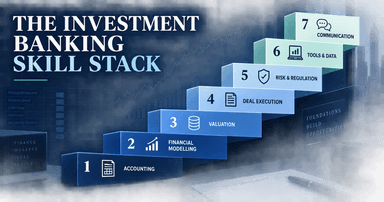
This is what actually gets you hired. Financial modelling (three-statement, DCF, LBO, M&A), valuation, and advanced Excel are the core. These are learned by building, not watching — a point worth taking seriously. For a full breakdown, see the skills you learn in an investment banking course, and for the single most important one, our guide to financial modelling.
Step 3 — Get certified or take a course
A recognised certification or program does three things: it structures the learning, it forces you to build a portfolio, and it provides placement support (mock interviews, resume help, recruiter connections). For working professionals, this is often the most efficient route in. Costs vary widely — see the section below on choosing a course, and check current fees on the pricing page.
Step 4 — Gain real experience
Internships, live projects, and a portfolio of models you can defend in an interview matter more than certificates alone. Off-cycle and boutique internships are realistic entry points. Build things you can show.
Step 5 — Network deliberately
Referrals drive a large share of finance hiring. Connect with professionals on LinkedIn, attend finance events, and engage with alumni networks while you study — not after. This is the step most candidates neglect and the one that most often makes the difference.
Step 6 — Apply and interview
Target analyst or associate roles at firms that match your route (boutiques and domestic firms are more accessible early). Prepare rigorously for technical questions — walking through a DCF, explaining valuation methods, discussing a deal. Practise with real investment banking interview questions.
Qualifications and eligibility: what's mandatory vs optional
There is no single mandatory qualification, but there is a common structure.
- Effectively requiredUndergraduate degreeB.Com, BBA (Finance), BA Economics, BAF or BMS
- Strong advantagePostgraduate degreeAn MBA in Finance — the classic accelerator, not mandatory
- Route-dependentProfessional qualificationsCFA, CA and FRM; NISM for Indian market roles
- Increasingly decisiveSkill certificationsFinancial modelling and IB certifications signal job-ready ability
- Undergraduate degree (effectively required): B.Com, BBA (Finance), BA Economics, BAF or BMS are the usual foundations. A finance-adjacent degree helps but isn't strictly required.
- Postgraduate degree (strong advantage, not mandatory): an MBA in Finance is the classic accelerator, especially for bulge-bracket roles.
- Professional qualifications (valuable, route-dependent): CFA, CA, and FRM build deep credibility. NISM certifications are relevant for Indian market roles.
- Skill certifications (increasingly decisive): financial modelling and IB certifications signal job-ready ability, which matters more than ever to recruiters.
A common question is whether to choose the CFA or an MBA or a focused course — they serve different goals and timelines. Our dedicated comparison of IB vs CFA vs MBA breaks down which fits which situation.
What investment banking pays in India
The earning potential is real, and it's what draws most people to the field. Here's the current, cited picture — with the honest caveat that these are market ranges, not guarantees, and individual offers vary sharply by firm, city and performance.
Lakhs per annum (LPA). Indicative market ranges, not guaranteed offers.
For a first-year analyst in 2026, starting compensation typically ranges from roughly ₹12–25 LPA at domestic firms and boutiques to ₹15–30 LPA at global bulge-bracket banks, with Mumbai analysts averaging around ₹15.6 LPA — meaningfully above other cities. Fresh graduates at boutique and mid-market firms often start lower, around ₹6–12 LPA. Mumbai pays roughly 20–30% more than other cities for the same role.
Compensation then scales steeply: associates into the ₹22–45 LPA range, vice presidents to ₹60–150 LPA at global banks, and managing directors to ₹3 crore or more at the top of the market. Base salary is 70–80% of an analyst's package; bonuses grow as a share of pay with seniority.
Sources: 2026 compensation data from Glassdoor, AmbitionBox, Indeed, and industry salary guides (Quintedge, Mentor Me Careers, Amquest). Figures are indicative ranges. For a full role-by-role breakdown, see our dedicated investment banker salary in India guide.
One thing the pay tables never show: the hours. Analyst and associate roles routinely involve 80–100 hour weeks during live deals. The compensation is a return on genuinely demanding work.
The honest challenges
Investment banking is one of the most competitive careers in Indian finance. Be clear-eyed about what you're signing up for:
- Intense competition. Thousands of qualified candidates compete for limited entry-level seats each year.
- Long hours. The 80–100 hour weeks are real, especially at junior levels in M&A and capital markets.
- High entry barriers at the top. Bulge-bracket firms often prefer premier-institute MBAs, CAs, or CFA-track candidates — which is exactly why the skills-and-portfolio route matters for everyone else.
- Continuous learning. Markets and regulations change constantly; the learning curve never fully flattens.
None of this is a reason not to pursue it — it's a reason to choose your route deliberately and build real, demonstrable capability rather than collecting credentials.
Do you need a course — and how to choose one?
You don't strictly need a paid course to become an investment banker, but for most graduates and career-switchers, a good one is the most efficient way to close the skills gap, build a portfolio, and get placement support. The question is how to choose one that's worth the fee.
Use these criteria to evaluate any investment banking program:
- Does it build front-office skills, or operations skills? Confirm which track it actually leads to.
- Do you build real models with feedback, or just watch videos?
- Is the regulatory content India-specific (SEBI, RBI, FEMA), not just Western frameworks?
- Do you get genuine tool access (Bloomberg, Capital IQ, advanced Excel)?
- Does the format fit a working professional (weekend/live classes, recordings)?
- Are outcome claims specific and conditional, rather than "guaranteed placement"?
Meritshot's PG Program in Investment Banking is built precisely around this best-fit route, and it's designed to meet all six criteria: a six-to-nine-month, nine-module program at ₹2,10,000 + GST, with weekend live classes that fit around a full-time job, 1:1 mentorship from practising bankers, front-office skills built on real deal case studies, genuine industry tools (Bloomberg, Capital IQ, advanced Excel), and India-specific SEBI/RBI/FEMA content. On cost, Meritshot has awarded scholarships of up to 90% to eligible, high-scoring candidates, assessed through a scholarship test and profile (with additional savings possible through resume-based offers, batch-closing discounts, referrals and seasonal offers) — so the effective fee for a strong candidate can be considerably lower than the sticker price. For a working professional or graduate weighing time, cost and outcome, that combination — job-ready in months rather than years, at a fraction of MBA cost — is why the certification-plus-skills route is the practical choice for most people. Judge it against the six criteria yourself, compare it to any alternative, and read learner outcomes such as our placement success stories to see what a realistic transition looks like.
Self-assessment: are you ready to start?
A quick honest check to find your next step:
- Do you have a finance foundation? If no → start with foundational finance and accounting before anything advanced.
- Can you build a three-statement model and a DCF from scratch? If no → this is your priority skill gap; a modelling-focused course closes it fastest.
- Do you have a portfolio you could show in an interview? If no → build 2–3 defensible models on real companies.
- Do you have contacts in the industry? If no → start networking on LinkedIn and at events this month.
- Is your target role front-office or operations? Decide, because it changes your whole route.
If you answered "no" to most of these, that's normal — it just means the certification + skills route (Step 1–5 above) is your realistic starting point. If you answered "yes" to most, you may be closer to applying than you think.
Frequently asked questions
How do I become an investment banker in India after graduation?
After graduation, the realistic path is to build technical skills (financial modelling, valuation, Excel), earn a recognised certification or take a focused IB program, build a portfolio of models, network deliberately, and target analyst roles — starting with boutiques and domestic firms, which are more accessible than bulge-bracket banks. An MBA in Finance accelerates the route but isn't mandatory.
Can I become an investment banker without a finance background?
Yes. Engineers, IT professionals and other non-finance graduates regularly move into investment banking by first closing the finance and modelling skills gap through a structured course, then building a portfolio and networking. Banks value analytical and quantitative ability, which technical backgrounds often already have.
How long does it take to become an investment banker in India?
It depends on your starting point. A focused certification-plus-skills route can take roughly one to two years to a first role; the MBA or CFA routes take two to five years including the qualification. There's no fixed timeline — it's driven by how quickly you build demonstrable skills and a network.
Do I need an MBA for investment banking?
No, an MBA is not mandatory, but it is a strong advantage — especially for bulge-bracket roles that recruit heavily from top B-schools. Working professionals and career-switchers who can't commit to a full-time MBA often use the certification-plus-skills route instead, which is faster and more affordable.
Is investment banking a good career in India in 2026?
For those who can handle the demands, yes. India's deal market is growing, compensation is among the highest in the country, and exit opportunities into private equity, corporate finance and consulting are strong. The trade-off is intense competition and long hours (80–100 hour weeks during live deals).
Which degree is best to become an investment banker?
At undergraduate level, B.Com, BBA (Finance) and BA Economics are the common foundations; at postgraduate level, an MBA in Finance is the classic choice. Professional qualifications like CFA and CA also build strong credibility. No single degree is required — demonstrable skills increasingly matter as much as the qualification.
What's the difference between investment banking and investment banking operations?
Front-office investment banking is the deal-making, client-facing analyst-to-MD track with the highest pay. Investment banking operations (KYC, settlements, reconciliation) support the business and are generally easier to enter but have a different, lower pay ceiling. Many "IB courses" actually train for operations roles, so confirm which track a program leads to before enrolling.
Your next step
Becoming an investment banker in India is demanding but achievable, and the route that fits you depends on where you're starting from. If you're a working professional or graduate, the practical next move is to close your skills gap and build a portfolio you can defend.
Salary and market figures are drawn from publicly reported 2026 compensation data and industry salary guides for India; they are indicative ranges, not guaranteed outcomes. Program details reflect information published on Meritshot's site and should be confirmed before enrolling.