Most people research an investment banking course by comparing fees, duration and placement claims. That's a reasonable start, but it skips the question that actually determines your return: what will you be able to do at the end that you can't do now?
This guide answers that directly. It breaks down the specific skills a serious investment banking course teaches — grouped the way the work is actually organised inside a bank, not as a random list. For each skill you'll see what you learn, what it looks like on a live deal, and how to judge whether you already have it or need to build it. The guidance reflects how serious, practitioner-led programs — the kind designed and taught by bankers who've actually executed deals — build these skills. You'll also find current India salary data, honest advice on what a course can't do for you, and a short self-check to work out where you stand.
It's written for working professionals in India — from finance, accounting, IT or analytics backgrounds — weighing whether an investment banking course after graduation or mid-career is worth the time and money.
The short answer: what an investment banking course teaches
The rest of this guide explains each of those, in the order you'd typically learn and use them.
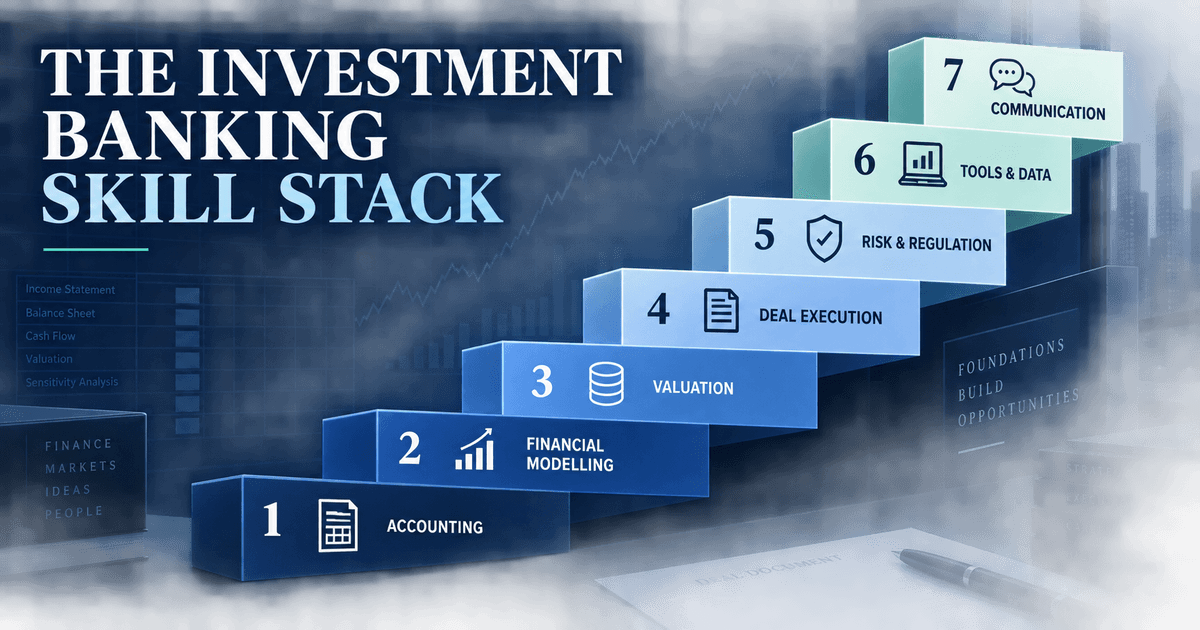
The IB Skill Stack: how these skills fit together
It helps to see the skills as a stack rather than a checklist, because each layer depends on the one below it. You can't value a company you can't model, and you can't model a company whose financial statements you can't read.
| Layer | Skill group | What it lets you do |
|---|---|---|
| 1. Foundation | Accounting & financial statement analysis | Read and interpret how a business actually performs |
| 2. Core craft | Financial modelling | Turn statements into a forward-looking model |
| 3. Judgement | Valuation | Decide what a business or deal is worth |
| 4. Application | Deal execution, M&A, due diligence | Apply modelling and valuation to a live transaction |
| 5. Guardrails | Risk, compliance & regulation | Keep the deal legal, sound and defensible |
| 6. Tooling | Excel, Bloomberg, Capital IQ, PitchBook | Do all of the above faster and more accurately |
| 7. Delivery | Communication, pitch books, presentation | Convince a client or committee to act |
A good course moves through these layers deliberately. Programs built by practising bankers — Meritshot's nine-module curriculum is one example — sequence learning this way, foundations first and advanced deal work later. Be cautious of any course that jumps straight to LBO modelling before confirming you can build a clean three-statement model; that ordering usually signals a curriculum built to impress rather than to teach.
Layer 1 — Accounting and financial statement analysis
What you learn: How the income statement, balance sheet and cash flow statement connect, and what they reveal about a company's profitability, solvency and liquidity. You'll cover revenue recognition, working capital, depreciation, and key ratios such as return on equity, debt-to-equity and current ratio.
What it looks like on the job: Before any model is built, an analyst reads a company's filings to understand where it makes money, where the risks sit, and whether the numbers are internally consistent. Analysts are expected to be financially literate and comfortable working with numbers, because errors here compound into every downstream model. A deep understanding of how the three statements interconnect underpins everything else you'll do.
This is the layer most self-taught learners underestimate. It isn't glamorous, but it is the single strongest predictor of whether your modelling will hold up under scrutiny.
Do you already have it? If you've prepared or audited financial statements (many CAs and accountants have), you're ahead. If your background is IT or analytics, this is usually the layer that needs the most work — not because it's hard, but because it's unfamiliar.
Layer 2 — Financial modelling
Financial modelling is the skill most often associated with investment banking, and for good reason: building detailed, flexible spreadsheet models to forecast performance and analyse deals is central to the job. A financial modelling course sits at the heart of almost every investment banking program.
What you learn:
- Three-statement models — linking the income statement, balance sheet and cash flow so a change in one assumption flows correctly through all three.
- DCF (discounted cash flow) models — forecasting a company's free cash flows and discounting them to a present value using the weighted average cost of capital (WACC).
- LBO (leveraged buyout) models — modelling how a private-equity buyer funds a large acquisition with debt and calculates its returns. This is especially relevant if you're interested in private equity.
- M&A / merger models — testing whether an acquisition adds to or dilutes the acquirer's earnings (accretion/dilution analysis).
- Scenario and sensitivity analysis — stress-testing your assumptions rather than trusting a single output.
What it looks like on the job: Analysts spend a large share of their time inside Excel, building and updating models that deal teams use to price transactions and advise clients. The skill isn't just constructing a model — it's building one that's clean, auditable, and easy for a senior banker to check.
A practical way to build it: Model one listed company end-to-end, then model a company in a different sector. You learn modelling far faster by building than by watching tutorials. A structured course accelerates this by giving you feedback on the models you build — which is the part that's almost impossible to replicate alone, and the reason small-batch programs with dedicated mentors tend to produce stronger modellers.
Layer 3 — Valuation
What you learn: How to answer "what is this company worth?" using the three standard methodologies, and — just as important — when each applies.
- DCF valuation: intrinsic value based on projected cash flows and WACC.
- Comparable company analysis (comps): valuing a company against listed peers using multiples such as EV/EBITDA or P/E, which requires careful peer selection and normalisation.
- Precedent transaction analysis: valuing against past M&A deals, adjusting for control premiums and deal timing.
What it looks like on the job: Valuation underpins almost every pitch and deal — bankers use it to justify pricing and strategy to clients. A real skill here is triangulation: no single method is "correct," so analysts run all three, then form a defensible view on which to weight most heavily and why. Being able to explain that reasoning is what separates someone who ran a model from someone who understands it.
Common test in interviews: You'll frequently be asked to walk through a DCF from memory or explain why two valuation methods disagree. Courses that include mock interviews — as Meritshot's does through its career-readiness module — prepare you for exactly this.
Layer 4 — Deal execution, M&A and due diligence
What you learn: How a transaction actually moves from idea to close — origination, structuring, valuation, negotiation, and closing — across mergers, acquisitions, IPOs and leveraged buyouts. You'll also learn structured due diligence: examining a target's financial, legal and commercial position to surface risks before money changes hands.
What it looks like on the job: Analysts support deal teams with research, models, and the documentation that keeps a transaction moving. Due diligence is where financial statement analysis and modelling meet real-world messiness — the numbers rarely arrive clean, and identifying what's missing is a skill in itself.
Where courses add real value: The strongest programs teach this through case studies of actual transactions rather than textbook exercises. Meritshot's program, for instance, has learners reconstruct the RJR Nabisco leveraged buyout, model Tesla's acquisition of SolarCity, value Airbnb ahead of its IPO, and dissect the WeWork valuation collapse. Working through real deals — with mentorship from practising bankers — builds the pattern recognition that generic exercises can't.

- 1UnderstandRead the company
- 2ModelForecast performance
- 3ValueTriangulate worth
- 4StructureShape the transaction
- 5DiligenceTest the assumptions
- 6DeliverClose and communicate
Layer 5 — Risk, compliance and regulation
What you learn: The rules and risk frameworks that govern how deals are done. In an India-focused course, this means the domestic regulatory landscape — SEBI (securities regulation), RBI (banking and monetary policy), and FEMA (foreign exchange and cross-border transactions) — alongside global standards such as the Basel accords on bank capital. On the risk side, you'll cover credit risk, market risk, and quantitative measures such as Value-at-Risk (VaR).
What it looks like on the job: Regulatory knowledge isn't a side topic — it shapes what's possible in a deal. Knowing the constraints early prevents structuring a transaction that can't actually clear. Compliance obligations such as KYC (know your customer) and AML (anti-money laundering) are part of daily banking operations.
A quick note on sourcing: this is an area where older or non-India course materials often mislead, citing only Western frameworks such as Dodd-Frank or MiFID II. Those matter for global context, but for a career in India, SEBI and RBI knowledge is far more immediately useful. Verify that any course you consider treats the Indian regulatory environment as primary — Meritshot's dedicated compliance and regulatory modules, for example, centre on SEBI, RBI, FEMA and Basel norms rather than treating them as an afterthought.
Layer 6 — Tools you'll actually use
Technical knowledge is delivered through a specific software stack. Fluency with these tools is often what makes a fresh analyst productive from day one.
| Tool | What it's for |
|---|---|
| Advanced Excel (+ VBA/macros) | The backbone of all modelling; automation speeds up repetitive work |
| Bloomberg Terminal | Real-time market data, pricing, and Excel integration for live models |
| Capital IQ / PitchBook | Company financials, comparables, and private-market intelligence |
| PowerPoint | Building pitch books and client presentations |
| Python / SQL (increasingly) | Data analysis, automation, and querying large financial datasets |
Programming is no longer only a "quant" skill. A working knowledge of Python or SQL gives analysts an edge in a data-heavy environment, though it remains optional at entry level for traditional IB roles. What's becoming non-negotiable in 2026 is the judgement to use AI-assisted tools well — knowing when an AI-generated output is wrong, and being able to defend every number without the tool.
Treat any course's tool list as a claim to verify: ask whether you get hands-on access or only a demonstration. Programs like Meritshot's build the stack in directly — Bloomberg Terminal, Capital IQ, PitchBook and advanced Excel with VBA — which is the difference between recognising a tool and actually using it under deal conditions.
Layer 7 — Communication and the human skills
Technical skill gets you shortlisted; communication gets you hired and promoted. This is the layer competing articles mention but rarely explain.
What you learn:
- Pitch books and deal documentation — structuring data visually and telling a financial story a client can trust. This is a large part of a banker's daily life, and analysts spend significant time formatting these presentations.
- Written communication — clear, concise memos and recommendations.
- Presentation and Q&A — defending your analysis under questioning.
The soft skills banks actually screen for: attention to detail (a small error in a model can have real consequences), analytical thinking, resilience under long hours, time management, and the ability to work in a team. Investment banking rewards a rare combination — the technical ability to do rigorous, accurate work and the personal qualities to handle pressure and earn a client's trust.
These skills are also the most transferable. The toolkit an IB course builds — modelling, valuation, analysis, communication — opens doors across private equity, corporate finance, consulting and senior finance roles, not just banking.
What an investment banking course can't do for you
Honesty here is rare in course marketing, so it's worth stating plainly.
- It can't guarantee a job. Any program promising a guaranteed salary or placement without conditions should be treated with scepticism. Placement support — mock interviews, resume help, recruiter connections — is real and valuable; a guaranteed outcome is a marketing claim, not a contract you should rely on.
- It can't replace repetition. A course gives you structure and feedback, but modelling fluency comes from building many models. The course shortens the path; it doesn't remove the work.
- It can't substitute for networking. Referrals still drive a large share of finance hiring. Start reaching out to professionals while you study, not after.
- It can't teach judgement overnight. Knowing which valuation method to weight, or what a due diligence red flag means, develops through exposure. Courses with real case studies compress this, but experience still matters.
Choosing a course: a quick decision framework
Rather than ranking providers, use these questions to evaluate any investment banking course against your own situation:
- Does the curriculum follow the skill stack? Foundations before modelling, modelling before advanced deal work.
- Do you build real models, or watch them being built? Hands-on modelling with feedback is the differentiator.
- Is the regulatory content India-specific? SEBI, RBI and FEMA should be central.
- Are the tools taught with real access? Bloomberg and Capital IQ exposure is only useful if you actually use them.
- Is the format compatible with your job? Working professionals need weekend or flexible schedules and recorded backup.
- Are the outcome claims specific and conditional, or vague and absolute? Specific, conditional claims are more trustworthy.
- Does the fee match the depth? A premium fee should buy mentorship, projects, small batches and real career support — not just recorded videos.
Where a leading program fits: Meritshot's PG Program in Investment Banking
To see the skill stack built deliberately, it helps to look at a program engineered around it. Meritshot's PG Program in Investment Banking is a nine-month, nine-module program designed for working professionals, moving through the stack in order — financial systems and Excel foundations, valuation, equity and derivatives, M&A and leveraged buyouts, startup and VC due diligence, and regulatory frameworks — before a capstone of analyst-grade portfolio projects.
Several features make it a useful benchmark for the depth a serious course should offer:
- Practitioner-led teaching. Its published instructor roster is drawn from advisory and financial-services firms — including managers at PwC, EY and Deloitte and M&A advisors from boutique firms — alongside senior finance academics. Curriculum built by people who've executed deals is a core credibility signal, and the reason a course's teaching quality tends to track its faculty's real-world experience.
- Real deal case studies. Rather than textbook scenarios, learners reconstruct actual transactions — Tesla–SolarCity, the RJR Nabisco LBO, the Airbnb IPO and the WeWork valuation collapse — plus a slate of hands-on projects spanning M&A, LBO modelling, IPO valuation, startup fundraising and portfolio risk. This is how Layer 4 judgement is built.
- Genuine tool access. The program covers the industry stack directly — Bloomberg Terminal, Capital IQ, PitchBook, advanced Excel and VBA — the Layer 6 fluency that makes a new analyst productive from day one.
- Small batches and 1:1 mentorship. Batches of 25–30 with a dedicated mentor mean real feedback on the models you build, delivered through weekend live classes with recorded lectures for revision.
- Recognised certification. Completion carries an NSDC-aligned certificate alongside a post-graduate program certificate.
- Role-mapped career support. The curriculum maps to specific destinations — investment banking analyst, equity research, private equity, corporate finance, risk and portfolio, and financial consulting — backed by placement support including mock interviews with hiring managers, resume development and recruiter connections.
On fees, Meritshot lists the program at ₹2,10,000 + GST, with no-cost EMI options — placing it in the premium, placement-supported tier rather than among low-cost self-paced certificates. Whether you choose this program or another, use the same combination as your bar: practitioner mentors, real deals, real tools, small batches and recognised certification.
Meritshot's work in professional upskilling has been covered by national outlets including ANI, DNA India and Amar Ujala.
Common mistakes when learning IB skills
- Chasing advanced skills first. Learners often want to jump to LBO models because they sound impressive. Without solid accounting and three-statement modelling underneath, advanced models produce confident-looking nonsense.
- Collecting certificates instead of building models. A certificate signals completion; a portfolio of models you can defend in an interview signals capability. Recruiters increasingly want the latter — which is why project-heavy programs tend to convert better into offers.
- Memorising instead of understanding. Being able to explain the logic behind a DCF beats reciting the formula. Interviewers probe for reasoning.
- Ignoring communication. Technically strong candidates get filtered out because they can't present their analysis clearly. Don't treat pitch-book and presentation skills as optional.
- Trusting outdated or non-India data. Salary and regulatory information from Western sources can mislead. Anchor your expectations to current Indian figures.
Why these skills are worth building: the India outlook
The skills above map onto a well-defined career ladder, and compensation in India has matured significantly over the past decade.
For a first-year analyst in 2026, starting compensation typically ranges from roughly ₹12–25 LPA at domestic firms and boutiques to ₹15–30 LPA at global bulge-bracket banks, with Mumbai analysts averaging around ₹15.6 LPA — meaningfully above the national figure. Broader entry-level ranges are wider still: fresh graduates across the market often start between ₹6 and ₹15 LPA depending on firm type, city and background.
These are indicative market ranges drawn from 2026 compensation data (Glassdoor, AmbitionBox, Indeed and industry salary guides), not guarantees — individual offers vary sharply by firm, team and performance. It's also worth knowing the trade-off upfront: the pay comes with 80–100 hour weeks during live deals. Compensation then scales steeply with seniority, into associate, vice-president and, eventually, managing-director levels.
The point for a skills-focused reader is this: the earning potential is real, but it's a return on the skills, not on the certificate. The market pays for people who can model, value and execute — which is exactly what the layers above describe, and exactly what a well-built program is designed to produce.
Practical takeaways
- Learn in the order the work is done: accounting → modelling → valuation → deals → risk → tools → communication.
- Prioritise building models with feedback over passively consuming content.
- For an India career, insist on India-specific regulatory content (SEBI, RBI, FEMA).
- Build a portfolio of defensible models, not just certificates.
- Treat communication and soft skills as core, not extras.
- Judge outcome claims by whether they're specific and conditional rather than absolute.
- Anchor salary expectations to current, cited India data — and factor in the hours.
Frequently asked questions
What skills do you learn in an investment banking course?
You learn financial statement analysis, financial modelling (three-statement, DCF, LBO and M&A models), business valuation, deal execution and due diligence, risk and regulatory knowledge (SEBI, RBI, Basel), industry tools (advanced Excel, Bloomberg, Capital IQ), and communication skills such as pitch-book creation and presentation. Together these let you analyse companies and support live transactions the way a junior banker does.
Is financial modelling the most important skill in investment banking?
Financial modelling is the most heavily used technical skill and sits at the core of the job, but it isn't sufficient on its own. It depends on solid accounting underneath it and is only useful when paired with valuation judgement and the communication skills to present your conclusions. Firms expect the full stack, not modelling in isolation.
Can I learn investment banking skills online?
Yes. Reputable providers in India offer online and weekend-format investment banking courses designed for working professionals, combining live classes, recorded lectures and hands-on modelling practice — Meritshot's nine-month program is structured this way. The key is ensuring the online format still includes real feedback on models you build and genuine access to tools, rather than passive video alone.
Do I need to know coding for investment banking?
Not for most traditional entry-level IB roles. A working knowledge of Python or SQL is increasingly valued for data-heavy work and gives you an edge, but it remains optional at the analyst level. Advanced Excel is far more essential than any programming language.
Is an investment banking course worth it after graduation?
It can be, if it builds genuine, demonstrable skills and fits your background. For graduates without a finance foundation, a structured course compresses the accounting-to-modelling learning curve and provides case-study exposure that's hard to get alone. Judge value by curriculum depth, hands-on practice and honest, conditional outcome support — not by placement guarantees.
How much does an investment banking course cost in India?
Fees vary widely by provider, format and depth — from low-cost self-paced certificates to premium instructor-led programs with mentorship and placement support. As a reference point in the premium tier, Meritshot's PG Program in Investment Banking is listed at ₹2,10,000 + GST with no-cost EMI options. Rather than choosing on price alone, weigh the fee against curriculum depth, live mentorship, hands-on projects, batch size and career support, and confirm current fees directly with each provider.
What's the difference between a financial modelling course and a full investment banking course?
A financial modelling course focuses narrowly on building models in Excel — a single (if central) layer of the skill stack. A full investment banking course covers modelling plus accounting foundations, valuation, deal execution, due diligence, regulation and communication. If you already have strong accounting and just need modelling reps, a focused modelling course may suffice; if you're building the whole capability, you need the broader program.
Salary and market figures cited above are drawn from publicly reported 2026 compensation data and industry salary guides for India; they are indicative ranges, not guaranteed outcomes. Program details for Meritshot reflect information published on its program page and should be confirmed with the provider before enrolling.