By Anupam Dixit, Trainer -Financial Modelling| Fin markets| Derivatives| Excel| BFSI | Finance for Non Finance | Microsoft Certified Excel Expert, 20+ yrs cross functional experience. MBA | MS.Finance | CFA(ICFAI) | CWM Published: 23 September 2026 · Reading time: ~15 minutes
A trade takes milliseconds to match and a full business day to finish. Everything in that gap is the trade life cycle, and it is where most capital markets jobs actually are.
This guide walks all ten stages as they work in India in 2026 — who owns each, what breaks, and who fixes it. It is written for people who need to explain this process rather than merely recognise it: candidates preparing for trade operations interviews, business analysts scoping post-trade systems, and finance graduates deciding whether this is the part of the market they want.
What makes it different: India now runs the fastest settlement cycle of any major equity market, and much of the trade life cycle content online has not caught up. Guides written for US or European markets describe a rhythm India abandoned in January 2023, and some Indian material still repeats it. Every timing here reflects the current cycle, with the regulatory source cited.
What is the trade life cycle?
The trade life cycle is the end-to-end process a security transaction passes through, from order placement to final settlement and reconciliation. In India it runs across ten stages spanning three operational areas: the front office creates and executes the order, the middle office validates and confirms it, and the back office clears, settles and reconciles it.
Indian equities settle on T+1 — funds and securities exchange one business day after the trade. Since 31 January 2025 an optional T+0 same-day cycle has also been available for the top 500 listed stocks.
Execution is the fastest part of the equity trade life cycle. Almost all of the operational work, and effectively all of the operational risk, sits after it. The industry term for everything downstream of execution is post trade processing.
Front office, middle office and back office: who owns what
Worth settling early, because the terminology misleads people into applying for the wrong jobs.
Trade operations is securities operations — middle and back office. It is not front-office investment banking. A front-office banker in M&A or capital markets advises clients on transactions and does not run settlement. The two share an industry and very little else: different entry routes, different daily work, different compensation.
That is not a ranking. Operations is a substantial profession with a clear ladder, and considerably more accessible from a commerce degree than front-office banking. But choose it deliberately, because a fair amount of Indian training marketing blurs the line.
| Front office | Middle office | Back office | |
|---|---|---|---|
| Owns | Order generation, execution | Validation, risk, affirmation, confirmation | Clearing, settlement, reconciliation |
| Typical roles | Trader, sales trader, dealer | Trade support analyst, risk analyst | Settlements analyst, reconciliations analyst, corporate actions analyst |
| Measured on | P&L, execution quality | Breaks caught before settlement | Settlement rate, breaks cleared, deadlines met |
Middle office vs back office, put simply: the middle office stops bad trades reaching settlement; the back office makes good trades settle. The middle office is preventive, the back office is executional, and the two together are what most people mean by trade operations.
The settlement cycle in India: T+2 to T+1 to T+0
This is the part that dates other guides, so it is worth being precise.
India completed its move to a mandatory T+1 settlement cycle in January 2023, phased in from February 2022, making it the first major equity market to run T+1 across the board. The United States did not complete the same transition until May 2024.
SEBI introduced an optional T+0 cycle in beta on 28 March 2024, covering 25 scrips through a limited set of brokers.
A SEBI circular of December 2024 widened optional T+0 to the top 500 stocks by market capitalisation, effective 31 January 2025, phased at roughly 100 scrips a month from the bottom of that list upward.
What is T+0 settlement?
T+0 settlement means funds and securities are exchanged on the same day the trade is executed, rather than the next business day. In India it is optional and runs alongside T+1 rather than replacing it. Trades executed within a defined intraday window settle that day, with the securities and funds legs completing before the market closes.
It is available on the top 500 listed stocks and is sometimes described as same day settlement India in market commentary.
(Reported 2026 status — that T+0 is operational across the full top 500 and may extend further — comes from market commentary rather than a SEBI circular verified here. Treat the 2026 expansion as reported rather than confirmed, and check SEBI's circulars page before relying on it in an interview.)
Why the compression matters operationally, which no competing page explains.
Under T+2, an operations team had a full working day between trade date and the day before settlement to find and fix problems. Under T+1 that buffer is gone. Affirmation, confirmation and exception handling that used to sit on T+1 now happen on trade date, often within hours of the close. Under T+0 the window collapses into the same session.
Compression does not change the stages. It changes which errors are recoverable. A mismatch caught at 6pm on trade date is an inconvenience. The same mismatch found at 9am the next morning is a settlement failure with a cost attached.
Which rules actually govern this
For a trade executed on an Indian exchange, the governing framework is Indian.
SEBI sets the settlement cycle, margin framework and reporting obligations. The exchanges (NSE, BSE) set trading rules. The clearing corporations — NSE Clearing Limited and Indian Clearing Corporation Limited — set clearing and default-handling rules including the auction process. The depositories, NSDL and CDSL, govern movement of securities. Anti-money laundering obligations flow from the Prevention of Money Laundering Act and SEBI's implementing circulars.
Basel III, SEC rules and MiFID II appear in a good deal of Indian trade operations content, and they matter — to different things. Basel III governs bank capital adequacy, not equity settlement. SEC rules govern US markets, MiFID II European ones. They become relevant if you work at a global capability centre supporting overseas desks, which many Indian operations professionals do. They do not govern a trade on the NSE.
If an interviewer asks which regulations apply to Indian equity settlement and the answer begins with the SEC, the interview is effectively over.
The ten stages of the trade life cycle
1. Order generation
A client instructs a broker to buy or sell. Retail through an app or terminal; institutional via a relationship manager, sales trader, or electronically through an order management system. Owner: front office · Timing: T · Fails when: the instruction is incomplete — quantity, limit price or account unclear.
2. Pre-trade compliance and risk checks
Before the order reaches the exchange, systems verify sufficient funds or margin, confirm the order sits within price and quantity limits, and check it breaches no regulatory or internal restriction. Owner: front office systems, middle office oversight · Timing: T, pre-execution · Fails when: margin falls short, or an order breaches a client mandate and should never have routed.
3. Execution
The order routes to NSE or BSE and matches. This is the millisecond part. Owner: front office · Timing: T · Fails when: partial fills, or a disputed execution price.
4. Trade capture and enrichment
The executed trade is booked and enriched with everything needed downstream — client account, settlement instructions, custodian details, brokerage, statutory charges. Owner: middle office · Timing: T · Fails when: this is where most settlement problems are born. A wrong standing settlement instruction at capture surfaces as a failed delivery a day later, by which point it is expensive.
5. Affirmation and confirmation
Both sides check they agree on what was traded. Owner: middle office · Timing: T, and genuinely urgent under T+1 · Fails when: counterparties disagree on quantity, price or settlement date.
6. Clearing
The clearing corporation steps between buyer and seller as central counterparty. NSE Clearing Limited clears NSE trades; Indian Clearing Corporation Limited clears BSE trades. The CCP novates the trade, becoming buyer to every seller and seller to every buyer. Owner: clearing corporation, back office support · Timing: T · Fails when: margin falls short against the CCP.
7. Netting and obligation determination
Rather than settling every trade individually, the clearing corporation nets positions and issues one net obligation per security and per fund leg. Owner: clearing corporation · Timing: T.
8. Settlement: pay-in and pay-out
The actual exchange. Securities move through NSDL or CDSL, funds through clearing banks, the two legs linked by delivery versus payment. Owner: back office, executed through depositories and clearing banks · Timing: T+1, or same day under optional T+0 · Fails when: short delivery or funds shortfall.
9. Exception handling
Where a quiet job becomes a difficult one. Short delivery, funds shortfall, mismatched settlement instructions, trades held for corporate action adjustment. Owner: back office · Timing: T+1 · Why it matters: under a compressed cycle, exceptions resolve in hours rather than days.
10. Reconciliation, books and reporting
Positions and cash reconciled across internal records, custodian statements and depository records. Discrepancies — breaks — investigated and cleared. Books updated, corporate actions applied, regulatory reporting completed. Owner: back office · Timing: T+1 onward · Fails when: breaks age. A break not cleared quickly becomes considerably harder to explain.
Clearing vs settlement: the difference
Clearing determines what each party owes and interposes a central counterparty between buyer and seller. Settlement is the actual exchange of securities and funds. Clearing comes first and establishes the obligation; settlement discharges it.
The two are frequently used interchangeably and are not interchangeable. In the clearing and settlement process, clearing is where risk is managed and obligations are calculated; settlement is where assets move.
What is netting?
Netting is the process by which a clearing corporation offsets a member's buy and sell positions in the same security, leaving a single net obligation to deliver or receive.
A member who bought 10,000 shares and sold 7,000 of the same security delivers or receives the net 3,000 rather than settling both legs. The same applies to funds.
The effect is large. Netting sharply reduces the volume of movements the settlement system must process, which is most of why settlement is manageable at all at Indian market volumes. Interviewers ask about it for exactly that reason.
What is delivery versus payment (DVP)?
Delivery versus payment links the two legs of settlement so that securities transfer only if funds transfer. Neither side can be left having delivered without being paid.
In the Indian trade settlement process, the securities leg runs through NSDL or CDSL and the funds leg through clearing banks, with the clearing corporation ensuring both complete together. DVP removes principal risk — the risk of losing the full value of a transaction because one leg settled and the other did not.
Trade affirmation vs trade confirmation
These are different things and candidates mix them up constantly.
Affirmation is the operational check in which both sides verify that trade details match. For institutional trades, the custodian affirms before accepting the settlement obligation.
Confirmation is the legal record of the agreed terms. For a retail client in India, the contract note is the confirmation.
Affirmation is a process; confirmation is a document. Under T+1 both must happen on trade date, which is why the middle office day now ends later than it used to.
Short delivery and auction settlement
Short delivery occurs when a seller fails to deliver the securities due at settlement.
When it happens, the clearing corporation conducts an auction — buying the securities in the open market and delivering them to the buyer, with the cost charged to the defaulting seller. Where the auction cannot source the securities, the obligation is closed out financially at a penalty rate.
The buyer is protected throughout. That is the point of the central counterparty: the buyer's position is guaranteed by the CCP regardless of whether the original seller performs.
Short delivery and auction settlement is the single most common exception scenario put to candidates in trade operations interviews, and the one most poorly answered.
The failure-mode map
Most guides list the stages. Fewer explain where the work actually goes. In an operations role this table is closer to the job description than the stage list is.
| Stage | What goes wrong | Who catches it | Cost of missing it |
|---|---|---|---|
| Pre-trade checks | Margin shortfall; mandate breach | Automated limits, middle office | Rejected order, or a compliance incident |
| Trade capture | Wrong settlement instruction; missing custodian | Middle office at enrichment | Failed delivery, auction cost, client escalation |
| Affirmation | Counterparties disagree on economics | Middle office, custodian | Unsettled trade; same-day escalation under T+1 |
| Clearing | Margin shortfall against the CCP | Clearing corporation | Penalty, position square-off |
| Settlement | Short delivery; funds shortfall | Back office, clearing corporation | Auction cost charged to the defaulter |
| Reconciliation | Break between internal and custodian records | Back office | Ageing break; audit and regulatory exposure |
The pattern worth noticing: the cheapest place to catch an error is stage 4, and the most expensive place to discover it is stage 8. Almost everything a good operations analyst does is pulling detection earlier.
One trade, all the way through
An institutional client instructs a broker at 10:15 on a Tuesday to buy 50,000 shares of a listed company. Pre-trade checks confirm margin. The order routes to the exchange and fills in two tranches by 10:22.
By mid-afternoon the trade is captured and enriched — client account, custodian, standing settlement instruction, brokerage and statutory charges. The custodian affirms that evening. The contract note issues.
The clearing corporation novates the trade and nets the broker's obligations across the day. Wednesday morning, pay-in and pay-out run: funds move through the clearing bank, 50,000 shares move through the depository, delivery versus payment ensuring both legs complete together.
Wednesday afternoon, reconciliation confirms the position against the custodian statement. No break.
Elapsed time from instruction to settled position: roughly 24 hours across two business days. Execution accounted for seven minutes.
Had the standing settlement instruction been wrong at capture on Tuesday, the failure would have surfaced Wednesday morning — and the fix would have involved an auction, a cost, and a conversation with the client.
Trade operations jobs in India
Roles that sit directly on this process:
- Trade support analyst — affirmation, confirmation, exception queries, front-office support. The most common entry point into the middle office.
- Settlements analyst — pay-in and pay-out, failed trades, auction handling.
- Reconciliations analyst — breaks between internal, custodian and depository records.
- Corporate actions analyst — dividends, splits, mergers and their effect on in-flight trades.
- Client onboarding and KYC — adjacent, and a common way in.
- Business analyst, capital markets — specifying the systems that run all of the above.
Employers include custodian banks, global capability centres of international banks, domestic brokers, clearing members, asset managers and the fintechs building post-trade systems. Investment banking operations at a GCC is one of the larger employers of this skill set in India.
Entry routes are genuinely open to commerce, finance and economics graduates, and to people moving across from banking operations or accounting. Unlike front-office banking, this does not depend on a target-school recruitment pipeline. What it requires is demonstrable understanding of the process — which is exactly what an interviewer probes.
Is trade operations a good career? It is an accessible entry into capital markets with a defined ladder: trade support into settlements or reconciliations, then into corporate actions, risk, compliance or product. It is middle and back office work rather than front-office investment banking, and worth choosing on that basis rather than by accident.
On compensation, honestly: published figures for these roles vary widely by employer type and city, and aggregator averages are unreliable at small sample sizes. Research ranges for the specific role and employer you are targeting, and treat any provider quoting you an expected salary with caution.
Common mistakes
Learning the stages without the exceptions. Anyone can recite ten stages. Interviews turn on what happens when a trade does not settle.
Learning a T+2 process. A surprising amount of available material, including some training content updated as recently as 2026, still describes T+2 or T+3. India left that cycle in January 2023.
Confusing clearing with settlement. Clearing determines obligations and interposes the CCP. Settlement is the exchange.
Confusing affirmation with confirmation. Affirmation is a process. Confirmation is a document.
Citing SEC or MiFID II for an Indian trade. They govern other markets.
Assuming this is front-office investment banking. It is not, and applying as though it is wastes everyone's time.
Practical takeaways
- Learn the cycle by timing, not by list. For each stage, know what must happen by when. That survives contact with an interviewer; a memorised sequence does not.
- State the current settlement position precisely — T+1 mandatory, T+0 optional for the top 500 stocks since 31 January 2025 under SEBI's December 2024 circular.
- Be able to walk one failure end to end. Short delivery is the canonical example: what happens, who bears the cost, how the auction works.
- Name the infrastructure correctly. NSE Clearing and ICCL clear; NSDL and CDSL move securities; clearing banks move funds. Mixing these up signals inexperience faster than anything else.
- Decide between operations and front office before spending money on training. They require different preparation.
Frequently asked questions
What is the trade life cycle? The end-to-end process a security transaction passes through, from order generation to final settlement and reconciliation. In India it runs across ten stages spanning the front office (order and execution), middle office (validation and confirmation) and back office (clearing, settlement and reconciliation).
What are the stages of the trade life cycle? Order generation, pre-trade compliance and risk checks, execution, trade capture and enrichment, affirmation and confirmation, clearing, netting and obligation determination, settlement pay-in and pay-out, exception handling, and reconciliation and reporting.
What is T+1 settlement? Funds and securities are exchanged one business day after the trade date. India completed its transition to a mandatory T+1 cycle in January 2023, the first major equity market to do so. The United States completed the same move in May 2024.
Does India have same-day settlement? Yes, optionally. SEBI introduced a T+0 beta on 28 March 2024 for 25 scrips, and a December 2024 circular widened optional T+0 to the top 500 stocks from 31 January 2025, phased monthly. It runs alongside T+1 rather than replacing it.
What is the difference between clearing and settlement? Clearing determines what each party owes and interposes a central counterparty. Settlement is the actual exchange — securities through the depository, funds through clearing banks. Clearing comes first.
What is netting in clearing? The clearing corporation offsets a member's buy and sell positions in the same security, leaving one net obligation rather than settling every trade individually. It sharply reduces the volume of movements the settlement system must process.
What is delivery versus payment? DVP links the two legs of settlement so securities transfer only if funds transfer. It removes principal risk — the risk of delivering without being paid.
What happens if a seller fails to deliver shares? This is short delivery. The clearing corporation conducts an auction, buying the securities in the market and delivering them to the buyer, with the cost charged to the defaulting seller. Where the auction cannot source them, the obligation is closed out financially at a penalty rate.
What is the difference between trade affirmation and trade confirmation? Affirmation is the operational check in which both sides verify details match. Confirmation is the legal document recording agreed terms — for a retail client in India, the contract note.
What does a trade support analyst do? Trade support analysts sit in the middle office handling affirmation and confirmation, investigating exceptions and supporting the front office on trade queries. Under a compressed settlement cycle, much of the role is identifying and resolving problems on trade date.
What is the difference between middle office and back office? The middle office stops bad trades reaching settlement — validation, risk, affirmation. The back office makes good trades settle — clearing, settlement, reconciliation. Preventive versus executional.
Is trade operations a good career in India? It is an accessible entry into capital markets for commerce and finance graduates, with a defined path through settlements, reconciliations and corporate actions into risk, compliance or product roles. It is middle and back office work rather than front-office investment banking.
Do I need a finance degree to work in trade operations? Most employers require a graduate degree, commonly commerce, finance or economics, though other disciplines are frequently accepted. What matters more at entry level is demonstrable understanding of the settlement process and the ability to reason through an exception.
Where to go from here
If you want to work in this part of the market, the useful next step is not more reading — it is being able to walk someone through the cycle, exceptions included, without notes.
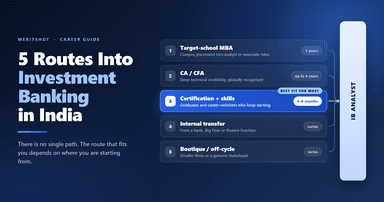
Meritshot's PG Program in Investment Banking covers capital markets, corporate transactions, due diligence and the compliance and regulatory framework that governs settlement, taught live by practitioners and assessed on applied work rather than recall. To place this operations path beside the other routes, plan an investment banking career from the ground up.
Explore the curriculum and speak with a counsellor →