By Muskan Nagpal, Manager at Meritshot Published: 23 September 2026 · Next review: December 2026 · Reading time: ~16 minutes
What's in this article
- Investment banking courses in India: fees at a glance
- Which are the top investment banking courses in India?
- What do these terms actually mean?
- Why pursue investment banking in India?
- How do I choose the right programme?
- Frequently asked questions
Investment banking courses in India: fees at a glance
Investment banking course fees in India range from around ₹35,000 for short exchange-linked certifications to over ₹1,60,000 for full operations programmes, with residential postgraduate programmes higher still. Here is the whole field in one table.
| # | Course | Provider | Duration | Indicative fee | Focus |
|---|---|---|---|---|---|
| 1 | PG Program in Investment Banking | Meritshot | 6–9 months, weekend live classes | ₹2,10,000 + GST | AI + finance integration |
| 2 | Certified Investment Banking Operations Professional (CIBOP) | Imarticus Learning | ~150 hrs (3 mo full-time / 6 mo part-time) | ₹1,40,000–₹1,60,000 | Operations |
| 3 | Financial Modelling & Valuation | The Wall Street School | 8 weeks full-time / 3.5 mo weekend | From ₹50,000 + GST | Modelling |
| 4 | Certificate in Investment Banking | NSE Academy | ~95 hrs | ~₹35,000 | Foundations |
| 5 | Advanced Certificate in Investment Banking | BSE Institute | ~7 months | Contact provider | M&A, capital markets |
| 6 | PG Program in Investments & Securities Markets | NISM | 1 year residential | Verify on official site | Securities markets |
| 7 | Financial Modeling & Investment Banking | EduPristine | ~100 hrs | ₹70,000–₹1,20,000 | Modelling |
| 8 | Investment Banking Operations | IMS Proschool | ~4 months | ₹1,20,000–₹1,50,000 | Operations |
| 9 | Financial Modeling & Valuation Analyst (FMVA) | CFI | Self-paced | From ~US$125 | Modelling |
| 10 | Investment Banking Certificate | NYIF | ~70 hrs | ~US$2,690+ | International |
Fees, formats and batch details change regularly. Everything above reflects publicly available information at the time of writing. Verify current pricing on each provider's own site before enrolling — nothing here is a quotation.
Which are the top investment banking courses in India?
1. PG Program in Investment Banking — Meritshot
Meritshot's PG Program in Investment Banking is built around what an analyst actually does rather than around theory — valuation, financial modelling, comparable company analysis, transaction structuring and deal documentation.
Sessions at Meritshot are live and taught by practitioners working in the field, which is where the judgement calls come from — why a team chose one comparable set over another, what breaks in a model under scrutiny, what a hiring manager actually probes in a technical round.
The programme is AI-integrated rather than AI-labelled. Alongside the core finance curriculum, Meritshot learners work with AI-assisted document and comparables analysis and the confidentiality constraints that govern its use in regulated finance. That second half matters more than it sounds: deal information cannot go into a public tool, and understanding why is a professional competency in banking in a way it is not elsewhere.
Career support at Meritshot includes resume and profile work, mock interviews with practitioners, aptitude and interview preparation, and referrals to hiring partners. As with every provider on this list, that is placement assistance rather than a job guarantee — hiring decisions rest with employers.
- Duration: 6–9 months, with live weekend classes
- Fees: ₹2,10,000 + GST, with scholarships of up to 90% and no-cost EMI options
- Key highlights: Lifetime access to study materials, lifetime career support, guaranteed internships at MNCs, guaranteed interviews, and AI + finance integration
- Best for: Working professionals
2. Certified Investment Banking Operations Professional (CIBOP) — Imarticus Learning
One of India's best-known finance certifications, CIBOP focuses on investment banking operations — trade lifecycle, securities and derivative products, risk, reconciliation and compliance. It is a well-established entry route into middle and back-office roles at global banks, supported by a substantial hiring-partner network.
- Duration: ~150 hours; commonly 3 months full-time or 6 months part-time
- Fees: Widely reported at ₹1,40,000–₹1,60,000, varying by mode and location
- Best for: Commerce and finance graduates targeting operations, treasury and clearing roles
3. Financial Modelling and Valuation — The Wall Street School
A long-established name in Indian finance training, with a curriculum centred on financial modelling, valuation and Excel-based practical work. The emphasis is hands-on, and the modelling skill transfers across investment banking, equity research and corporate finance.
- Duration: ~8 weeks full-time (~240 hrs) or 3.5 months weekend (~170 hrs)
- Fees: From around ₹50,000 + GST
- Best for: Learners wanting strong modelling capability at a lower price point
4. Certificate in Investment Banking — NSE Academy
Run by the educational arm of the National Stock Exchange, covering foundations including M&A, valuation and financial modelling. The exchange affiliation carries recognition in Indian finance, and the price point makes it among the more accessible structured options.
- Duration: ~95 hours
- Fees: ~₹35,000
- Best for: Beginners wanting an exchange-linked credential without a large commitment
5. Advanced Certificate in Investment Banking — BSE Institute
Runs longer than most certifications, covering M&A, financial advisory and capital markets in greater depth. Suits learners wanting a substantial exchange-affiliated qualification rather than a short course.
- Duration: ~7 months
- Fees: Not consistently published — contact the institute directly
- Best for: Learners wanting a longer, comprehensive exchange-linked programme
6. PG Program in Investments & Securities Markets — NISM
NISM is the educational initiative of SEBI, which gives this programme standing few others match. A full-time residential postgraduate year covering securities markets, investments and capital markets, with genuine depth on trading and securities.
- Duration: 1 year, residential
- Fees: Tuition and residential costs charged separately — verify on the official NISM page
- Best for: Graduates able to commit to a full-time residential year
7. Financial Modeling and Investment Banking — EduPristine
Practical-heavy, starting from company valuation and building through financial modelling, with hands-on work in Excel and PowerPoint. Long-running, with a reasonable footprint across Indian cities.
- Duration: ~100 hours
- Fees: Reported at ₹70,000–₹1,20,000; confirm directly, as a fixed figure is not always published
- Best for: Learners wanting tool-based practical training
8. Investment Banking Operations — IMS Proschool
Trains learners for middle and back-office roles, covering reconciliation, risk management, settlements and compliance. Open to finance and commerce backgrounds, with hands-on project work.
- Duration: ~4 months
- Fees: Reported at ₹1,20,000–₹1,50,000 depending on package
- Best for: Graduates entering operations-focused roles
9. Financial Modeling & Valuation Analyst (FMVA) — CFI
A globally recognised certification in financial modelling and valuation, delivered self-paced. Useful across investment banking, equity research and corporate finance, and among the most cost-effective recognised credentials available — though without live instruction or placement support.
- Duration: Self-paced
- Fees: Subscription pricing, typically from ~US$125 depending on plan; INR cost varies with exchange rate and taxes
- Best for: Self-directed learners wanting a recognised international credential
10. Investment Banking Certificate — New York Institute of Finance
Structured online training spanning finance fundamentals through M&A, valuation, fund management and capital markets. The name carries international weight, though pricing is in dollars and considerably higher than most Indian options.
- Duration: ~70 hours
- Fees: Programme-dependent, reported at ~US$2,690 and above
- Best for: Learners wanting an international credential and able to bear the cost
What do these terms actually mean?
"Investment banking course" describes at least three different products in India, leading to three different careers. Knowing which is which is the most useful thing on this page.
| Term | What it means |
|---|---|
| Front office | Deal origination and execution — pitching, comparable company analysis, valuation, M&A, capital raising. The most competitive entry point in Indian finance. |
| Middle / back office (operations) | Supporting deal and trade execution — trade lifecycle, settlements, reconciliation, KYC and AML, risk and compliance. A genuine, well-trodden entry route into banking from a commerce or finance degree. |
| Financial modelling | A skill rather than a department. Used across investment banking, equity research, corporate finance, FP&A and private equity. |
| Placement assistance | Preparation, portfolio work, mock interviews and referrals to hiring partners. Not a guarantee of employment, job role or salary — at Meritshot or anywhere else. |
| Hiring partner | A company in a provider's network that may hire. Not a commitment by that company to interview or employ any individual learner. |
Several well-known Indian programmes are operations programmes, which their own naming makes clear — Imarticus's CIBOP and IMS Proschool's Investment Banking Operations both say so directly. That is not a criticism; operations is a real, stable, well-paid career and a recognised internal route into other parts of a bank. It is simply a different career from front-office banking, and worth choosing deliberately.
Why pursue investment banking in India?
India's investment banking sector is both expanding and professionalising, and the regulatory direction confirms it.
In December 2025, SEBI overhauled the Merchant Bankers Regulations, introducing a capital adequacy framework and a two-category structure: Category 1 firms require a net worth of at least ₹50 crore and may undertake all permitted activities, while Category 2 requires at least ₹10 crore and may undertake all except managing main-board equity issues. Regulators do not build frameworks like that around shrinking industries.
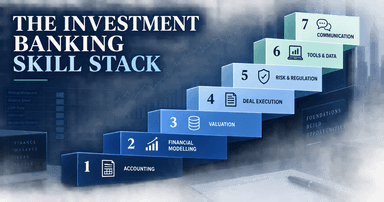
The career also compounds unusually well. The technical foundation — accounting, valuation, modelling, deal structuring — transfers across investment banking, private equity, equity research, corporate development and corporate finance. Few skill sets in finance carry as broadly.
What has changed recently is the tooling. AI now assists with a large share of the document-heavy analyst workload: comparables screening, filing analysis, first-draft pitch materials, data room review. Banking's adoption has a distinctive shape, though — research from Evident Insights, which tracks AI deployment across the world's largest banks, has found that the overwhelming majority of banking generative AI use cases are restricted to internal functions rather than customer-facing ones, precisely because deal information cannot leave controlled systems.
What has not changed is accountability. An analyst who cannot spot an invented figure in an AI-generated summary is not faster — they are riskier. That is why the stronger programmes now teach the tools and their failure modes together, and it is a reasonable thing to ask any provider about.
How do I choose the right programme?
Work through these in order. The first question eliminates most of the field.
1. Which career do you actually want? Front office, operations, or modelling as a transferable skill. Until you can answer this, comparing fees will not help.
2. Does the curriculum match? Read the module list, not the landing page. A programme heavy on trade lifecycle, settlements and reconciliation is an operations programme whatever it is titled.
3. What is the total cost? Fee, plus GST if extra, plus interest if you are financing. Ask for the total repayable, not the monthly instalment.
4. Can you attend the format? Live or recorded, weekday or weekend, hours per week. A programme you cannot attend is not cheaper for going unattended.
5. What does career support concretely include? Not the phrase "placement assistance" — how many interview opportunities, arranged how, with what kind of employer. In writing.
6. What does the refund policy say? Read it before paying. Windows in this sector are narrow and differ substantially between providers.
7. Can you speak to recent alumni you found yourself? Not only those the institute introduces. Ask how long after finishing they got an offer, and how many interviews were actually arranged.
8. What does the programme not do? Ask directly. A provider that answers this readily is telling you more than one that lists only benefits.
Frequently asked questions
What is the fee for an investment banking course in India? Fees range from around ₹35,000 for short exchange-linked certifications to ₹1,40,000–₹1,60,000 for full operations programmes. Modelling-focused courses commonly start around ₹50,000 plus GST. Residential postgraduate programmes and university degrees cost considerably more. Verify current pricing directly with each provider.
Which is the best investment banking course in India? There is no single best course — the right choice depends on which career you want, your budget and the format you can commit to. A learner targeting operations roles is best served by an operations programme; one wanting modelling capability across finance roles is better served by a modelling certification. Match the programme to the role first.
What is the eligibility for an investment banking course? Most programmes accept graduates from any discipline, though commerce, finance and economics backgrounds help with the accounting fundamentals. Some advanced programmes require prior finance experience. Check requirements for the specific programme you are considering.
How long does an investment banking course take? Short certifications run roughly 70–240 hours, typically over 2–4 months. Operations programmes usually run 3–6 months depending on format. Residential postgraduate programmes such as NISM's run a full year.
Can I do an investment banking course after graduation? Yes. Most certification programmes are designed for recent graduates, and several — including operations programmes — recruit directly from that pool. A commerce or finance degree helps but is not always required.
Can I do an investment banking course while working full-time? Yes. Most providers offer weekend or evening batches for working professionals. Confirm the schedule and the expected weekly commitment before enrolling, and check whether recorded sessions count toward any attendance requirement.
Do investment banking courses include placement support? Many include placement assistance — resume support, mock interviews, and referrals to hiring partners. This is not a job guarantee. Ask exactly what is included, how many interview opportunities are typical, and get the answer in writing.
Do any investment banking courses guarantee placement? Treat guarantees carefully. Hiring decisions rest with employers, and the Central Consumer Protection Authority's Guidelines for Prevention of Misleading Advertisement in Coaching Sector, 2024 expressly prohibit job security promises, assured admissions and guaranteed selections in advertising. Where a guarantee is offered, ask to see the clause, its eligibility conditions and its remedy before paying.
What salary can I expect after an investment banking course? Compensation depends on the role, employer, city, your prior background and your interview performance. Front-office and operations roles pay differently and the gap is significant. Research current ranges for your target role independently, and treat any specific salary promise from a provider with caution.
What is the difference between investment banking and investment banking operations? Front office originates and executes deals — pitching, valuation, M&A, capital raising. Operations supports execution — trade lifecycle, settlements, reconciliation, KYC and AML, compliance. They differ in entry route, day-to-day work and pay. Several Indian programmes focus on operations, as their names indicate.
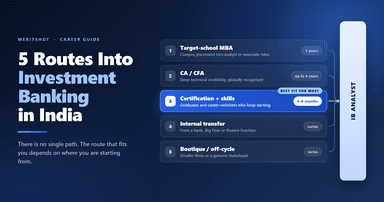
Can I get into front-office investment banking through a certification course? It is uncommon as a direct route. Front-office recruitment in India draws heavily from target MBA programmes, CA qualification and lateral hires. A strong certification builds real technical capability and a defensible portfolio, which helps — but it does not replicate that pipeline, and you should be sceptical of any provider suggesting otherwise.
Is investment banking operations a good career? Yes, on its own terms. It is accessible from a commerce or finance degree, stable, reasonably paid at entry, and a recognised internal route into other parts of a bank. The point is to choose it deliberately rather than by accident.
Is an MBA better than a certification course? They do different things. An MBA from a target school is the established front-office recruitment pipeline and costs correspondingly more in money and time. A certification builds specific technical capability faster and far more cheaply. Choose based on the career you are pursuing and what you can commit.
Do I need AI skills for an investment banking career? Increasingly, though not in the way the phrase usually implies. Analyst work is document-heavy, which is what AI tools assist with, so familiarity is becoming an expectation. What matters more is understanding the confidentiality constraints — most banking AI deployment is restricted to internal systems for exactly that reason.
Is GST included in course fees? It depends on the provider — some quote inclusive, others add it. At 18%, this is a material difference on a six-figure fee. Ask explicitly and get the answer in writing.
Are online investment banking courses as good as classroom ones? Online programmes can be equally effective where they include live instruction, practical modelling work, assignments and real feedback. Recorded-only content generally is not. The useful question is not online versus classroom but how much live interaction and individual feedback you actually receive.
How do I verify a provider's placement claims? Ask for the denominator behind any percentage — of whom, over what period, counting what kind of offer. Ask for the median salary rather than the highest. And find recent alumni yourself on LinkedIn rather than relying only on introductions.
What should I check before paying for any course? The career path it prepares you for, the total cost including GST and financing interest, what career support concretely includes, the refund policy and when eligibility ends, whether you can attend the format, and what the programme does not do.
What is Meritshot's PG Program in Investment Banking? Meritshot's PG Program in Investment Banking is designed for working professionals and runs for 6–9 months through live weekend classes. It combines investment-banking skills with AI + finance integration, lifetime study-material access, lifetime career support, guaranteed internships at MNCs, and guaranteed interviews.
How do I apply to Meritshot's investment banking programme? Apply through direct counselling. Applicants must be graduates, and admission includes resume verification.
Final word
Investment banking rewards technical depth and clear thinking, and the right programme accelerates both. The wrong one costs money and months.
Take the shortlist above, verify current fees and formats directly with each provider, speak to people who have completed the programmes you are considering, and use the investment banking career roadmap to choose based on the role you actually want rather than the one the marketing describes.
Explore the Meritshot PG Program in Investment Banking · Talk to a counsellor