

Will AI Replace Business Analysts? How to Stay Relevant in the AI Era
Artificial intelligence can summarise a meeting in seconds.
It can turn rough notes into user stories, draft requirements, analyse datasets, suggest SQL queries, identify patterns and even create a first version of a process flow.
So, it is natural for Business Analysts to ask:
Will AI eventually replace Business Analysts?
The short answer is no—but AI will change what companies expect from a Business Analyst.
The Business Analyst skills that matter most are shifting from document production towards problem framing, validation, stakeholder alignment and informed decision-making.
The Business Analyst who spends most of the day manually preparing documents, updating reports and converting meeting notes into structured requirements may see a large part of that workload automated.
But the BA who can understand ambiguous business problems, challenge assumptions, manage conflicting stakeholders, validate AI-generated information and connect business goals with technology becomes even more valuable.
That distinction matters.
The future does not belong to Business Analysts who compete with AI at producing documents faster.
It belongs to AI-augmented Business Analysts who know what to automate, what to question and what still requires human judgement.
What Is an AI-Augmented Business Analyst?
An AI-augmented Business Analyst is a Business Analyst who uses artificial intelligence to improve the speed and quality of analysis while retaining human responsibility for business decisions, stakeholder alignment and validation.
Instead of spending hours turning meeting notes into a first draft of requirements, for example, a BA may use AI to create the draft and then focus on questions such as:
- Is this actually what the stakeholder meant?
- Are any requirements contradictory?
- What assumptions has the AI made?
- What business rules are missing?
- Which edge cases have not been considered?
- Does the proposed solution solve the original business problem?
- What could go wrong if this requirement is implemented?
That shift—from producing information to interpreting and validating information—is one of the most important changes happening in business analysis.
IIBA practitioners are already documenting the use of AI for elicitation preparation, requirement drafting, validation, stakeholder communication and analysis while emphasising that professional judgement remains with the Business Analyst.
Will AI Replace Business Analysts?
AI is unlikely to replace the complete Business Analyst role, but it can automate or accelerate several individual BA tasks.
The difference between a role and a task is important.
Consider stakeholder requirements.
An AI system may be able to take a meeting transcript and produce:
- meeting summaries;
- draft requirements;
- user stories;
- acceptance criteria;
- potential risks;
- possible questions for the next workshop.
But producing a requirement document is not the same as understanding the requirement.
Imagine three departments requesting changes to the same internal system.
Sales wants fewer mandatory fields because representatives need speed.
Finance wants more mandatory fields for reporting accuracy.
Compliance wants additional approval steps to reduce risk.
AI can summarise all three opinions perfectly.
But somebody still has to determine:
What should the organisation actually do?
That requires context, negotiation, prioritisation and an understanding of business consequences.
That is where the Business Analyst becomes critical.
How AI Is Changing Business Analysis
AI is already useful across several parts of the business analysis lifecycle.
| BA Activity | What AI Can Help With | Where the BA Still Adds Value |
|---|---|---|
| Stakeholder meetings | Transcription and summarisation | Reading concerns, probing deeper and resolving disagreements |
| Requirements | Creating first drafts | Validating needs, assumptions and business rules |
| User stories | Drafting stories and acceptance criteria | Ensuring they reflect actual user and business needs |
| Process analysis | Suggesting process flows | Understanding exceptions and real operational behaviour |
| Data analysis | Finding patterns and generating queries | Asking the right business questions and interpreting results |
| Research | Summarising large amounts of information | Checking relevance, reliability and context |
| Testing | Drafting scenarios and test cases | Identifying critical edge cases and business risks |
| Documentation | Formatting and rewriting information | Determining what should be documented and why |
| Reporting | Creating first-pass summaries | Turning findings into business recommendations |
The pattern is fairly clear.
AI performs especially well when the task involves generating, organising, summarising or transforming existing information.
A Business Analyst becomes particularly valuable when the work involves ambiguity, judgement, relationships, trade-offs and accountability.
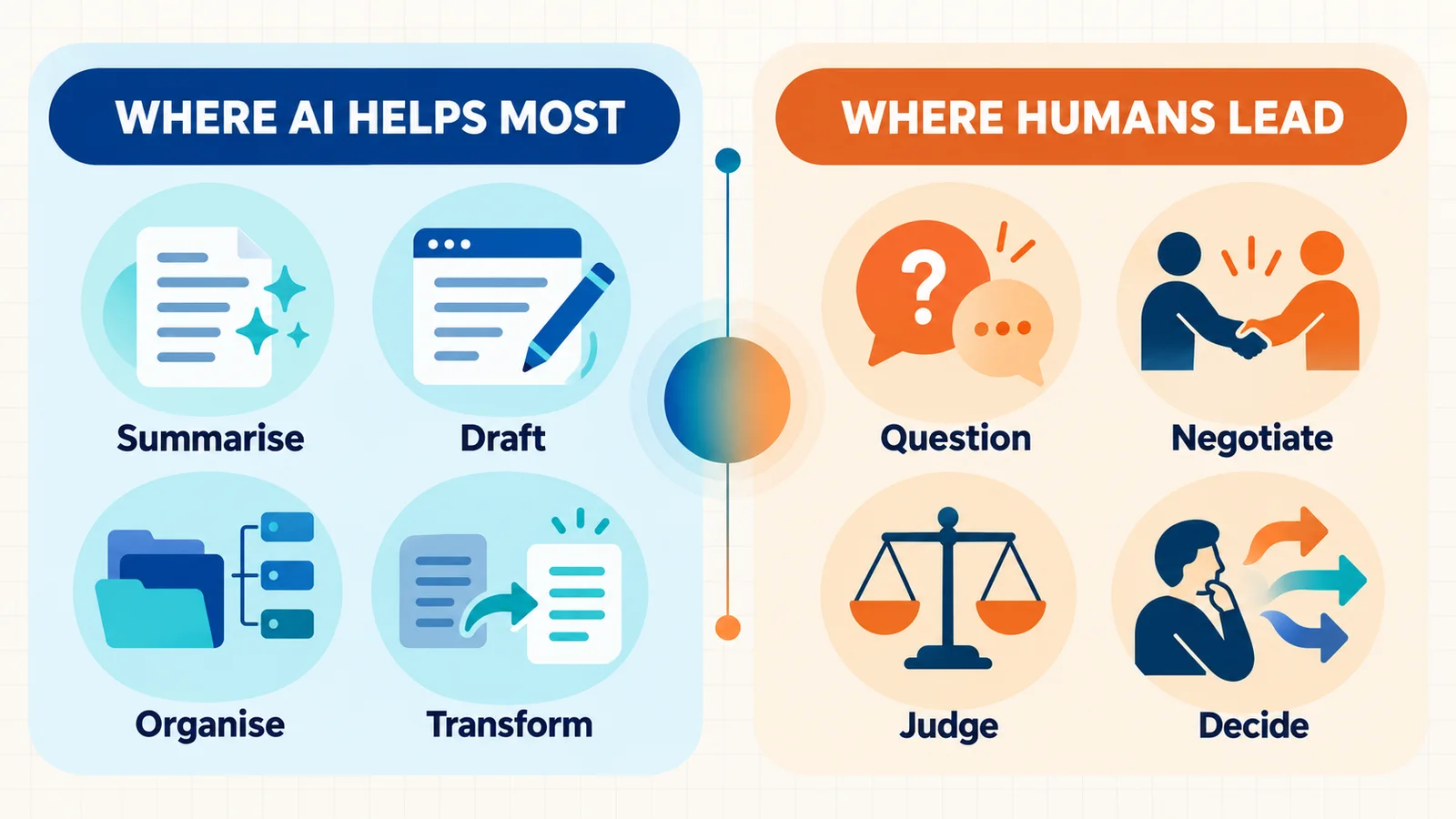
AI is strongest at repeatable information work; people remain essential for questioning, negotiation, judgement and accountable decisions.
The Skills Making Business Analysts More Valuable in the AI Era
Interestingly, the rise of AI does not make human skills less important.
It can make them more important.
The World Economic Forum's Future of Jobs Report 2025 found that analytical thinking remains the most commonly cited core skill among employers, while AI and big data rank among the fastest-growing skill areas. The report also highlights creative thinking, technological literacy, leadership, resilience and lifelong learning as increasingly important capabilities.
For Business Analysts, this creates a powerful combination.
You need enough AI knowledge to work with technology—but enough business judgement to know when technology is wrong.
Here are the capabilities likely to differentiate strong Business Analysts.
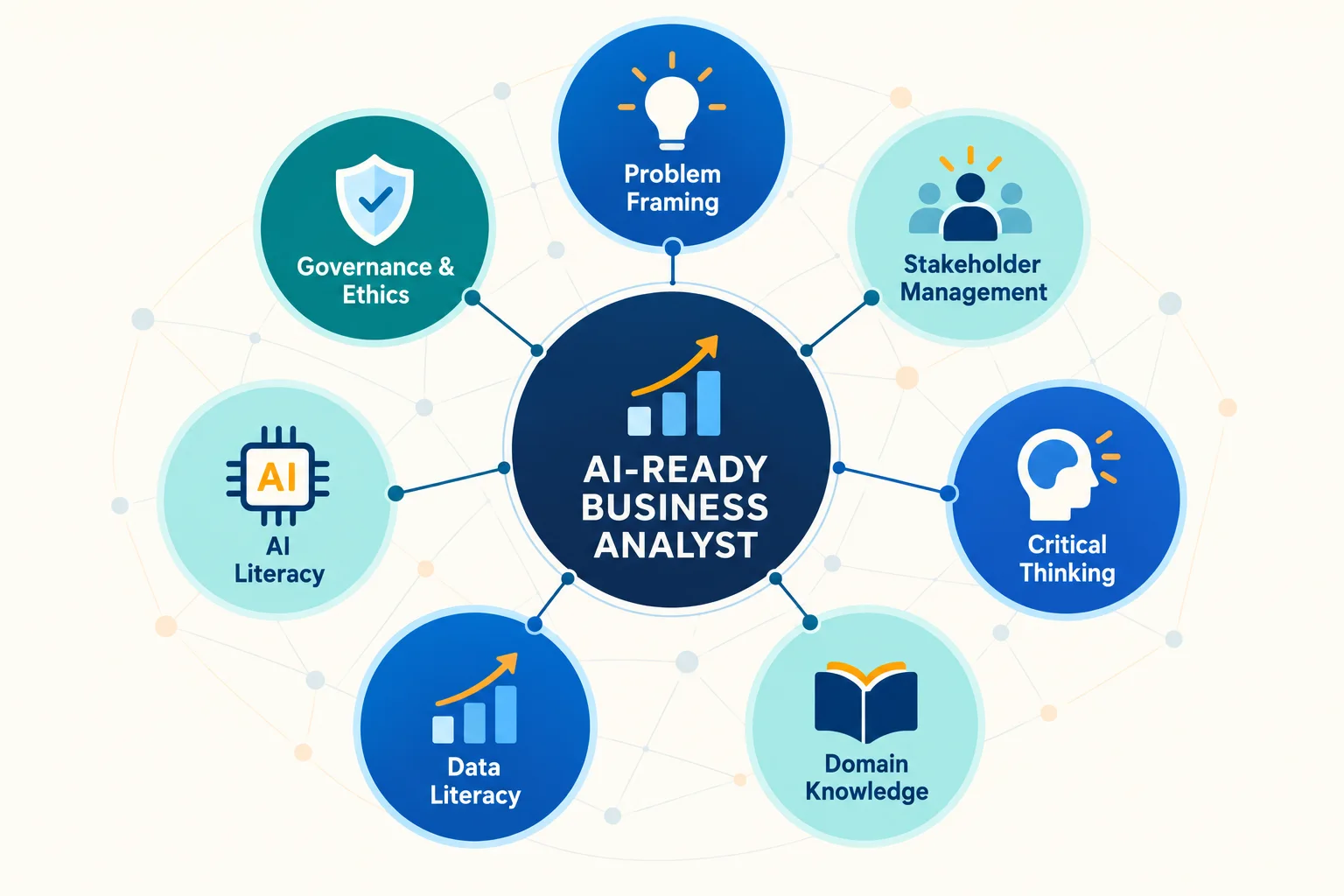
The strongest profile combines technical fluency with context, critical thinking and responsible decision-making.
1. Problem Framing
One of the biggest mistakes organisations can make with AI is solving the wrong problem faster.
Suppose a company tells its Business Analyst:
“We need an AI chatbot because customer support costs are increasing.”
A weak analyst may immediately start collecting chatbot requirements.
A stronger analyst asks:
- Why are support costs increasing?
- Which queries generate the most tickets?
- Are customers contacting support because the product itself is confusing?
- Would fixing onboarding reduce more tickets than introducing a chatbot?
- Which queries could safely be automated?
- Which conversations require human intervention?
That is problem framing.
AI can generate dozens of solutions.
The Business Analyst helps determine whether the organisation is solving the right problem in the first place.
2. Stakeholder Management
Stakeholder management may become one of the strongest competitive advantages for Business Analysts.
Businesses are not spreadsheets.
People disagree.
Departments protect priorities.
Customers struggle to explain what they actually need.
Senior leaders sometimes request solutions before defining problems.
Technical teams and business teams may use completely different language for the same issue.
An effective Business Analyst works between these groups and builds shared understanding.
That requires:
listening, questioning, negotiation, facilitation and communication.
AI can help prepare questions for a stakeholder workshop.
It cannot independently build the trust required for someone to reveal that the “official process” described in the documentation is not how employees actually work.
That distinction is huge.
3. Critical Thinking and AI Validation
Generative AI can produce an answer that sounds extremely convincing while still being incomplete or incorrect.
For tomorrow's Business Analyst, therefore, simply knowing how to generate AI output will not be enough.
You must know how to challenge it.
Ask:
- What evidence supports this conclusion?
- What information is missing?
- Which assumptions were made?
- Does the recommendation conflict with another requirement?
- Does this output reflect all stakeholder groups?
- What happens in unusual scenarios?
- Could sensitive information be exposed?
- Could the model introduce bias?
- Can the result be traced back to a reliable source?
Think of AI as an extremely fast junior assistant.
You can delegate work to it.
You should not automatically approve everything it produces.
4. Domain Knowledge
The easier generic analysis becomes, the more valuable specific business knowledge becomes.
Consider two analysts reviewing the same banking workflow.
One understands process diagrams.
The other understands process diagrams plus banking operations, KYC requirements, fraud risks, customer onboarding and regulatory constraints.
Who is more valuable?
Usually, the second analyst.
Industry understanding allows BAs to recognise problems that generic AI systems may overlook.
Depending on your career path, useful domains may include:
- banking and financial services;
- healthcare;
- retail and e-commerce;
- insurance;
- logistics;
- SaaS;
- telecommunications;
- manufacturing;
- fintech.
The future BA will not simply ask, “Can I create requirements?”
A stronger question is:
“Which business problems am I particularly qualified to understand?”
5. Data Literacy
Business Analysts do not necessarily need to become Data Scientists.
But being uncomfortable with data is becoming increasingly difficult.
Modern BAs should understand how to:
- work confidently with Excel;
- query structured data using SQL;
- interpret dashboards;
- understand KPIs;
- recognise misleading metrics;
- perform basic exploratory analysis;
- communicate insights visually;
- distinguish correlation from business causation.
If you want to strengthen the technical side of this skill set, begin with our practical guide to SQL for data analysis.
Tools such as Power BI and Tableau can also help analysts turn business information into understandable insights.
AI may make querying and visualising data easier.
That does not remove the need to understand whether the analysis makes business sense.
6. AI Literacy and Prompting
You do not need to become an AI engineer to become an AI-ready Business Analyst.
The Business Analytics Program combines these AI capabilities with the analytical and stakeholder skills required in modern BA roles.
You do need to understand how to communicate effectively with AI systems.
A vague prompt such as:
“Create requirements for an e-commerce website.”
will usually produce generic output.
A BA who provides:
- business context;
- stakeholder information;
- constraints;
- expected format;
- assumptions;
- exceptions;
- business rules;
- acceptance conditions;
can generate something far more useful.
Prompting for a Business Analyst is therefore not simply about memorising “best prompts.”
It is an extension of an existing BA capability:
asking better questions.
7. AI Governance, Risk and Ethics
As businesses introduce more AI-driven decisions, someone needs to ask uncomfortable questions.
For example:
- What data was used?
- Should this information have been given to the AI system?
- Who validates the output?
- Can a human override the decision?
- How will errors be detected?
- Could the system unfairly disadvantage certain users?
- What happens when confidence is low?
- Who is accountable when something goes wrong?
These are increasingly business-analysis questions, not merely technical ones.
IIBA has highlighted how existing BA capabilities—including elicitation, stakeholder management, process design and traceability—can extend naturally into responsible AI and governance work.
This could become a particularly valuable specialisation for future Business Analysts.
The New BA Workflow: Human Judgement + AI Speed
Instead of thinking about AI as replacing Business Analysts, consider how it can redesign the BA workflow.
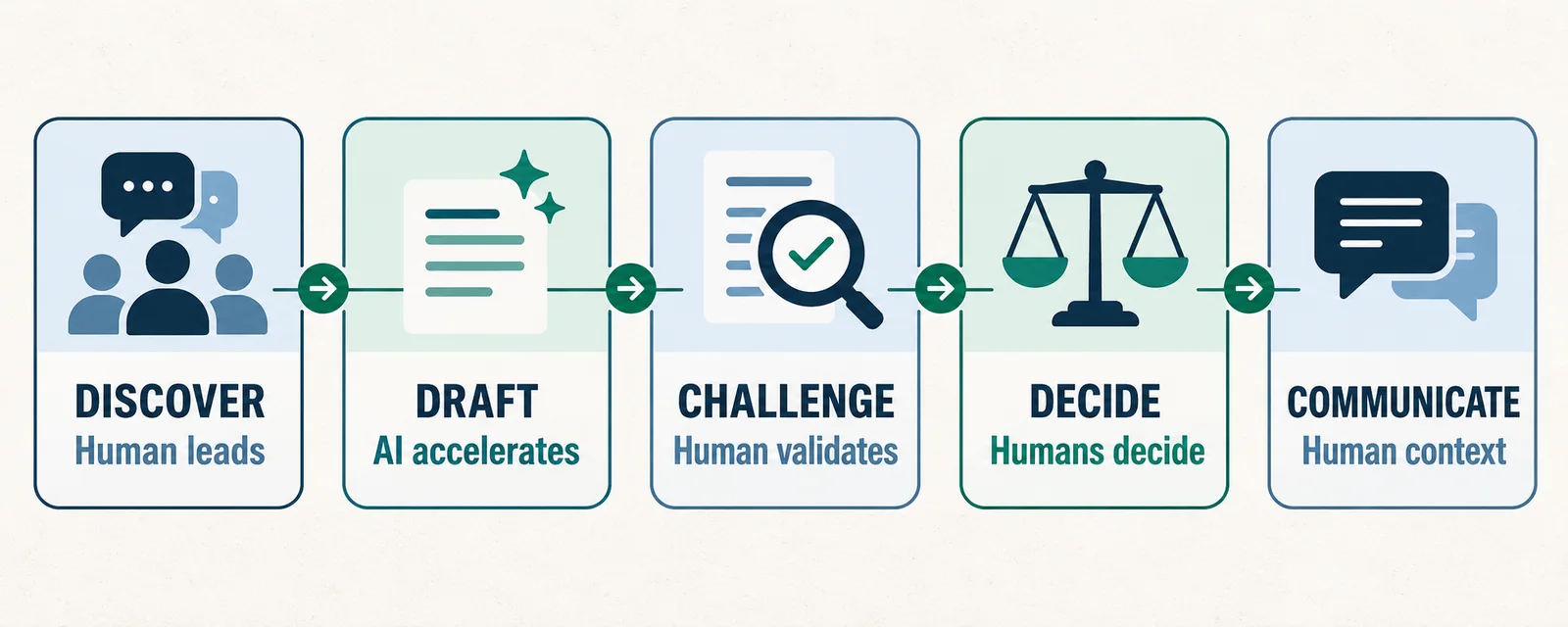
AI accelerates drafting, while people continue to lead discovery, validation, decisions and communication.
Step 1: Discover
The BA speaks with stakeholders, observes workflows, studies data and understands the business problem.
Human leads.
Step 2: Draft
AI helps organise meeting notes, create first-draft requirements, identify questions and structure documentation.
AI accelerates.
Step 3: Challenge
The BA reviews assumptions, contradictions, missing cases, dependencies and risks.
Human validates.
Step 4: Decide
Stakeholders evaluate options, make trade-offs and agree priorities.
Humans remain accountable.
Step 5: Communicate
AI may help visualise or simplify information, while the BA adapts the message for executives, developers, product teams and operational users.
Human context + AI productivity.
That is what AI augmentation looks like in practice.
Not human versus AI.
But human judgement multiplied by AI speed.
What Business Analyst Tasks Are Most Likely to Become Automated?
Routine, repeatable and template-based activities are the most obvious candidates.
These may include:
- basic meeting summaries;
- first-draft user stories;
- standard acceptance criteria;
- documentation formatting;
- repetitive status reports;
- initial research summaries;
- basic data categorisation;
- standard test scenarios;
- first-pass process descriptions.
Does that mean BAs should worry?
Only if those tasks represent most of the value they currently provide.
When AI removes repetitive work, a Business Analyst gains more time for:
- root-cause analysis;
- stakeholder workshops;
- strategic analysis;
- process improvement;
- solution evaluation;
- risk identification;
- decision support;
- change management.
The challenge is therefore not protecting every existing BA task from automation.
It is moving towards higher-value BA work faster than automation moves into lower-value work.
Can AI Gather Business Requirements Without a Business Analyst?
AI can help capture and structure requirements, but requirement elicitation involves much more than recording what people say.
IIBA defines requirements as usable representations of needs and emphasises the relationship between stakeholder needs, requirements, designs and traceability.
A stakeholder may say:
“The dashboard needs to load faster.”
That is not yet a useful requirement.
A Business Analyst may ask:
“How fast?”
“Which dashboard?”
“For which users?”
“Is the problem initial load time or filtering?”
“What is the current response time?”
“What business outcome is being affected?”
“Does performance change when datasets become larger?”
The quality of requirements depends heavily on the quality of questioning.
AI can assist that conversation.
The BA still needs to understand what lies behind the answer.
Does a Business Analyst Need to Learn Coding Because of AI?
Not necessarily.
Most Business Analyst roles still do not require professional software-development skills.
However, technical literacy is becoming increasingly valuable.
A modern BA benefits from understanding:
- SQL;
- APIs;
- databases;
- system integrations;
- data flows;
- Agile and Scrum;
- Jira;
- process modelling;
- basic automation concepts;
- generative AI and LLMs.
The goal is not necessarily to build the system yourself.
The goal is to understand technology well enough to communicate effectively with the people who will.
Which Tools Should an AI-Ready Business Analyst Learn?
Specific tools will continue changing, so learning categories is more valuable than chasing every new application.
A strong BA toolkit could include:
Analysis and Data
- Excel
- SQL
- Power BI
- Tableau
Requirements and Collaboration
- Jira
- Confluence
- Microsoft Teams
- collaboration and documentation platforms
Process Modelling
- BPMN
- UML
- flowchart and diagramming tools
AI
- generative AI assistants;
- AI-enabled analytics tools;
- meeting transcription and summarisation tools;
- AI-assisted research;
- AI-assisted prototyping.
The objective is not to become dependent on one application.
Build the underlying skill first.
Tools will change.
Business problems will remain.
Is Business Analyst Still a Good Career in the Age of AI?
Yes—but the definition of a good Business Analyst is changing.
Employers increasingly need professionals who can connect:
Business + Data + Technology + People + AI.
That combination is difficult to automate because organisations do not operate on perfectly structured inputs.
Real businesses contain:
- incomplete information;
- competing priorities;
- legacy processes;
- conflicting stakeholders;
- budget constraints;
- technical limitations;
- regulations;
- organisational politics;
- changing customer behaviour.
AI can analyse information within that environment.
A Business Analyst helps the organisation make sense of the environment itself.
That is a significantly larger responsibility.
How to Future-Proof Your Business Analyst Career
If you are already working as a BA—or preparing to become one—focus your learning around five priorities.
These Business Analyst career skills provide a structured foundation for moving from routine documentation towards higher-value analytical and decision-support work.
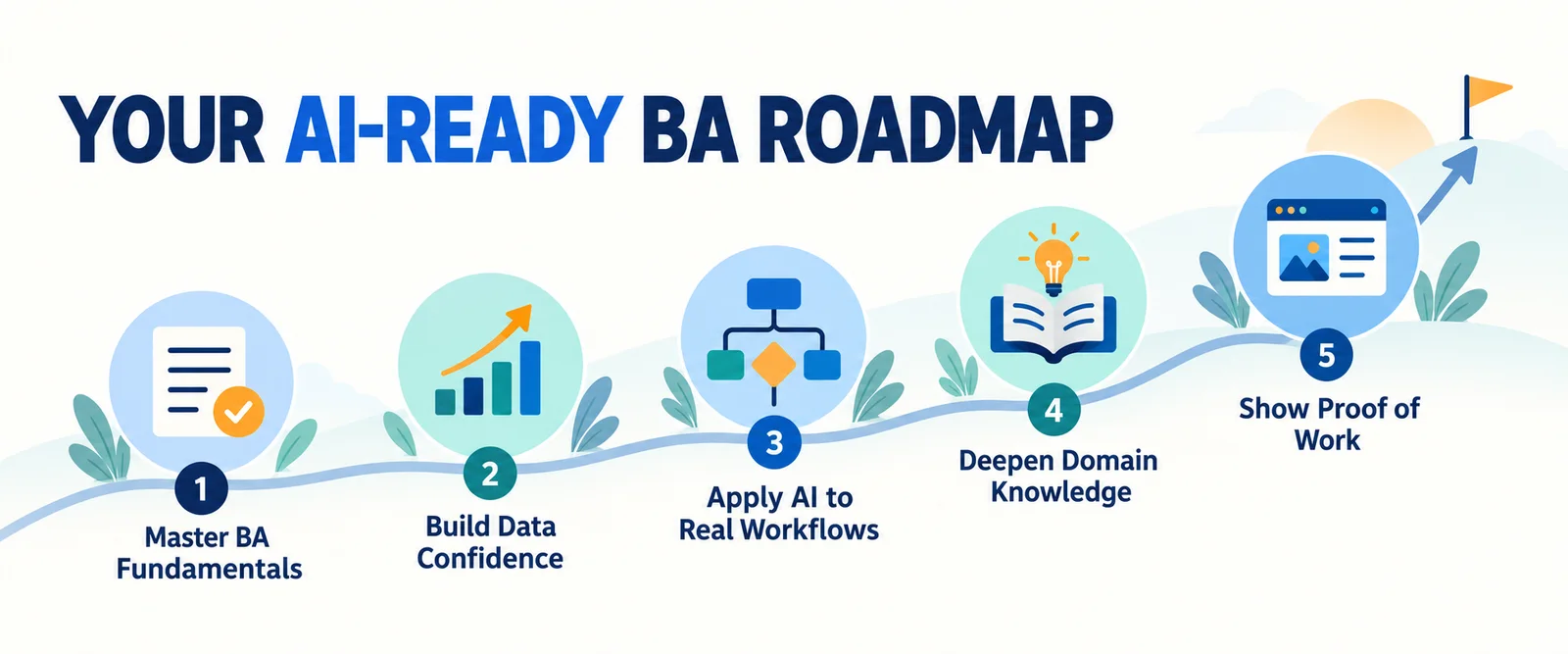
Build from strong BA fundamentals to practical AI experience, domain depth and visible proof of work.
1. Strengthen your core BA fundamentals
Learn requirements elicitation, process modelling, stakeholder management, business analysis, Agile methodologies and documentation properly.
AI does not make fundamentals obsolete.
It makes weak fundamentals easier to expose.
2. Become comfortable with data
Build practical proficiency in Excel, SQL and visualisation tools such as Power BI or Tableau.
3. Start using AI in real BA workflows
Use it for:
- brainstorming stakeholder questions;
- reviewing requirements;
- finding gaps;
- drafting user stories;
- creating test cases;
- summarising research;
- improving documentation.
Then validate everything.
4. Develop business domain knowledge
Choose industries and business functions you understand deeply.
5. Build proof of work
Don't simply write “AI” on your résumé.
Build projects showing how you used business analysis and AI together.
For example:
Problem → Stakeholders → Analysis → Requirements → AI assistance → Human validation → Proposed solution → Business impact
That demonstrates something employers care about far more than familiarity with a trendy tool:
the ability to solve business problems.
The Business Analyst Is Not Disappearing. The Job Description Is Evolving.
AI may eventually make several traditional BA activities almost instantaneous.
That does not make Business Analysts irrelevant.
It changes where their value comes from.
The BA of the past could sometimes succeed by being an excellent producer of requirements documents.
The BA of the future needs to become something more:
a problem framer, stakeholder translator, data interpreter, AI validator and business decision partner.
The safest career strategy is therefore not trying to become better than AI at the things AI does well.
Let AI summarise.
Let it format.
Let it generate the first draft.
Then develop the abilities that determine whether that first draft becomes a successful business outcome.
Because organisations do not simply need more information.
They need people capable of deciding which information matters, what it means and what should happen next.
And that is where a skilled Business Analyst remains essential.
Build the Skills of an AI-Ready Business Analyst
The Business Analyst role is moving beyond traditional documentation.
Today's professionals need a combination of business analysis, data skills, stakeholder management, problem-solving and practical AI literacy.
If you want to build these capabilities through structured, industry-focused learning, explore the Meritshot Business Analytics Specialization Program and learn how modern Business Analysts work with business problems, data, analytical tools and real-world projects.
Frequently Asked Questions
For course-specific information about eligibility, curriculum, projects and career support, visit the Business Analytics Program FAQs.
1. Will AI replace Business Analysts?
AI is unlikely to completely replace Business Analysts, but it will automate or accelerate some repetitive BA tasks such as meeting summaries, first-draft requirements, reporting and documentation. Skills involving stakeholder management, problem framing, validation, negotiation and business judgement remain strongly human-dependent.
2. What is the future of Business Analysts with AI?
The future is likely to be AI-augmented business analysis. Business Analysts will use AI to perform routine analysis and documentation faster while spending more time on strategic problem-solving, stakeholder alignment, decision support, governance and solution evaluation.
3. Which Business Analyst skills cannot easily be replaced by AI?
Skills that are harder to automate include stakeholder management, critical thinking, negotiation, business judgement, problem framing, domain expertise, facilitation, communication, change management and contextual decision-making.
4. How can Business Analysts use AI?
Business Analysts can use AI to summarise meetings, prepare elicitation questions, draft requirements, create user stories, identify potential gaps, analyse datasets, generate test scenarios, support research and create first versions of process documentation.
AI-generated output should still be reviewed and validated by the Business Analyst.
5. What AI skills should a Business Analyst learn?
Business Analysts should learn practical AI literacy, structured prompting, AI-output validation, responsible AI principles, data privacy awareness and how to integrate AI into requirements, research, data analysis and documentation workflows.
6. Is Business Analyst a good career after the rise of generative AI?
Business analysis can remain a strong career path for professionals who continuously upgrade their skills. Routine work is becoming easier to automate, making analytical thinking, data literacy, stakeholder communication, domain expertise and technology understanding increasingly important.
7. Does a Business Analyst need coding skills?
Most Business Analysts do not need advanced programming skills. However, understanding SQL, APIs, databases, integrations and basic technical concepts can significantly improve collaboration with technical teams and strengthen career opportunities.
8. What should I learn to become a Business Analyst in the AI era?
Start with business-analysis fundamentals such as requirement gathering, process modelling, stakeholder management and Agile. Then develop Excel, SQL, Power BI or Tableau skills and learn how generative AI can support business-analysis workflows.
The strongest profile combines business understanding, analytical capability, technology awareness and communication skills.