


- 01Graduate in commerce, finance or a related discipline
- 02Working knowledge of customer due diligence
- 03Minimum 1–3 years of relevant experience
- 04Strong attention to detail
Line 03 is the one she kept closing listings over. She did it a few dozen times before she understood the problem wasn't her.
There is a particular sound a laptop makes when you close it harder than you need to.
The routine had a shape by then. Open the portal. Scroll. Find something that looked possible — the title made sense, the company was one she'd heard of, the description described work she thought she could do. Read down. And there it would be, four lines from the bottom, sitting in the requirements like a locked door.
She did that dozens of times. Not over months — over weeks. And the thing about doing it dozens of times is that the conclusion you draw slowly stops being about the jobs and starts being about you.
She had a degree. She was not short of effort — the hours going into the search were proof of that. What she did not have was the one thing every posting wanted and none of them would let her earn: experience. It is a closed loop, and from the inside it does not look like a loop. It looks like a verdict.
Enrolling was not a leap of faith so much as a decision to stop guessing. She had spent enough weeks proving that effort alone was not moving anything. What was missing was direction and something to show for the time — and those, at least, were things a structured programme could supply. She paid the registration fee on a Thursday in August. The programme started the same day.
After a while I wasn't even reading the full posting. I'd scroll to the experience bit, see two or three years, and close it. I'd more or less decided none of it was meant for me.Reshu Singh · [draft for approval]
Sit on the other side of the desk. A recruiter opens two hundred applications for one entry-level role. Almost every candidate has a degree. Almost every degree looks like the others. There's no employment history to compare, no portfolio to assess, nothing separating application 47 from application 112.
So the recruiter does the only thing available — filters on the one criterion that produces a shorter list.
Which means the fresher's problem isn't lack of experience. It's lack of anything else. And unlike experience, anything else can be built.
What does Meritshot's Investment Banking programme involve?
The — the same day the programme began. Nine months of it:
The order matters more than the list does. Accounting and financial systems come before modelling; modelling comes before valuation; valuation comes before the judgement calls that depend on all three. Someone teaching themselves from the internet usually meets these in the order they look interesting, which is why they stall around the third one.
The material is all available free, and that is genuinely true rather than a thing said to sound reasonable. What is not free is the sequencing, somebody to ask when the twenty per cent you didn't follow turns out to be the twenty per cent you needed, and a fixed Tuesday evening that exists whether or not you feel like it. Most people who try this alone do not fail because the accounting is hard. They fail in month three, quietly, having missed a fortnight.

She still wasn't sure what she'd signed up for. She knew she wanted to work in finance, but didn't yet know that finance isn't a career — it's a dozen careers wearing the same coat, with different doors and different keys.
Somewhere early the question stopped being how do I get into finance and became something more useful: which role, doing what, hiring which kind of person. That shift did not happen on its own. It came out of the first few weeks at Meritshot — someone whose job was to know the market pointing out that "finance" was not a plan, and helping her narrow it to something she could actually aim at.
She landed on KYC — know your customer, the due diligence work at the front of every regulated financial institution in the country. (For how a trade actually moves through settlement, see our guide to the trade life cycle — coming soon.) It suited how she worked: careful, methodical, the sort of person who notices when two documents do not quite agree. That it was also one of the few corners of the market where hiring was moving the right way, she would not fully appreciate until later.
The early weeks were the hardest, in the way the start of anything unfamiliar is. Financial statements that assumed a vocabulary she was still building. Excel doing things she had not known Excel did. There is a particular discouragement in being a beginner at something you have committed money and months to, and it arrives right about the point the initial resolve wears thin. She has said the thing that carried her through it was not willpower but scaffolding — that the next class was already on the calendar, the next assignment already due, so the question each week was never whether to continue but only what came next.
Two invoices, two months apart. The first in August to open the LMS account and book the seat; the second in October for the programme itself. Both inclusive of GST, both marked received in full, balance zero.
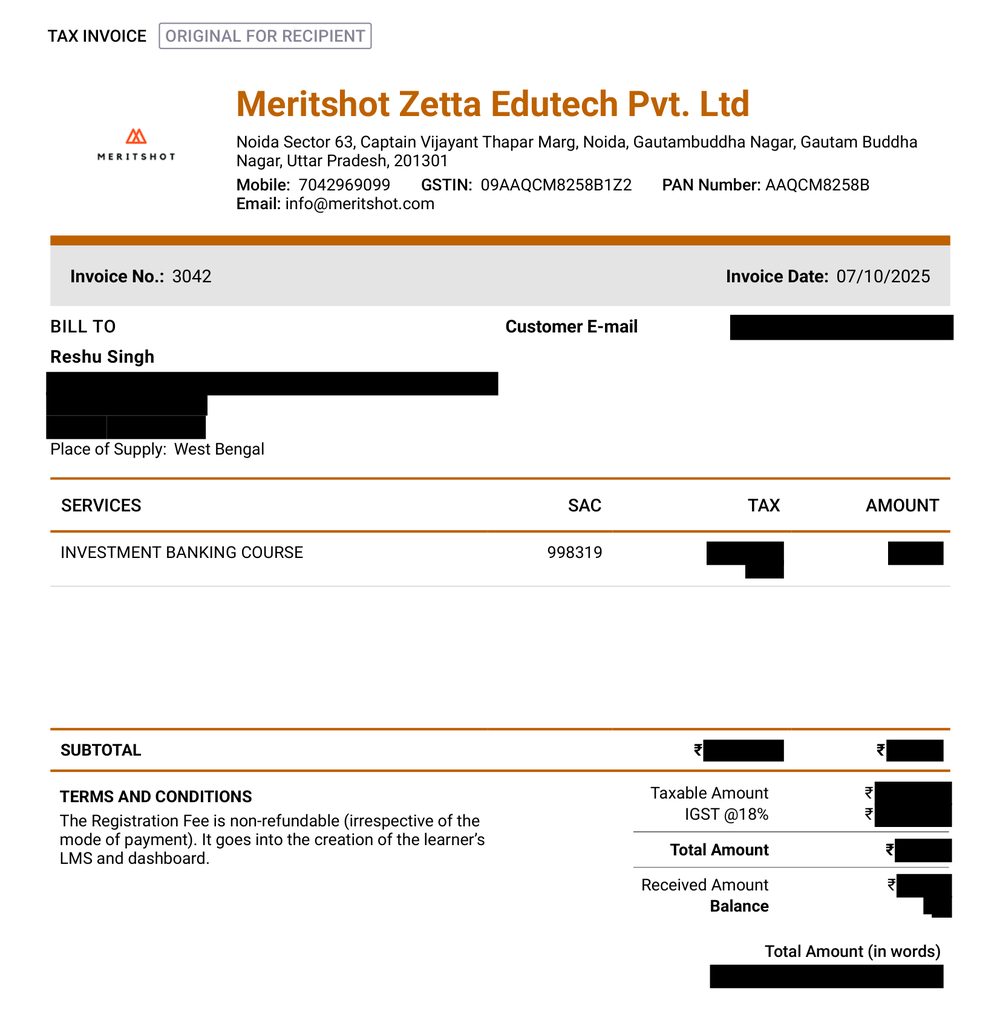
It is worth saying what her fee was and wasn't. It was not the headline number on the programme page, because fees here depend on eligibility. It was also not a discount in the sense that word usually carries — there was no countdown, no expiring offer, no manager consulted for a special rate. It was assessed, quoted, and paid.
Set against nine months of live instruction, doubt sessions, mentorship, assessments and a capstone that ran to twenty-one worksheets, the figure worth working out is the one per contact hour. Ask for your own quote and do that arithmetic before comparing anything to anything.
KYC sits at the front of a regulated financial institution. A file arrives for review. The documentation gets checked against what the risk policy requires for that customer type. Names run against sanctions lists, politically exposed person databases and adverse media, and the results need interpreting — a common name throws up matches that are not the customer, and somebody has to decide which.
If the customer is a company rather than a person, the ownership structure has to be worked through until the individuals who actually control it are identified. Some structures are two lines. Others run through several entities across jurisdictions.
A risk rating gets assigned, which determines how closely the relationship is watched afterwards. Higher-risk customers go through enhanced due diligence — deeper checks on source of funds and business activity. Existing customers come up for periodic review, because risk is not fixed.
Every decision is written down with reasoning that has to make sense to an auditor reading the file eighteen months later without the context.
The pressure is not volume. It is the file that does not resolve cleanly — documentation that contradicts itself, a partial sanctions match, a structure that does not quite explain itself. Clearing it wrongly creates regulatory exposure. Escalating everything makes you useless.
Compliance work has held up in a period when a lot of entry-level operational hiring has not.
The functions holding up are the ones where a decision carries a regulatory consequence: KYC and AML compliance, financial crime operations, underwriting support, regulatory reporting. A model can flag a name against a sanctions list. Deciding whether a partial match is the same person, what documentation would resolve it, and whether the file should be escalated or cleared is a judgement someone has to own.
Sources: Careernet, July 2025 · Han Digital, India IT-BPM Talent Intelligence Report 2026.
The part that gets edited out
The middle of any career change is the section the success story skips. It's also the part with the best evidence attached — because programmes leave records, and records don't flatter anyone.
What the nine months of the Investment Banking PG Program looked like, in practice, was a rhythm. Live classes at a fixed time, whether or not the day had gone well. Assignments that came back with comments on them. Doubt sessions where the twenty per cent she had not followed in class got unpicked in a smaller room — the part, she has said since, that kept her from quietly falling behind the way people studying alone tend to.
None of it was dramatic, which is rather the point. A career change is not built in a moment of inspiration; it is built in the unremarkable act of turning up to the ninth session in a row after the novelty has worn off. Meritshot's part was not motivational. It was structural — a timetable that existed independently of her mood, work marked by someone who had done the job, and a mentor who could say which roles took people with her profile and how to approach them.
She finished with in the high eighties and low nineties. Not perfect. Good — the ordinary evidence that someone did the work, kept doing it, and understood what they had done.
Ninety-one per cent means she missed some. That's roughly what nine months looks like when you're also living a life — and as evidence it is worth considerably more than a hundred would be.
| Comparable | Sales | EBITDA | BEV | Rev × | EBITDA × |
|---|---|---|---|---|---|
| Comparable 1 | 5,000 | 400 | 4,500 | 0.90 | 11.25 |
| Comparable 2 | 4,000 | (600) | 6,000 | 1.50 | excluded |
| Comparable 3 | 3,000 | 200 | 3,000 | 1.00 | 15.00 |
| Applicable multiple — median | 1.00 | 13.13 |
| Method | Metric | Multiple | Implied BEV | Weight |
|---|---|---|---|---|
| Revenue multiple | 4,500 | 1.00 | 4,500.00 | 50% |
| EBITDA multiple | 350 | 13.13 | 4,593.75 | 50% |
| Concluded business enterprise value | 4,546.88 |
One of her three comparable companies had negative EBITDA. Including it would have produced a meaningless multiple. Note 2 of her own methodology reads:
"Comparable 2 EBITDA multiple is excluded from the median as EBITDA is negative (not meaningful for valuation)."
She used the median rather than the mean as well, and wrote down why — to limit the impact of outliers.
That is the whole thing in one cell. Anyone can follow a valuation template. Recognising that one input would break the answer, removing it, and documenting the reason is the judgement an interviewer spends the technical round hunting for — and it sits in a spreadsheet built nine months after starting from zero. This is the point where the fresher who had been closing job tabs became someone with something to show: not because she was told to build a model, but because she had been taught how, given real data to break it against, and left to make the calls herself.
| INR millions | FY24 | FY25 | FY26 | FY27 | FY28 |
|---|---|---|---|---|---|
| Total current assets | 46.0 | 55.0 | 81.2 | 65.3 | 62.0 |
| Total current liabilities | 57.6 | 50.0 | 50.8 | 44.7 | 51.0 |
| Net working capital | (11.6) | 5.0 | 30.4 | 20.6 | 11.0 |
| Incremental working capital | — | 16.6 | 25.4 | (9.8) | (9.6) |
Admitted
Investment Banking PG Program, nine months, starting the same day the letter was issued. Registration fee invoiced and received on 14 August 2025.
Before the interview that mattered
, run by people who conduct real ones. Technical rounds. Behavioural rounds. Sessions where she had to defend that valuation to someone determined to find the weak point in it.
She did well in the first one, which the scorecard below records. What it also records, in the business-acumen row, is the one thing she had not yet got to — and that is the part worth paying attention to.
It was scored, which is the part that makes it useful. Ten parameters, a mark against each, and a written remark — not a pass or a certificate, but an assessment with a weak spot on it.
| Evaluation parameter | Score | Remark |
|---|---|---|
| Communication skills | 8/10 | Communicates ideas clearly and confidently |
| Confidence & presence | 8/10 | Good confidence with a positive professional presence |
| Problem-solving approach | 8/10 | Demonstrates a logical and structured approach |
| Analytical thinking | 8/10 | Able to understand situations and provide relevant responses |
| Business acumen | 7/10 | Good understanding; can further improve business-oriented thinking |
| Teamwork & collaboration | 9/10 | Strong collaborative attitude and team orientation |
| Adaptability | 8/10 | Shows willingness to learn and adapt to new situations |
| Professionalism | 9/10 | Professional attitude and appropriate workplace behavior |
| Ownership & accountability | 8/10 | Takes responsibility and demonstrates a proactive attitude |
| Interview etiquette | 8/10 | Good overall interview etiquette and professional conduct |
| Overall performance | 8.1/10 | Good — recommended for further interview process |
The business acumen score was the useful one, honestly. Everything else told me I was doing fine. That one told me what to actually work on before the real interviews.
Reshu Singh · [draft for approval]
The row worth looking at is business acumen. Seven out of ten, and a remark that does not soften it: can further improve business-oriented thinking. That is the sheet doing its job. A scorecard returning nines across the board would be a formality; one that names a specific weakness is an assessment, and it is the reason the other ten rows mean anything.
By the time a real interviewer asked a scenario question — a customer's documentation showing one address, their utility bill showing another — she'd been asked something like it before. Not that question. But that kind of question, in that kind of silence, with someone watching her think.
The interview that mattered came in the summer. She does not remember it as a triumph — most people who get the job do not; they remember it as the one that finally went the way the practice ones had taught them it could. She was asked to reason through a case, and she reasoned through it out loud, the way she had learned to. She was asked why she wanted the role, and for once the answer was not a rehearsed line about passion but a specific account of work she had actually done. The difference between that interview and the applications she had abandoned a year earlier was not confidence. It was that this time she had something to say when the questions got specific.
They run to a shape, which is most of why they stop being frightening once you've sat a few.
The framework questions come first. What is customer due diligence for. When does standard become enhanced. Why beneficial ownership matters. A candidate who has memorised definitions gets through these adequately; one who understands what the regulation is trying to prevent gets through them well, and the difference is audible within about two answers.
Then the scenarios, which is where interviews are actually decided. The documents contradict each other — what do you do. The sanctions match is eighty per cent similar but the date of birth is wrong — do you clear it. The ownership runs through three entities in two jurisdictions — how do you establish who controls it.
There is rarely one right answer, and candidates who go looking for one tend to freeze. What the interviewer is listening for is the reasoning: what else you'd want to know, what the cost of clearing it wrongly would be, at what point you'd stop and escalate, and whether you can set all that down clearly enough that somebody could follow it in a file note six months later.
Then the behavioural round, which in compliance is mostly about whether you'll hold a position. Attention to detail across work that repeats. What you do when a relationship manager wants a customer onboarded faster than you're comfortable with. Whether you escalate something awkward or quietly let it through.
You cannot prepare a scenario answer in advance, because you haven't seen the scenario. What you can prepare is the habit of thinking out loud while somebody watches — and that only comes from having done it badly a few times first, somewhere it didn't count.
Where she is
The offer came in August 2026, seven months after the admission letter. KYC Analyst at Slice — the exact role she had narrowed down to in those first few weeks, reached not by luck but by working backwards from it for the better part of a year.
Reshu Singh is a KYC Analyst at Slice. Her days contain customer files, documentation that doesn't quite match, screening results needing a human to decide whether an eighty per cent match is the same person, ownership structures that take an afternoon to unpick. It is precisely the work the programme had been describing since the autumn — the quiet test of whether a course is honest about the job it prepares you for. She arrived on day one and recognised it.
The first weeks in any job are a scramble, and hers were no different — new systems, a team to learn, the ordinary disorientation of being the newest person in the room. But the work itself was not foreign. She had built a valuation, so a due-diligence file did not frighten her. She had defended her reasoning to a mock panel, so being questioned by a senior colleague was uncomfortable rather than paralysing. The programme had not made the job easy. It had made it familiar, which for a first job is the more useful of the two.
Meticulous work with consequences attached — a fair description of most careers worth having.
Her on 26 June 2026, a few days after she finished. If you'd rather check than take an article's word for it, the details are there.
A first job matters less for what it is than for what it opens, and this one opens more than it looks like from outside.
Two or three years in, KYC analysts typically move toward enhanced due diligence on the complex and high-risk files, or sideways into transaction monitoring — watching customer activity for the patterns that suggest something is being laundered through it. Both are a step up in judgement rather than volume, and they pay accordingly.
After that the field opens out. Sanctions compliance is a specialism of its own and getting more so, given how quickly the international regime now moves. Financial crime investigation takes the cases that escalate out of monitoring and works them properly. Regulatory reporting and compliance advisory sit closer to policy than to casework. Some people move into the technology side, working on the systems that do the screening. Others go lateral into risk or audit, where the frameworks overlap enough that the experience carries.
There is a qualification path running alongside all of it — the professional certifications in anti-money laundering and financial crime are widely held and usually employer-funded once you are in a seat, which makes them a considerably better second step than first.
None of which is visible from a job portal at the point where you are closing tabs. It is one of the reasons picking a specific role early does more work than it appears to: you can see the ladder before you step onto it.
Nothing in Reshu's nine months was unusual. The sequence is repeatable, and most of it is free.
- Pick the role, not the field. KYC, AML, financial analysis, credit, audit. Read real job descriptions for three or four before choosing. Until this is settled, nothing else can be.
- Learn why the work exists before learning the steps. Compliance interviews are scenario questions. Someone who has memorised a process answers them badly.
- Build something applied. Not a certificate — a file with decisions in it that you made and can explain.
- Rewrite the CV around what you can do. Organised as education history it reads as a fresher. Organised around capability, with work attached, it reads as a candidate.
- Do mock interviews before you feel ready. Feeling ready is not a prerequisite and waiting for it costs months.
- Prepare for the screening rounds. Aptitude and assessment tests remove large numbers of capable candidates before a human opens the application.
- Apply as a specialist. "Looking for opportunities in finance" asks the recruiter to do the work of placing you.
There's a version of this that's more inspiring and less true — one where Reshu is exceptional, spotted early, excelling effortlessly. That version teaches you nothing except that things work out for exceptional people.
Here's what actually happened. She picked one role instead of a whole industry. She attended 91% of nine months. She scored in the high eighties, not the hundreds. She built one model properly — and when a comparable company would have broken it, she took it out and wrote down why.
None of that requires being exceptional. All of it requires being consistent over nine months at something with no guaranteed outcome, which is a harder ask than talent and available to considerably more people.
What it also requires is a structure that holds you to it — somewhere to turn up, someone to mark the work, a plan running from where you are to where you are trying to get. Reshu supplied the persistence, and that was hers. But persistence needs something to push against, and that is the part worth being plain about: the tabs stopped closing on her the moment she had somewhere to point all that effort.
People assume the course was the hard part. It wasn't, really. The hard part was before any of it — not knowing which door was even open to me. Once I knew I was aiming at KYC, the rest was just turning up and doing the work.Reshu Singh · KYC Analyst at Slice · [draft for approval]
The record
Reshu Singh reviewed this page before publication and approved every detail. Checked against Meritshot's records by the Meritshot placement team.
| Item | Source | Reference |
|---|---|---|
| Admission letter | Signed, Founder & CEO | 14 Aug 2025 |
| Registration fee | Tax invoice 2466 | 14 Aug 2025 |
| Course fee | Tax invoice 3042 | 07 Oct 2025 |
| Attendance | Meritshot LMS | 91% |
| Module scores | Meritshot LMS | 86.67 · 86.67 · 93.33 |
| Capstone valuation | Model file | 21 sheets |
| Certificate | Verifiable by ID | Issued 26 Jun 2026 |
| Offer letter | slice Small Finance Bank | 3 Aug 2026 |
Can a fresher get placed in finance through Meritshot?
Yes. Reshu joined as a fresher with a degree and no work experience, and was placed as a KYC Analyst at Slice about seven months after starting — on the record above: 91% attendance, module scores in the high eighties and low nineties, and a capstone valuation she built herself.
How long did the career change take?
Around seven months from the admission letter of 14 August 2025 to the offer in August 2026, across a nine-month programme covering financial systems, valuation, due diligence and compliance.
Is a KYC Analyst role a good way into finance?
KYC — know your customer — is due diligence and financial-crime-prevention work at the front of regulated financial institutions. It hires freshers, rewards careful methodical people, and sits in one of the few operations areas where Indian hiring has been growing rather than shrinking. How settlement works — coming soon gives the wider context.
What did the Meritshot programme involve?
Nine months of live practitioner-led classes, assignments, small-group doubt sessions, one-to-one mentorship, assessments, mock interviews and a capstone — for Reshu, a 21-worksheet business enterprise valuation. The full Investment Banking PG Program curriculum is on the programme page.