Investment Banker Salary in India 2026: Analyst to MD (Complete Breakdown)
By Muskan Nagpal, Admission Counselling Manager at Meritshot · Published 21 September 2026
Investment banking pay in India is talked about constantly and reported inconsistently — one page shows an analyst earning ₹13 LPA, another ₹28 LPA, and neither explains why. Both can be right, because the number depends on three things most articles blur together: your level, your firm type, and your city. This guide separates them so you can see where a real offer would land for someone like you, using current 2026 data with sources named.
It's written for working professionals and graduates weighing whether the pay justifies the path. If you're still deciding on that path, start with our guide on how to become an investment banker in India; if you're here for the numbers, read on.
The short answer
In 2026, a first-year investment banking analyst in India earns roughly ₹12–30 LPA total compensation — around ₹12–25 LPA at domestic firms and boutiques, and ₹15–30 LPA at global bulge-bracket banks, with Mumbai at the top of the range. From there, pay scales steeply: associates ₹30–70 LPA, vice presidents ₹60–150 LPA, directors ₹150–300 LPA, and managing directors ₹3 crore or more. Base salary dominates junior pay (70–80% of the package); bonuses grow to become the larger share at senior levels. All figures are indicative market ranges, not guarantees — individual offers vary sharply.
Salary by level: the full ladder
The single biggest driver of pay is seniority. Here's the 2026 picture across the ladder, blending base and bonus into total compensation, with the lower end reflecting domestic/boutique firms and the upper end global bulge-brackets.
| Level | Typical experience | Total compensation (2026) |
|---|---|---|
| Analyst (Year 1) | 0–3 years / entry | ₹12–30 LPA |
| Associate | 3–6 years (or post-MBA entry) | ₹30–70 LPA |
| Vice President (VP) | 6–9 years | ₹60–150 LPA |
| Director / SVP | 9–13 years | ₹150–300 LPA |
| Managing Director (MD) | 13+ years | ₹300 LPA (₹3 Cr)+ |
Ranges synthesised from 2026 compensation data (Quintedge, Bmuonline, Mentor Me Careers, ResumeVera, AmbitionBox, Glassdoor). Figures are indicative.
The jumps are not linear — each promotion roughly doubles total pay, and the largest leap is from VP upward, where deal origination and client relationships start to drive compensation.
What an analyst actually earns (the number most readers want)
For entry-level candidates, here's the detail behind the headline range.
A first-year analyst's package splits into a fixed base (the number on your offer letter) and a performance bonus:
- Base: roughly ₹10–16 LPA, higher at global banks.
- Bonus: typically 20–50% of base in an average year, higher in a strong deal year.
- Total: roughly ₹12–30 LPA depending on firm and city.
At a bulge-bracket in Mumbai, a first-year analyst commonly sees a base around ₹14–20 LPA with a bonus of ₹3–10 LPA on top. At domestic firms and boutiques, freshers often start closer to ₹6–15 LPA total. The base makes up 70–80% of an analyst's package — bonuses matter, but they become a much larger share of pay only later in the career.
How firm type changes the number
The same title pays very differently depending on where you sit.
| Firm type | Examples | Analyst pay effect |
|---|---|---|
| Global bulge-bracket | Goldman Sachs, JP Morgan, Morgan Stanley, Citi, BofA | Highest — a 20–40% premium at junior levels |
| Domestic bank-owned IB | Kotak IB, Axis Capital, ICICI Securities, SBI Caps, JM Financial | Strong, below bulge-brackets at entry |
| Boutique / mid-market advisory | Avendus, and smaller M&A firms | Lower base, but bonuses can be tied closely to deal fees |
Global bulge-brackets carry the biggest premium at the analyst and associate levels — roughly 20–40% — and that gap widens to 30–50% at VP and above. Interestingly, the gap can narrow again at the most senior levels, because strong domestic franchises compete aggressively for experienced bankers who bring client relationships, offering deal-linked incentives and sometimes equity.
How city changes the number
Location is the third lever, and it's larger than most people expect.
Mumbai is the clear leader. As India's financial capital, it hosts the densest concentration of bulge-brackets, domestic IBs and boutiques, and pays roughly 20–30% more than other cities for the same role at the same firm. Investment banking analysts in Mumbai average around ₹15.6–18 LPA. Delhi NCR and Bengaluru follow (Bengaluru is a major execution-centre hub for global banks). Tier-2 cities trail meaningfully.
The practical implication: if maximising early-career pay is the goal, a Mumbai-based bulge-bracket or top domestic firm sets a materially higher baseline than a boutique outside the main hubs.
Base vs bonus: why the structure matters as much as the total
Two people with the same title and total number can have very different financial lives, because the base-to-bonus split changes with seniority:
- Analyst: base is 70–80% of comp; bonus is the smaller, more predictable part.
- Associate: bonus grows to a significant share (often 50–100% of base in good years).
- VP and above: bonus frequently equals or exceeds base.
- MD: the bonus is the compensation; base is almost secondary.
This matters for planning. Junior bankers can rely on a stable base; senior bankers' incomes are cyclical and tied directly to deal flow, which is both the upside and the risk of the career. Bonus pools swell in boom years and shrink sharply in downturns.
What actually drives your number
Beyond level, firm and city, four factors move an individual offer:
- Product group. M&A and ECM (equity capital markets) roles typically pay more than DCM or research at the same bank, especially in bonus.
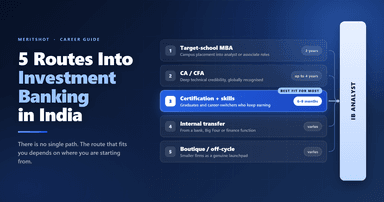
- Entry route. Post-MBA hires from IIM-A/B/C or ISB often enter at associate level (₹30–60 LPA at global banks), skipping the analyst rung entirely.
- Skills at entry. Deal-ready modelling and valuation ability can command a premium, because it reduces ramp-up time — one more reason the skills you build matter as much as the credential.
- Performance bucket. Top-bucket performers pull meaningfully ahead through bonuses that compound year over year.
The honest trade-off: pay per hour, not just pay
The headline numbers are real, but so is the cost. Analyst and associate roles routinely involve 80–100 hour weeks during live deals. On a per-hour basis, junior IB pay is strong but not the outlier the annual figure suggests — the compensation is a return on genuinely demanding, high-pressure work. Factor this into any comparison with other finance careers, not just the LPA number.
How India compares globally
India IB base salaries run roughly 50–70% of equivalent US or London roles in nominal terms. But cost-of-living-adjusted purchasing power is broadly comparable, and many Indian bankers use two to three years at a global bank's India office as a launchpad to move abroad — capturing both the lower entry barrier and the global upside later.
What this means for your decision
If you're weighing the path, the takeaway isn't the top-line MD number — it's that entry-level IB pay is a genuine return on demonstrable skill, and it compounds fast with each promotion. The market pays for people who can model, value and execute from day one. That capability is what a good program builds, and it's why the fastest, most affordable route in for most working professionals and graduates is a focused skills-and-certification program rather than a two-year detour — a point we make in full in the how to become an investment banker in India guide.
If you'd like to see how a structured route maps to these roles and pay bands, explore Meritshot's PG Program in Investment Banking, which prepares learners specifically for analyst-level positions across the firm types above.
Frequently asked questions
What is the average investment banker salary in India in 2026? Nationally, the average is often cited around ₹31 LPA, but that figure spans a very wide range — from fresh analysts at ₹6–12 LPA to managing directors earning ₹3 crore or more. The average is less useful than the level-specific ranges: analysts ₹12–30 LPA, associates ₹30–70 LPA, VPs ₹60–150 LPA. Always look at the range for your level, firm type and city rather than the national average.
How much does a fresher investment banking analyst earn in India? A first-year analyst typically earns ₹12–30 LPA total compensation in 2026 — around ₹6–15 LPA at domestic firms and boutiques, and ₹15–30 LPA at global bulge-bracket banks. Base salary is 70–80% of the package; the rest is a performance bonus. Mumbai pays at the top of the range.
Which pays more — a bulge-bracket bank or a domestic bank? Global bulge-bracket banks (Goldman Sachs, JP Morgan, Morgan Stanley) pay a 20–40% premium over domestic firms at the analyst and associate levels, widening at senior levels. However, strong domestic firms (Kotak IB, Axis Capital, Avendus) compete aggressively for experienced bankers and can close the gap at VP level and above with deal-linked incentives.
Which city pays investment bankers the most in India? Mumbai, by a clear margin. As the financial capital, it pays roughly 20–30% more than other cities for the same role at the same firm, with analysts averaging around ₹15.6–18 LPA. Delhi NCR and Bengaluru follow; tier-2 cities pay meaningfully less.
Do investment bankers in India really work 80–100 hour weeks? Yes, especially at the analyst and associate levels during live deals. The hours are a genuine part of the job, particularly in M&A and capital markets. This is why per-hour compensation is more modest than the headline annual figure, and why the trade-off should factor into any career decision.
Do you need an MBA to earn a top investment banking salary? No. An MBA from a top school is one route — and post-MBA hires often enter at the higher-paying associate level — but it isn't the only way to strong pay. Analysts who join through a skills-and-certification route and perform well progress on the same ladder. Demonstrable skill and performance drive compensation more than the entry credential over time.
Salary figures are drawn from publicly reported 2026 compensation data and industry salary guides for India (Quintedge, Bmuonline, Mentor Me Careers, ResumeVera, AmbitionBox, Glassdoor, Indeed). They are indicative market ranges, not guaranteed outcomes; individual offers vary by firm, city, product group and performance.