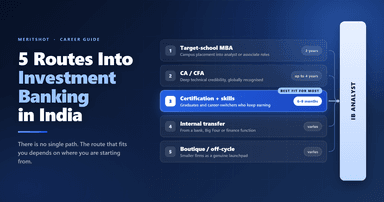
How to Get Into Investment Banking After Graduation in India (2026)
By Muskan Nagpal, Admission Counselling Manager at Meritshot · Published 21 September 2026
Getting into investment banking straight after graduation feels like a closed door if you didn't go to a target school or study finance. It isn't — but the route is different from the "do an MBA in two years" advice most guides give. This is a practical plan for recent graduates in India, including non-finance graduates, to build a realistic path into an analyst role: what to learn, what to build, who to talk to, and where to actually apply.
This is a focused companion to the broader how to become an investment banker in India guide — zoomed in on the just-graduated starting point.
The short answer
To get into investment banking after graduation in India: close the technical skills gap (financial modelling, valuation, Excel) through a focused course or serious self-study, build a portfolio of two or three defensible models, network deliberately on LinkedIn and through alumni, and apply strategically — starting with boutiques, domestic firms and off-cycle internships, which are far more accessible to fresh graduates than bulge-bracket analyst programs. An MBA can come later if a specific role demands it; it isn't a prerequisite for entry.
First, a reality check (an honest one)
Bulge-bracket analyst programs recruit heavily from a small set of target schools and top MBAs. If you're a fresh graduate from a non-target college — especially a non-finance one — competing head-on for those specific seats is hard. That's the honest part.
The useful part: those aren't the only seats. Boutique advisory firms, domestic banks, mid-market firms, and off-cycle internships hire on demonstrated skill far more than pedigree — and they're genuine launchpads. Two or three years of real deal experience at a boutique opens doors that were closed at graduation. So the strategy isn't "storm the front door of Goldman Sachs"; it's "get in the building through the door that's actually open, then move up."
The step-by-step plan
Step 1 — Close the technical skills gap
This is non-negotiable and it's what levels the playing field. You need financial modelling (three-statement, DCF, valuation) and advanced Excel. A non-finance graduate can build these from scratch — banks value the analytical ability engineers and other quantitative grads bring. The fastest route is a focused program that builds skills and gives feedback on your work; see how to learn financial modelling and the full skill set.
Step 2 — Build a portfolio you can defend
Skills you can't show don't count in interviews. Build two or three complete models on real listed companies — a three-statement model, a DCF, maybe a simple LBO. Being able to walk an interviewer through your assumptions and reasoning is worth more than any certificate. This is your single strongest asset as a non-target candidate.
Step 3 — Network deliberately, starting now
Referrals drive a large share of finance hiring, and this is where most graduates underinvest. Concretely: optimise your LinkedIn, connect with analysts and associates (not just recruiters), engage thoughtfully with their content, reach out to alumni from your college in finance roles, and ask for informational chats rather than jobs. Do this while you build skills, not after.
Step 4 — Target the accessible entry points
Apply where fresh graduates realistically get in:
- Boutique and mid-market advisory firms — hire on skill, offer real deal exposure.
- Domestic banks and financial-services firms — broader entry than bulge-brackets.
- Off-cycle and unpaid/short internships — a foot in the door that converts to full-time more often than cold applications.
- Big Four (Deloitte, PwC, EY, KPMG) deal/advisory teams — a common, respected stepping stone into IB.
Step 5 — Prepare rigorously for interviews
Technical interviews test whether you can actually do the work: walk through a DCF, explain valuation methods, discuss why two methods disagree, talk through a recent deal. Practise out loud, not just on paper. Use real investment banking interview questions and mock interviews.
Routes by background
Your degree changes your starting move:
- Commerce/finance graduate (B.Com, BBA, BA Econ): you have the foundation; focus on modelling skills + portfolio + networking. You're closest to ready.
- Engineering/science graduate: your analytical ability is an asset banks value; your gap is finance knowledge and modelling. Close it with a structured course, then lead with your quantitative strength.
- Non-finance, non-technical graduate: the longest gap, but not a closed door. Build finance foundations first, then modelling, then portfolio. A structured program is usually the most efficient path here.
- Already working (early career): consider an internal move toward finance, or the certification-plus-skills route alongside your job — you keep earning while you transition.
Do you need an MBA to start?
No. An MBA is a strong accelerator for bulge-bracket roles, but it's not a prerequisite for entering investment banking after graduation. Many people enter through the skills-and-portfolio route at boutiques and domestic firms, gain experience, and pursue an MBA later only if a target role requires it. For the full comparison of the course, CFA and MBA routes, see IB course vs CFA vs MBA. For fresh graduates who need to enter quickly and affordably, a focused course is usually the most practical first move.
If that's your situation, Meritshot's PG Program in Investment Banking is built for graduates and early-career professionals making exactly this transition — skills, real projects, mentorship and placement support, with merit scholarships for eligible candidates.
Common mistakes graduates make
- Waiting to feel "ready" before networking. Start conversations while you're still learning; relationships take time to mature.
- Applying only to bulge-brackets. You'll get rejected and demoralised. Target accessible firms first and move up.
- Collecting certificates instead of building models. A portfolio beats a stack of certificates every time.
- Neglecting the "why banking" story. Recruiters ask it constantly; have a genuine, specific answer, especially as a non-finance switcher.
- Underestimating boutiques. A boutique with real deal flow can be a better first job than a back-office seat at a famous bank.
Frequently asked questions
Can I get into investment banking right after graduation in India? Yes, though usually not directly into a bulge-bracket analyst program without a target-school background. The realistic route for most graduates is to build modelling and valuation skills, create a portfolio, network deliberately, and enter through boutiques, domestic firms, Big Four deal teams, or off-cycle internships — then progress from there.
Can I get into investment banking with a non-finance degree? Yes. Engineers, science and other non-finance graduates regularly enter investment banking by closing the finance and modelling skills gap through a structured course, then leveraging their analytical strengths, a portfolio, and networking. Banks value quantitative and problem-solving ability, which technical backgrounds often bring.
Do I need an MBA to get into investment banking after graduation? No. An MBA helps, especially for bulge-bracket roles, but it isn't required to enter. Many graduates start through a skills-and-portfolio route at boutiques or domestic firms and pursue an MBA later only if a specific role demands it.
What should I do in my final year of college to prepare? Start building financial modelling and Excel skills, apply for finance internships (including off-cycle and boutique roles), optimise your LinkedIn and begin networking with finance professionals and alumni, and start assembling a portfolio of models. Early preparation is a significant advantage.
Which companies hire fresh graduates for investment banking in India? Beyond bulge-brackets (which mostly recruit from target schools), boutique and mid-market advisory firms, domestic banks and financial-services firms, and Big Four deal/advisory teams (Deloitte, PwC, EY, KPMG) are the most accessible entry points for fresh graduates. Off-cycle internships at these firms often convert to full-time roles.
How long does it take to get into investment banking after graduation? With focused effort, building the skills and portfolio takes a few months, and landing a first role can follow within roughly six months to two years depending on your background, networking and market conditions. Non-finance graduates may need a little longer to close the knowledge gap first.
This guide is educational and reflects common entry routes into investment banking in India. Individual outcomes depend on background, effort, networking and market conditions.