IB Course vs CFA vs MBA: Which Path Into Investment Banking Fits You? (2026)
By Muskan Nagpal, Admission Counselling Manager at Meritshot · Published 21 September 2026
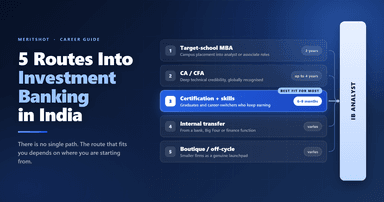
If you want a career in investment banking, three paths dominate the conversation: a focused investment banking course/certification, the CFA program, or an MBA in Finance. They're often discussed as if one is simply "best" — but they solve different problems, cost wildly different amounts, and suit different people. This guide compares them honestly on what actually matters (cost, time, difficulty, and fit) and gives you a framework to choose, rather than a verdict pretending to fit everyone.
For the wider roadmap this decision sits inside, see how to become an investment banker in India.
The short answer
There is no single best option — the right choice depends on your goal, time and budget. In brief: a focused IB course is the fastest and cheapest way to build job-ready skills and is the best fit for most working professionals and graduates who want to enter analyst roles quickly. The CFA is a rigorous, low-cost credential best suited to those aiming at research, asset management or roles that prize deep investment knowledge (and who can self-study for years). An MBA from a top school is the most expensive and time-consuming, but offers the strongest route to bulge-bracket roles through campus placement and a powerful network. Many people combine them over a career.
The comparison at a glance
| Factor | IB Course / Certification | CFA | MBA (Finance) |
|---|---|---|---|
| Primary purpose | Job-ready skills + placement | Deep investment knowledge credential | Broad management + network + placement |
| Typical duration | ~6–9 months | 2–4 years (3 levels) | 1–2 years |
| Typical cost (India) | ~₹0.5–3.5 lakh | ~₹1.5–3 lakh (exam + prep) | ~₹10–25 lakh+ (top schools) |
| Format | Live/online, works alongside a job | Self-study exams | Full-time (mostly) |
| Best route to | Analyst roles, quick entry | Research, asset mgmt, credibility | Bulge-bracket, associate entry |
| Difficulty | Moderate, applied | Very hard, low pass rates | Demanding, competitive entry |
| Keep earning while you do it? | Yes | Yes | Usually no |
Cost and duration figures are indicative 2026 ranges and vary by provider and institution.
What each path actually is
The IB course / certification
A focused program that builds the specific skills the job requires — financial modelling, valuation, deal analysis — usually in six to nine months, alongside a portfolio and placement support. It's applied and fast. It won't carry the brand prestige of an IIM MBA or the global recognition of the CFA charter, but it targets the one thing entry-level hiring actually screens for: can you do the work? For what it covers in depth, see the skills you learn in an investment banking course.
The CFA (Chartered Financial Analyst)
A globally recognised, self-study credential across three exam levels, typically taking two to four years. It's rigorous and inexpensive relative to an MBA, and it signals deep investment knowledge — which is why it's especially valued in equity research, asset management and portfolio roles. The trade-off is difficulty (pass rates are low) and time, and it's a knowledge credential rather than a skills-and-placement package.
The MBA in Finance
A one-to-two-year degree, strongest when it's from a top school (IIMs, ISB, leading B-schools) that recruits directly onto bulge-bracket analyst and associate programs. It offers the most powerful network and the clearest campus-placement pipeline — but it's by far the most expensive (₹10–25 lakh+) and usually requires leaving the workforce. Post-MBA hires often enter at the higher-paying associate level.
How to choose: a decision framework
Match your situation to the path, rather than chasing prestige:
- You're a working professional or graduate who needs to enter quickly and keep earning → the IB course is usually the best fit. Fastest, cheapest, applied, and designed around a job.
- You want research, asset management, or a credential that travels globally, and can self-study for years → the CFA.
- You're aiming specifically at a bulge-bracket seat, have two years and significant capital, and value the network → a top-school MBA.
- You have strong accounting foundations already (e.g. CA) → an IB course to add modelling/deal skills is often enough; you may not need the others.
These aren't mutually exclusive over a career. A common sequence: an IB course to enter quickly, then a CFA or MBA later if a specific role demands it.
Why the IB course is the best fit for most people (honestly)
For the majority of people asking this question — working professionals and graduates who want to enter analyst roles without a two-year, ₹10–25 lakh detour — the focused IB course wins on the metrics that matter most to them: it's the only one of the three that gets you job-ready in under a year, at a fraction of MBA cost, without leaving work. The CFA is cheaper but far slower and aimed at a different role type; the MBA is more prestigious but far more expensive and time-consuming.
This isn't to say the IB course is objectively "better" — the MBA and CFA are genuinely superior for their specific goals (bulge-bracket prestige and network; deep research credibility respectively). It's that for the most common goal and constraint set, the course is the practical winner. Set the numbers against the payoff: a ~₹0.5–3.5 lakh course (often less after scholarships) against a first-year analyst salary of roughly ₹12–30 LPA (see the salary guide), and the cost-to-earning ratio speaks for itself — provided the course genuinely builds skills and supports placement.
If that route fits you, Meritshot's PG Program in Investment Banking is built for exactly this: a six-to-nine-month, working-professional-friendly program with mentorship, real projects and placement support, with merit scholarships of up to 90% for eligible candidates.
Common mistakes in this decision
- Choosing on prestige alone. An MBA brand is valuable, but not if it costs you two years and ₹20 lakh for a role a ₹2 lakh course could have reached.
- Assuming the CFA is a shortcut into IB. It's excellent for research and asset management, but it's a knowledge credential, not a modelling-and-placement package — many CFA candidates still need applied skills training.
- Ignoring the "keep earning" factor. For working professionals, the opportunity cost of leaving a job for an MBA is often the largest hidden cost of all.
- Treating them as either/or forever. They stack. Enter with one; add another later if a role requires it.
Frequently asked questions
Is an IB course, CFA or MBA best for investment banking? None is universally best — they suit different goals. A focused IB course is fastest and cheapest for building job-ready skills and entering analyst roles, ideal for working professionals and graduates. The CFA suits research and asset management. A top-school MBA is strongest for bulge-bracket entry and networking but is the most expensive and time-consuming.
Is a CFA better than an MBA for investment banking? They serve different purposes. The CFA is a rigorous, inexpensive credential prized in research and asset management, done via self-study over years. An MBA is broader, more expensive, and offers stronger campus placement into front-office IB roles plus a powerful network. For pure front-office IB entry, a top MBA is often more direct; for research, the CFA.
Can I get into investment banking with just a course instead of an MBA or CFA? Yes. Many people enter analyst roles through a focused IB course that builds modelling, valuation and deal skills plus a portfolio and placement support — without an MBA or CFA. Demonstrable skills increasingly matter as much as the credential for entry-level hiring, especially at boutiques and domestic firms.
Which is cheapest — an IB course, CFA or MBA? The CFA and a focused IB course are both far cheaper than an MBA. A CFA costs roughly ₹1.5–3 lakh in exam and prep fees over several years; an IB course roughly ₹0.5–3.5 lakh over months; a top-school MBA ₹10–25 lakh+ over one to two years. The MBA's biggest hidden cost is often the income foregone while studying full-time.
How long does each take? A focused IB course typically takes about six to nine months. The CFA takes two to four years across three exam levels. An MBA takes one to two years. If speed to a first role matters most, the IB course is the fastest of the three.
Do employers respect an IB course as much as a CFA or MBA? It depends on the employer and the role. For entry-level analyst hiring — especially at boutiques and domestic firms — demonstrable skills and a strong portfolio from a good course carry real weight. For bulge-bracket prestige roles, an MBA or CFA may carry more brand signal. The strongest candidates often combine a credential with proven, hands-on skills.
Cost, duration and difficulty figures are indicative 2026 ranges for India and vary by provider and institution. This guide is educational; confirm current programme details directly with providers before deciding.